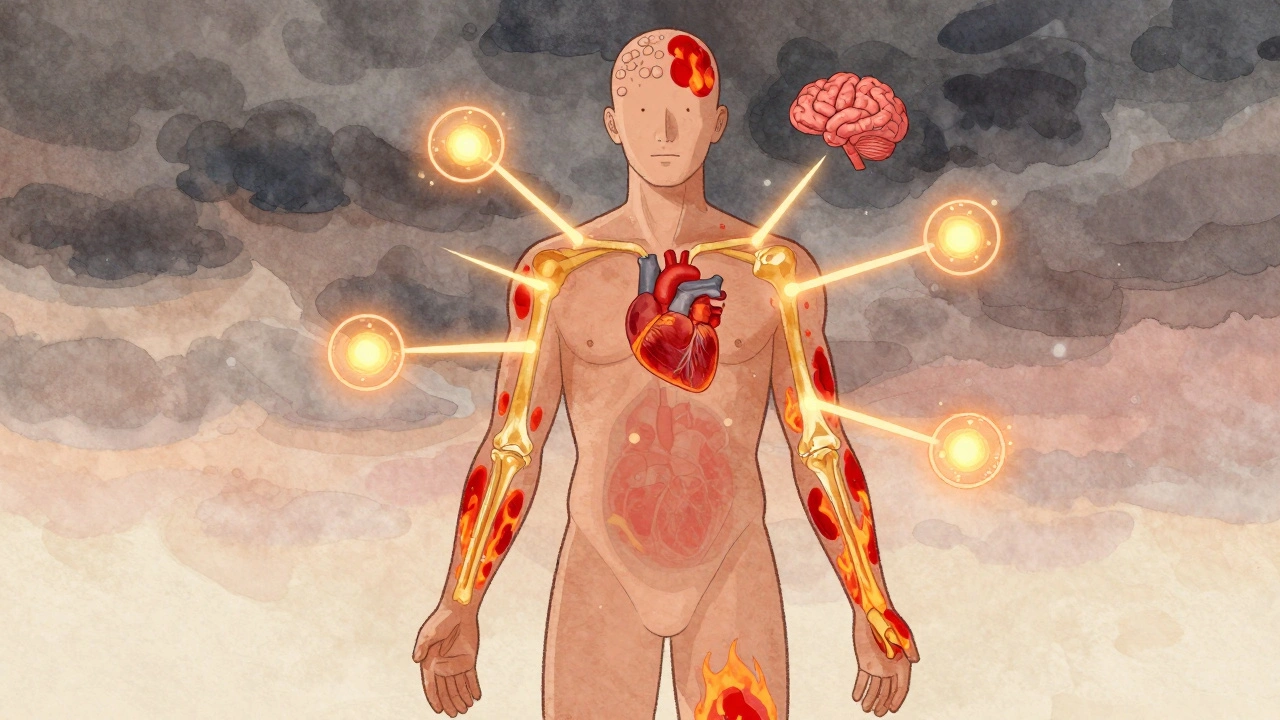
Psoriasis isn’t just a rash. It’s a lifelong condition that affects more than 125 million people worldwide. In the UK alone, about 2% of the population lives with it - that’s roughly 1.3 million people. And while it shows up as red, scaly patches on the skin, what’s happening underneath is far more complex. This isn’t dry skin or poor hygiene. It’s your immune system attacking your own body, speeding up skin cell production from a normal 28-day cycle to just 3 or 4 days. The result? Thick, itchy, sometimes painful plaques on elbows, knees, scalp, and lower back - and often far worse than that.
It’s Not Just a Skin Problem
Many people think psoriasis is only about the skin. But the truth is, it’s a systemic disease. That means it doesn’t stay on the surface. Up to 30% of people with psoriasis develop psoriatic arthritis - joint pain, stiffness, and swelling that can damage cartilage and bone over time. The inflammation doesn’t stop at the joints. Studies show people with psoriasis have a 58% higher risk of heart attack before age 50. They’re also far more likely to have metabolic syndrome - high blood pressure, high blood sugar, excess belly fat, and abnormal cholesterol levels. Depression and anxiety are common too, affecting nearly one in three patients. This isn’t coincidence. It’s connected. The same immune overdrive that causes skin plaques also fuels inflammation in blood vessels, joints, and even the brain.What Does Psoriasis Actually Look Like?
Not all psoriasis is the same. The most common type - chronic plaque psoriasis - affects 80 to 90% of people. These are the thick, red patches covered in silvery scales, usually on the outside of elbows and knees, the scalp, or lower back. But there are other forms. Inverse psoriasis shows up in skin folds - under the breasts, in the groin, or around the buttocks. It’s smooth, shiny, and gets worse with sweat and friction. Guttate psoriasis appears as small, drop-like spots, often after a strep throat infection. Pustular psoriasis is rare but serious: white, pus-filled bumps that can cover large areas or just the palms and soles. And erythrodermic psoriasis? That’s a medical emergency. The skin turns bright red, peels off in sheets, and can throw your body’s temperature and fluid balance out of control. If you see this, you need help right away.First-Line Treatment: Topical Therapies
Most people start with creams and ointments. The go-to combo for plaque psoriasis is calcipotriol (a vitamin D analog) and betamethasone (a strong steroid). This mix works fast - often clearing plaques in a few weeks. But here’s the catch: steroids can thin the skin if used too long, especially on the face, genitals, or armpits. That’s why guidelines now say to use them only where needed and for limited time. For the scalp, foam versions work better than lotions. For the face, vitamin D creams are safer than steroids. And for thick nails or stubborn patches on the palms and soles? Topicals alone rarely cut it. You need more.When Topicals Aren’t Enough: Phototherapy and Systemic Drugs
If creams don’t do the job, the next step is light therapy. Narrowband UVB is the most common - you sit in a light box 2 to 3 times a week for 8 to 12 weeks. It slows down skin cell growth and reduces inflammation. Home units are available, but they cost thousands upfront. For more severe cases, doctors turn to oral or injected systemic drugs. Methotrexate is a classic - taken once a week, it suppresses the immune system. But it can hurt your liver and cause nausea. Cyclosporine works quickly but can damage your kidneys if used long-term. Acitretin, a vitamin A derivative, helps with pustular psoriasis but can dry out your skin and raise cholesterol. These aren’t quick fixes. They’re long-term tools, and they need regular blood tests to stay safe.
The Game Changers: Biologics
Biologics are the biggest leap in psoriasis treatment in decades. Unlike older drugs that broadly suppress the immune system, biologics target specific parts of it. Think of them as precision missiles. Adalimumab and etanercept block TNF-alpha, a key inflammation signal. Ustekinumab targets IL-12 and IL-23. Secukinumab and ixekizumab block IL-17. Guselkumab and tildrakizumab go after IL-23. These drugs don’t just reduce symptoms - they can clear 90% or more of plaques in many patients. In clinical trials, about half of people on newer biologics hit PASI90 - meaning almost all their skin cleared. That’s life-changing. But they come with trade-offs. You need injections every few weeks or months. You must be screened for TB and hepatitis first. And they’re expensive - $1,200 to $5,500 a month without good insurance. Still, for many, the quality-of-life improvement makes it worth it.The Hidden Cost: Financial and Emotional Burden
One in three people with psoriasis delay or skip treatment because of cost. Even topicals can add up to $127 a month. Biologics? They’re often $3,500 a month before insurance. Many patients report spending hours on the phone fighting insurers for coverage. Beyond money, there’s the daily grind. Applying creams twice a day is messy and time-consuming. Injections can feel intimidating. Phototherapy requires weekly clinic visits. And then there’s the emotional toll. People with psoriasis are more likely to avoid social events, feel ashamed, or hide their skin. One Reddit user wrote, “I wear long sleeves in summer because I’m scared people will think I’m contagious.” That fear isn’t irrational - it’s real. And it’s part of the disease.What You Can Do Every Day
No treatment works without daily care. Moisturizing is non-negotiable. Thick petrolatum-based ointments like Vaseline or Cetaphil Restoraderm help seal in moisture and reduce scaling. Take short, lukewarm showers - hot water dries you out. Use gentle, fragrance-free cleansers. Avoid scratching - it triggers new plaques. Keep a symptom journal. Note what triggers flares: stress, alcohol, certain foods, cold weather, or infections. Many find that losing weight improves their psoriasis - even a 5% drop in body weight can make a difference. And don’t underestimate sleep and stress management. Meditation, yoga, or even walking daily can help calm your immune system.
What’s Next? The Future of Psoriasis Care
The treatment landscape is shifting fast. New oral drugs like deucravacitinib (a TYK2 inhibitor) are already approved and offer daily pills instead of injections. They’ve shown PASI90 in over half of patients. Other promising drugs in trials target RORγt, a protein deep in the immune pathway. These could be even more selective, with fewer side effects. But the biggest change isn’t just in drugs - it’s in mindset. Doctors are moving away from the old “step-up” approach (start weak, climb higher only if needed). Now, the goal is “right-care-first.” If your psoriasis is moderate to severe and affecting your life, you shouldn’t wait months on creams. You should get the right treatment early - even if it’s a biologic. And screenings for heart disease, diabetes, and depression are now part of standard care. Psoriasis isn’t just a dermatology issue. It’s a whole-body condition that needs a whole-body approach.Support Is Out There
You don’t have to manage this alone. The National Psoriasis Foundation offers free virtual support groups with thousands of participants. Apps like MyPsoriasisTeam let you track flares, treatments, and triggers alongside others who get it. In the UK, the Primary Care Dermatology Society now provides QR-coded leaflets you can scan for up-to-date info. And if you’re struggling with insurance or access, patient assistance programs from drugmakers can cut costs dramatically. The goal isn’t just to control plaques - it’s to help you live fully again.Is psoriasis contagious?
No, psoriasis is not contagious. You cannot catch it from touching someone’s skin, sharing towels, or being in close contact. It’s an autoimmune condition - your own immune system is overactive, not caused by bacteria, viruses, or fungi. Misunderstanding this leads to stigma, isolation, and unnecessary fear. Educating others helps.
Can diet cure psoriasis?
No diet can cure psoriasis, but some people notice fewer flares when they avoid alcohol, processed foods, or excess sugar. Losing weight - even 5 to 10% of body weight - can improve symptoms significantly. There’s no single “psoriasis diet,” but a balanced, anti-inflammatory diet rich in vegetables, fish, nuts, and whole grains may help. Always talk to your doctor before making major changes.
How long do biologics take to work?
Most biologics start showing results in 4 to 12 weeks. Some people see improvement in as little as 2 weeks, especially with IL-17 inhibitors like secukinumab. But full clearance can take 3 to 6 months. Patience is key. Your doctor will track progress using PASI scores and DLQI questionnaires. If you haven’t seen improvement by 12 weeks, they may adjust your treatment.
Do I need blood tests if I’m on psoriasis treatment?
Yes - especially if you’re on systemic drugs or biologics. Methotrexate and cyclosporine require monthly or quarterly blood tests to check liver and kidney function. Biologics need screening for TB, hepatitis B and C, and sometimes HIV before starting. Even if you feel fine, these tests catch problems early. Annual checks for cholesterol, blood pressure, and blood sugar are also recommended because of the increased risk of heart disease and diabetes.
Can psoriasis go away forever?
There’s no cure yet, but many people achieve long-term remission - sometimes for years - with the right treatment. Some stop treatment after achieving clear skin and stay clear for months or even years. Others need ongoing therapy to keep symptoms under control. The goal today isn’t just to reduce plaques - it’s to reach near-complete clearance (PASI 90 or higher) and restore quality of life. With new drugs and better care, that’s more possible than ever.
Jaswinder Singh
December 3, 2025 AT 08:15Man this is the real deal. I had psoriasis since I was 16 and no one gets how it eats you alive inside. Not just the itching, not just the looks, but the shame. I used to wear hoodies in 90 degree heat just to hide my elbows. People think it's contagious. They cross the street. I had a job interview once where the guy literally looked at my hands and said nothing. Just stared. That silence hurt more than any comment.
Sean McCarthy
December 5, 2025 AT 00:35Biologics cost too much. My insurance denied it for two years. I ended up using coal tar and olive oil. It worked okay but smelled like a gas station. I still have patches on my scalp. No one talks about the smell part. That’s the real social killer.
Courtney Co
December 6, 2025 AT 03:27I feel you so much. I cried in the dermatologist’s office last week because I couldn’t afford the biologic. I just want to wear a tank top. Is that too much to ask? I’m so tired of being invisible. Do you ever just want to scream at people who say it’s just dry skin? I do. Every. Single. Day.
Bee Floyd
December 7, 2025 AT 08:54I’ve watched my brother live with this for 15 years. He’s the quietest person I know. Not because he’s shy, but because he learned early that people don’t want to hear it. He started using a home UV unit last year. It’s expensive but worth it. He smiled at a family picnic last summer. First time in years. That’s the real win. Not clear skin. Just being able to breathe.
Jeremy Butler
December 9, 2025 AT 03:59It is an incontrovertible fact that the pathophysiology of psoriasis is intrinsically linked to systemic inflammatory cascades, which manifest not only in cutaneous tissues but also in vascular endothelium, synovial membranes, and central nervous system architecture. The reductionist paradigm of dermatological management is antiquated and ethically indefensible in light of contemporary immunological evidence.
Shashank Vira
December 9, 2025 AT 20:09Most of you are missing the point entirely. The real tragedy isn’t the plaques or the cost-it’s the fact that modern medicine still treats this as a dermatological nuisance rather than the autoimmune earthquake it is. Biologics are band-aids on a ruptured dam. We need gene editing. We need CRISPR. We need to stop pretending that topical steroids are a solution for a disease that rewrites your biology.
Eric Vlach
December 9, 2025 AT 20:31Just wanted to say moisturizing is everything. I use plain Vaseline on my legs every night. No fancy stuff. No scent. Just pure petrolatum. It’s boring but it works. And yeah I do it in front of my kids now. They think it’s weird but I told them it’s like putting armor on your skin. They get it now.
Souvik Datta
December 10, 2025 AT 13:57Psoriasis isn’t a curse-it’s a teacher. It taught me patience. It taught me to listen to my body. It taught me that healing isn’t linear. I lost 30 pounds. I meditate daily. I stopped drinking. My skin isn’t perfect. But I’m not afraid anymore. You don’t need a miracle drug. You need a new relationship with yourself. Start there.
Priyam Tomar
December 12, 2025 AT 09:38You all are wasting time talking about biologics. The real answer is gluten. I had psoriasis for 12 years. Went gluten free. Gone in 3 weeks. No joke. Your doctors won’t tell you this because Big Pharma doesn’t make money off bread. I’m not mad. I’m just saying. Try it. It’s free. And if you’re still using steroids? You’re part of the problem.
Jack Arscott
December 13, 2025 AT 12:56Just got my first biologic shot last week. 🥹 It hurt. I cried. But I saw my knees today and they’re… lighter? I don’t know. It’s a start. I’m scared but I’m trying. Thank you for writing this. I didn’t feel so alone anymore.
Irving Steinberg
December 14, 2025 AT 05:17Why are we even talking about this? Just use coconut oil and stop stressing. Everyone knows stress causes it. I had a rash once and I went on vacation. Poof. Gone. You’re all overcomplicating it. Also biologics? That’s just laziness. Get a tan. It’s free.
Lydia Zhang
December 15, 2025 AT 03:24My mom had it. She died of a heart attack at 52. Coincidence?
Kay Lam
December 16, 2025 AT 14:14I’ve been living with psoriasis for 27 years and I’ve tried everything from tar baths to acupuncture to raw food diets to prayer circles. I’ve been hospitalized for erythrodermic flare-ups. I’ve missed weddings. I’ve turned down swimsuits. I’ve had therapists. I’ve had support groups. I’ve had insurance battles that lasted longer than my relationships. And let me tell you something. The most powerful thing I’ve ever done is stop apologizing for my skin. Not because I’m brave. But because I’m tired. Tired of explaining. Tired of hiding. Tired of being told it’s just a rash. It’s not. It’s my life. And I’m still here. That’s the real victory.
Matt Dean
December 18, 2025 AT 04:29Everyone’s talking about treatment but no one’s talking about the fact that 80% of people with psoriasis are overweight. That’s not a coincidence. You think your skin is the problem? Look at your waistline. Lose weight. Stop eating junk. Stop drinking. Then come back and talk to me about biologics. Your skin will thank you. Your heart will thank you. Your bank account will thank you.