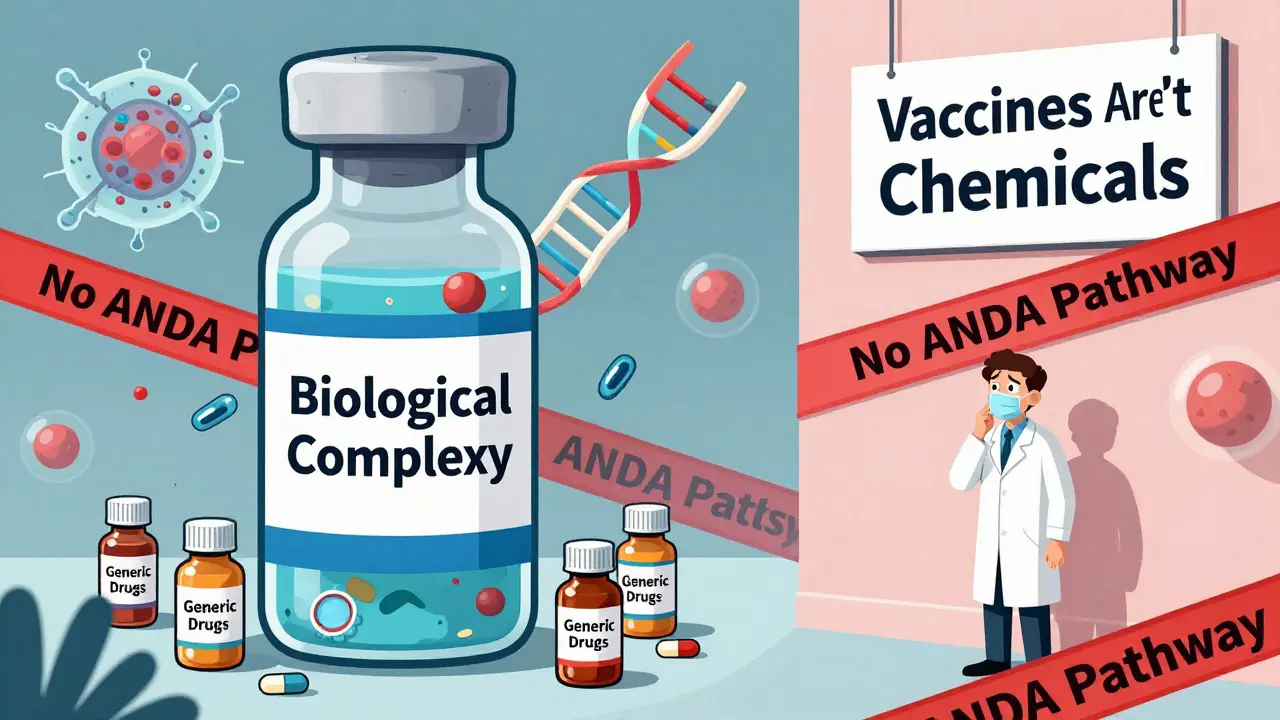
There’s no such thing as a vaccine generic in the way we think of generic pills. You can’t just copy a vaccine like you copy a cholesterol drug. Vaccines aren’t chemicals. They’re living, complex biological products. That changes everything about how they’re made, regulated, and distributed around the world.
Why vaccines can’t be generic
Most drugs you take - like ibuprofen or metformin - are made from simple chemical formulas. Once the patent runs out, another company can reverse-engineer the formula, make the same molecule, and sell it for a fraction of the price. That’s how generic drugs work. But vaccines? They’re made from viruses, proteins, or mRNA. Each one requires a living system to grow - yeast cells, chicken eggs, or human cell lines. The process isn’t just mixing ingredients. It’s farming biology. The U.S. Food and Drug Administration (FDA) doesn’t even have a shortcut path for vaccines like it does for pills. For chemical drugs, companies can file an Abbreviated New Drug Application (ANDA). For vaccines? They need a full Biological License Application (BLA). That means full clinical trials, full manufacturing validation, and full quality control. No shortcuts. No bioequivalence studies. You have to prove it’s safe, effective, and identical - down to the last protein fold - from scratch. The Bill & Melinda Gates Foundation says it plainly: “There’s no ‘generics’ vaccine market as there is for drugs.” It’s not about patents. It’s about physics, biology, and engineering.The manufacturing wall
Building a vaccine factory isn’t like building a pill plant. You need biosafety level 2 or 3 labs. Temperature-controlled rooms that stay at -70°C for mRNA vaccines. Clean rooms where even a speck of dust can ruin a batch. Equipment that costs millions - and often can’t be bought off the shelf. Take lipid nanoparticles. These tiny fat bubbles protect mRNA in vaccines like Pfizer’s and Moderna’s. Only five to seven companies worldwide make them. If one of them runs out of raw materials, or if the U.S. restricts exports during a crisis, production halts. That’s exactly what happened in India in 2021. When India’s second wave hit, the U.S. blocked exports of key materials. Global vaccine supply dropped by half. Even the world’s biggest vaccine maker, India’s Serum Institute, struggles. It produces 1.5 billion doses a year - more than any other company. But it still needs to import 70% of its vaccine raw materials from China. That’s a vulnerability. One flood, one export ban, one shipping delay - and millions of doses vanish.The supply chain is a global puzzle
Vaccines don’t just need factories. They need a chain of specialists: cell substrates, excipients, cold chain logistics, syringes, vials, labeling systems. Each link is fragile. Africa produces almost no vaccines. Yet it imports 99% of its doses. That’s not because African countries lack talent. It’s because the system was built to export from Asia to the rest of the world - not to build local capacity. In 2021, 83% of the 1.1 million COVID-19 doses Africa received through COVAX went to just 10 countries. Twenty-three African nations had vaccinated less than 2% of their people. Meanwhile, high-income countries bought up 86% of the world’s first COVID-19 vaccine doses. They had the money, the contracts, and the political leverage. Low-income countries got what was left.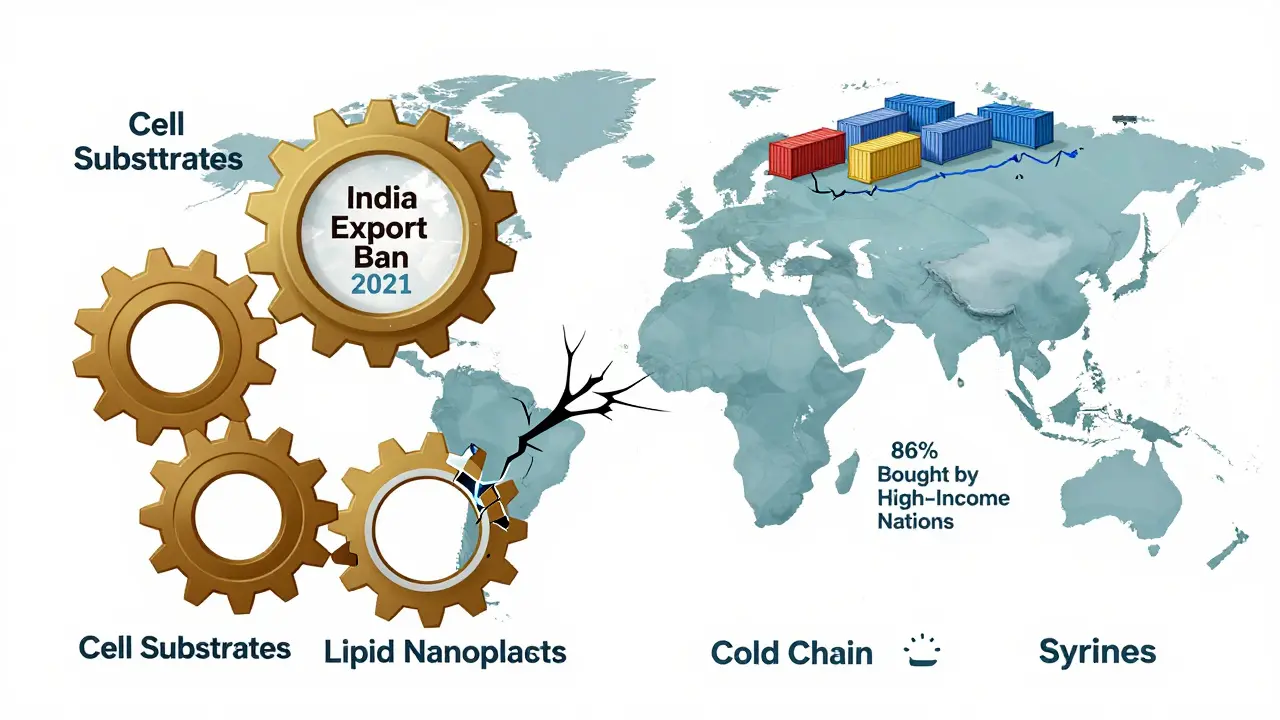
India: the world’s vaccine factory
India makes 60% of the world’s vaccines by volume. It supplies 90% of the WHO’s measles vaccines. 40-70% of its DPT and BCG doses. Yet, these aren’t “generics.” They’re branded, licensed, and produced under contract for companies like AstraZeneca, Johnson & Johnson, and Novavax. The Serum Institute produces the AstraZeneca shot for $3-$4 a dose. Western manufacturers charge $15-$20. But here’s the catch: India’s margins are razor-thin. Building a single vaccine line costs over $500 million. It takes five to seven years to get one up and running. Most Indian manufacturers can’t afford to invest unless they’re working under long-term global contracts. And when India needed vaccines for its own people during the 2021 surge, it stopped exports. That cut global supply by half. The system isn’t broken - it’s designed to serve wealthy markets first.The technology transfer trap
The WHO set up a mRNA vaccine hub in South Africa in 2021. It was supposed to be a game-changer. BioNTech, the German company behind Pfizer’s vaccine, agreed to share its tech. But two years later, it still hadn’t scaled. Why? Sourcing equipment. Training technicians. Getting approvals. Finding suppliers for lipid nanoparticles. Each step took longer than expected. The hub finally produced its first batch in September 2023 - but only enough for 100 million doses a year. That’s less than 1% of global need. Technology transfer isn’t about handing over a manual. It’s about building an entire industry from nothing. And no one wants to pay for it.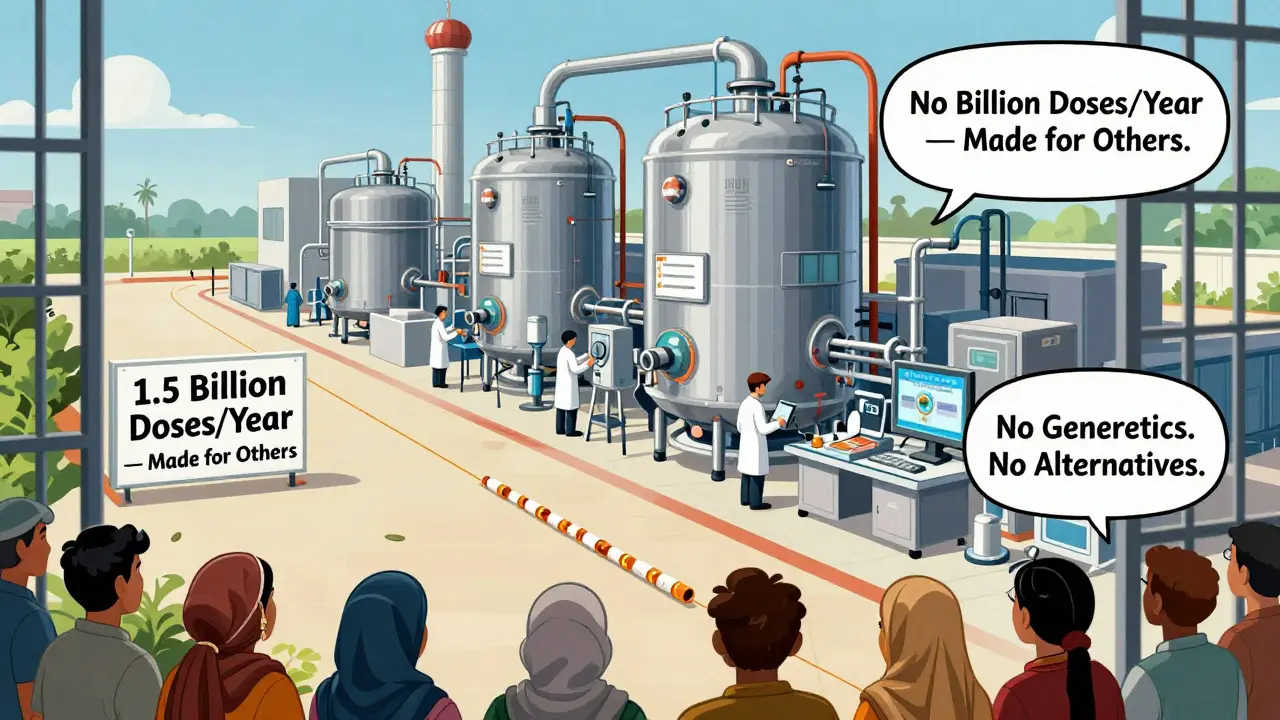
Who pays? Who benefits?
Gavi, the Vaccine Alliance, negotiates prices for low-income countries. But even they can’t get prices below $10 per dose for pneumococcal vaccines - despite promises of differential pricing. Why? Because manufacturers know there’s no real competition. No generics. No alternatives. Compare that to generic pills. In the U.S., 90% of prescriptions are filled with generics. But they cost only 20% of what brand-name drugs do. For vaccines? You get one price. Take it or leave it. Dr. Lucica Ditiu of the Stop TB Partnership says it plainly: “There are no reliable substitutes for API supplies, nor production capacity available.” If a country can make vaccines, it’s going to use them for its own people first. Not for global aid.The future: slow, uneven, and expensive
The African Union wants local vaccine production to reach 60% of the continent’s needs by 2040. That’ll take $4 billion and a decade of investment. The U.S. FDA is now offering faster reviews for generic drugs made domestically - because it’s scared of relying on China and India for 91% of its drug ingredients. But for vaccines? There’s no policy fix. No easy shortcut. The only way to fix access is to build more factories. More labs. More trained workers. More supply chains. Right now, low- and middle-income countries will still be 70% dependent on imports by 2025, even with all the new initiatives. That’s not a failure of distribution. It’s a failure of investment. Vaccines aren’t pills. They’re ecosystems. And right now, those ecosystems are built for profit - not for people.Why can’t we just copy vaccines like we copy pills?
Vaccines are biological products made from living cells, viruses, or mRNA - not simple chemical molecules. Copying them isn’t like duplicating a tablet. You need to replicate the entire biological process: cell culture, purification, formulation, and stability testing. Unlike generic drugs, there’s no legal shortcut. Each vaccine needs full clinical trials and manufacturing validation - making true "generics" impossible under current rules.
Does India really make most of the world’s vaccines?
Yes. India produces 60% of global vaccine volume by dose count. It supplies 90% of the WHO’s measles vaccines and 40-70% of DPT and BCG doses. The Serum Institute alone makes 1.5 billion doses a year. But most of these are produced under contract for Western companies. India doesn’t sell its own branded vaccines globally - it manufactures for others, often at very low margins.
Why is vaccine access so unequal?
High-income countries secured 86% of the first COVID-19 vaccine doses despite making up only 16% of the global population. This happened because they pre-bought large quantities, had stronger supply chains, and better cold storage. Low-income countries had no leverage. Even when vaccines were produced in India or elsewhere, export bans and logistical gaps meant they never reached the people who needed them most.
Can technology transfer solve vaccine inequality?
It helps - but not enough. The WHO’s mRNA hub in South Africa took over two years to produce its first batch and only makes 100 million doses annually - less than 1% of global need. Technology transfer isn’t about sharing a blueprint. It’s about building an entire supply chain, training workers, sourcing rare materials, and getting regulatory approval. Most countries lack the capital, infrastructure, or political will to do it.
Why don’t more countries build their own vaccine factories?
Because it costs $200-$500 million and takes 5-7 years to build one facility. Most governments can’t justify that kind of investment when they can buy vaccines cheaper - even if it means being dependent. When India halted exports in 2021, global supply dropped by 50%. That’s a warning: countries will always prioritize their own people first.
Southern Indiana Paleontology Institute
February 25, 2026 AT 20:42Meanwhile, we sit here watching our own supply chains get choked by export bans. This ain't a global health crisis - it's a geopolitical nightmare.
Anil bhardwaj
February 27, 2026 AT 02:55lela izzani
February 27, 2026 AT 17:14John Smith
March 1, 2026 AT 14:33Wake up. It’s not biology. It’s patents. It’s monopoly. It’s Big Pharma laughing all the way to the bank while kids in Africa wait. Stop pretending this is science. It’s capitalism.
Shalini Gautam
March 2, 2026 AT 14:11Natanya Green
March 4, 2026 AT 12:32They said ‘science will save us’… and then they gave us lipid nanoparticles that only 5 companies in the world can make? And we’re supposed to trust that? What if one of them has a bad day? What if someone sneezes in a clean room?
My baby got her second shot from a vial made in a country I can’t even pronounce. I’m terrified. I’m so terrified.
Steven Pam
March 5, 2026 AT 05:20Timothy Haroutunian
March 6, 2026 AT 21:12Erin Pinheiro
March 7, 2026 AT 17:18Michael FItzpatrick
March 9, 2026 AT 01:23Brandice Valentino
March 9, 2026 AT 20:58Larry Zerpa
March 10, 2026 AT 13:16Gwen Vincent
March 10, 2026 AT 18:26Holley T
March 11, 2026 AT 15:14Ashley Johnson
March 13, 2026 AT 01:14