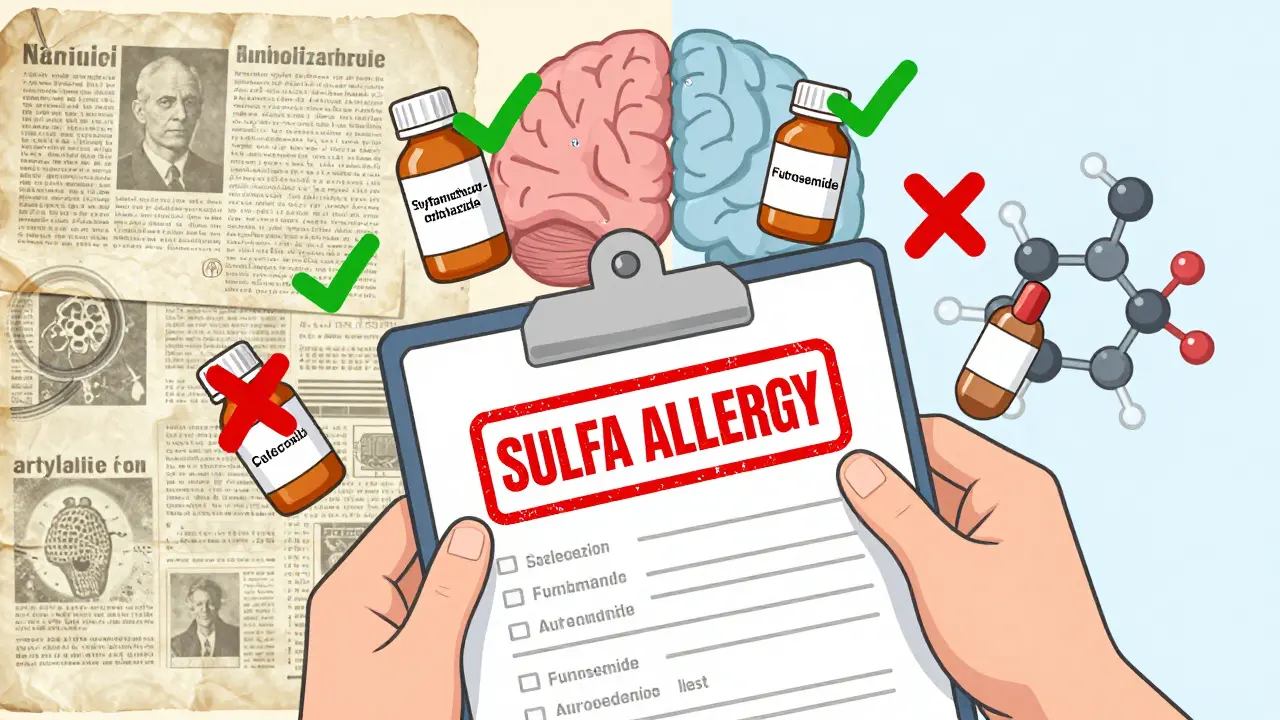
Sulfonamide Allergy Checker
Can You Take This Medication?
Select your reaction type and medication to check safety.
Most people who say they have a "sulfa allergy" don’t actually have one. The label sticks because of a rash they got years ago, maybe from taking sulfamethoxazole for a urinary tract infection. But here’s the problem: that label might be keeping you from safe, effective, and even life-saving medications - not because you’re allergic, but because the medical system got it wrong.
What Really Causes a Sulfonamide Allergy?
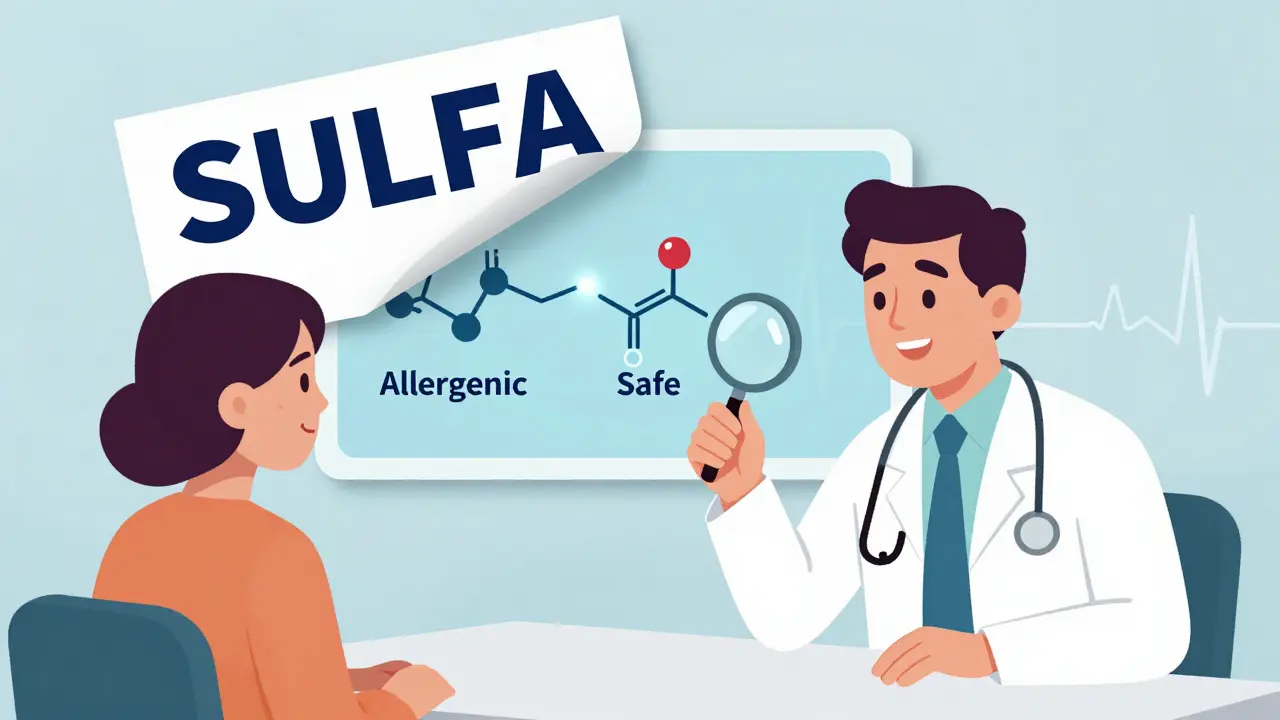
Sulfonamide antibiotics, like sulfamethoxazole and sulfadiazine, were among the first real antibiotics. They work by blocking bacteria from making folic acid. But they also have a specific chemical structure: an arylamine group attached at the N4 position and a nitrogen-containing ring at N1. That’s what makes them allergenic - not the sulfonamide group itself, which is found in dozens of other drugs.When your body reacts to these antibiotics, it’s usually not an immediate, life-threatening reaction like anaphylaxis. More often, it’s a delayed rash that shows up five to ten days after starting the drug. That’s not always an allergy - it could be a non-allergic side effect. Yet, once it’s written in your chart as "sulfa allergy," it stays there. And it’s everywhere. About 3 to 12% of people claim to have one, but true IgE-mediated allergies? Only 0.3 to 0.5% of the population.
The Big Misunderstanding: Cross-Reactivity
Here’s where things get messy. People with a documented reaction to sulfonamide antibiotics are often told they can’t take any drug with "sulf" in the name. That includes hydrochlorothiazide (for high blood pressure), furosemide (a water pill), celecoxib (for arthritis), and even acetazolamide (for glaucoma). But here’s the truth: there’s no meaningful cross-reactivity between these drugs.The key difference? Nonantimicrobial sulfonamides don’t have the arylamine group at N4. That’s the part your immune system actually reacts to. Celecoxib, for example, has a methyl group instead. Furosemide and hydrochlorothiazide have different side chains entirely. Their metabolites don’t form the same reactive proteins that trigger allergies.
Studies back this up. One review of over 10,000 patients found that those with a history of sulfonamide antibiotic allergy had a 1.3% chance of reacting to a nonantimicrobial sulfonamide. The control group without any allergy? 1.1%. That’s not a real difference. Another study showed the risk of reacting to hydrochlorothiazide was only 1.1% - almost the same as someone with no allergy at all.
What You Can Still Take (Safely)
If you’ve been told to avoid "sulfa" drugs, here’s what you can likely still use without risk:- Hydrochlorothiazide - common blood pressure pill
- Furosemide - used for fluid retention
- Celecoxib - arthritis and pain relief
- Acetazolamide - treats glaucoma and altitude sickness
- Metformin - diabetes medication (yes, it contains sulfur, but it’s not a sulfonamide)
And here’s the kicker: sulfur, sulfates, and sulfites are chemically unrelated. If you’re allergic to sulfonamide antibiotics, you can still safely take Epsom salts (magnesium sulfate), wine (which contains sulfites), or even some vitamins with sulfate in them. The names sound similar, but the chemistry is completely different. A 2020 survey found that nearly half of primary care doctors didn’t even know this.
What You Should Still Avoid
There are exceptions. Some nonantimicrobial sulfonamides do carry a higher risk - and it’s because they’re structurally closer to the antibiotics.- Dapsone - used to treat leprosy and Pneumocystis pneumonia. It has the arylamine group. Studies show up to 13% of people with sulfonamide antibiotic allergies react to it.
- Sulfasalazine - used for ulcerative colitis and rheumatoid arthritis. It’s actually a combination drug that breaks down into sulfapyridine (an antibiotic) and 5-ASA. So if you’re allergic to sulfonamide antibiotics, you’re likely allergic to this too.
These aren’t just theoretical risks. In one study, 91.5% of patients with a history of sulfonamide allergy were able to safely take sulfamethoxazole-trimethoprim under supervision for Pneumocystis pneumonia prevention. But dapsone? That’s a different story. Don’t assume safety here.
Why This Matters More Than You Think
Avoiding sulfonamide antibiotics because of a mislabeled allergy isn’t harmless. It’s dangerous - for you and for everyone else.When doctors can’t use sulfamethoxazole-trimethoprim (Bactrim), they turn to broader-spectrum antibiotics like fluoroquinolones. These carry black box warnings for tendon rupture, nerve damage, and aortic aneurysm. In fact, patients labeled with "sulfa allergy" are 2.4 times more likely to get these riskier drugs - even when the sulfonamide would’ve been the best, safest choice.
The financial cost is huge. In the U.S., this mislabeling leads to $1.2 billion in extra healthcare spending every year. More hospital stays. More expensive drugs. More antibiotic resistance. The CDC says it increases resistance rates in E. coli by 8.3% and in Staphylococcus aureus by 12.7%. That’s not just your problem - it’s a public health crisis.
What to Do If You Have a "Sulfa Allergy" Label
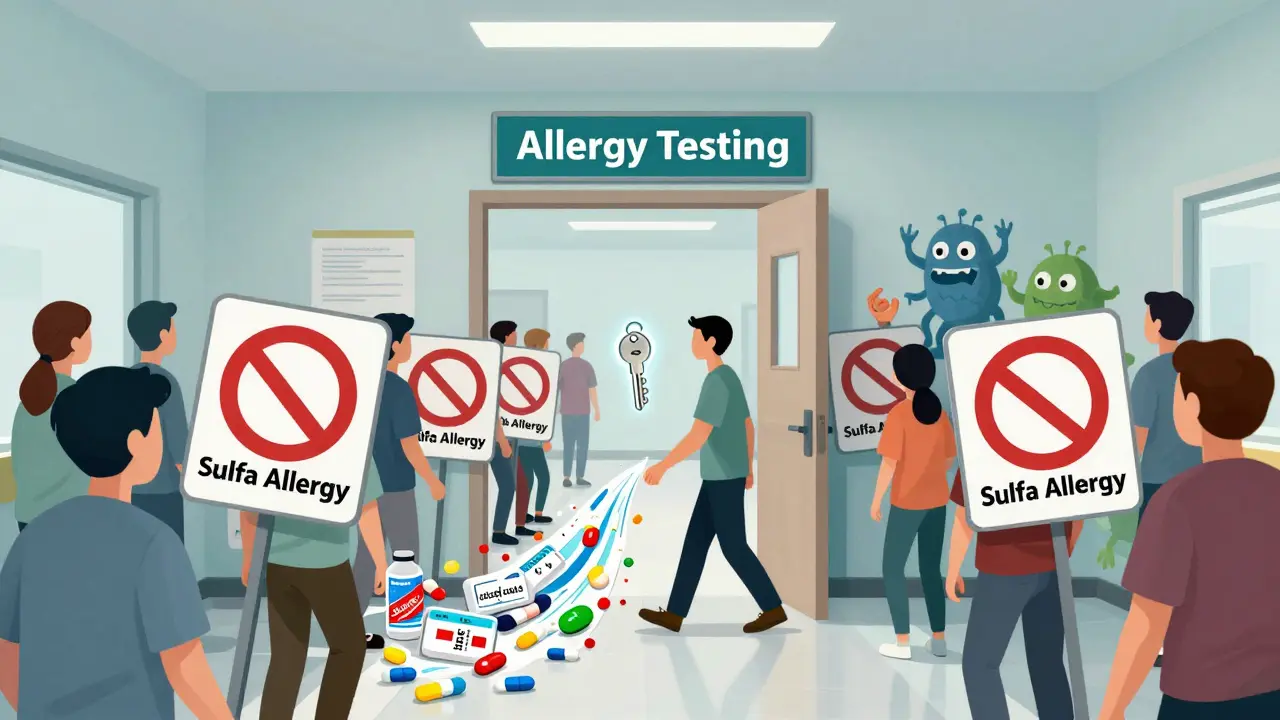
Don’t panic. But do take action.If your reaction was mild - a rash that showed up days after starting the drug, with no swelling, breathing trouble, or fever - you’re likely not truly allergic. Talk to your doctor about a referral to an allergist. Many clinics now offer supervised oral challenges. You’ll take a small dose of the suspected drug under observation. Over 94% of people with a "sulfa allergy" label pass these tests without issue.
If you had a severe reaction - like Stevens-Johnson syndrome, toxic epidermal necrolysis, or anaphylaxis - then yes, avoid all sulfonamide antibiotics. But even then, you can still safely take nonantimicrobial sulfonamides like hydrochlorothiazide. Just make sure your allergist documents the exact reaction: "maculopapular rash on day 6 of sulfamethoxazole" - not just "sulfa allergy."
And if you’re a patient, ask: "Is this reaction really an allergy? Can we test it?" If you’re a doctor, stop using vague labels. Write the exact drug and the exact reaction. One study showed this simple change reduced inappropriate avoidance by 63%.
The Future Is Clearer
New tools are coming. The SULF-RISK score, developed in 2022, helps predict who truly has a sulfonamide allergy based on reaction type, timing, and symptoms. It’s 92% accurate. Clinical trials are testing a blood test that detects specific IgE antibodies to sulfamethoxazole - with 89% accuracy. By 2025, most major hospitals will have automated alerts in their electronic health records that flag when a patient has a mislabeled allergy and suggest safer alternatives.But the biggest barrier isn’t science - it’s misinformation. A 2023 survey found that nearly 7 out of 10 patients with a "sulfa allergy" label believe they can’t take any medication with sulfur in it. That’s not just wrong. It’s harmful.
You don’t need to avoid hydrochlorothiazide because of a childhood rash. You don’t need to suffer through worse side effects from a riskier drug. And you don’t need to contribute to antibiotic resistance because of a label that doesn’t reflect reality.
Ask. Test. De-label. Your health - and everyone else’s - depends on it.
Can I take hydrochlorothiazide if I have a sulfa allergy?
Yes. Hydrochlorothiazide is a nonantimicrobial sulfonamide and does not share the chemical structure that causes allergic reactions to sulfonamide antibiotics. Studies show the risk of reaction is no higher than in people without any allergy history. Most patients with a labeled "sulfa allergy" tolerate hydrochlorothiazide without issue.
Is celecoxib safe if I’m allergic to sulfa drugs?
Yes. Celecoxib contains a sulfonamide group, but it lacks the arylamine group that triggers allergic reactions in sulfonamide antibiotics. Multiple large studies confirm no increased risk of reaction in patients with documented sulfonamide antibiotic allergies. The FDA also requires labeling to clarify this distinction.
Do sulfonamide allergies mean I can’t take sulfur or sulfites?
No. Sulfur, sulfates (like magnesium sulfate), and sulfites (used in wine and dried fruit) are chemically unrelated to sulfonamide drugs. An allergy to one does not mean you’re allergic to the others. This is a common misconception - even among some doctors.
What if I had a severe reaction like Stevens-Johnson syndrome?
If you had a life-threatening reaction like Stevens-Johnson syndrome or toxic epidermal necrolysis to a sulfonamide antibiotic, you should avoid all sulfonamide antibiotics. However, you can still safely take nonantimicrobial sulfonamides like hydrochlorothiazide or furosemide. Always discuss this with an allergist before trying any new medication.
Can my doctor just test me to confirm if I’m really allergic?
Yes. Allergists can perform supervised oral challenges with sulfonamide antibiotics or nonantimicrobial sulfonamides to test for true allergy. For mild reactions, this can be done in the office. For severe past reactions, skin testing may be used first. Over 90% of people with a labeled "sulfa allergy" pass these tests and can safely use these drugs.
Why do some doctors still refuse to prescribe sulfonamide drugs?
Many doctors rely on outdated information or fear liability. Electronic health records often flag "sulfa allergy" as a blanket warning, even when the reaction was mild or misattributed. But guidelines from the American Academy of Allergy, Asthma & Immunology clearly state there’s no cross-reactivity with nonantimicrobial sulfonamides. Patient education and updated documentation are changing this slowly.
What’s the best way to get my "sulfa allergy" label removed?
Start by asking your primary care doctor for a referral to an allergist. Bring your medical records and describe the exact reaction - including the drug name, timing, and symptoms. If your reaction was mild and delayed, an oral challenge may be recommended. Once cleared, ask your doctor to update your chart with "No true sulfonamide allergy - reaction was non-allergic" or similar wording. This prevents future mislabeling.
phara don
February 2, 2026 AT 03:33Wow, this is wild. I’ve been told for years I can’t take hydrochlorothiazide because of a rash I got in college… turns out I was fine the whole time? 😅 Time to call my doctor before I accidentally die from untreated hypertension.
Vatsal Srivastava
February 2, 2026 AT 20:44Typical medical system overcomplicating things. Everyone’s allergic to everything now. Next they’ll say you can’t drink water because it contains hydrogen. Sulfonamides? Please. The real issue is lazy documentation and fear-based prescribing. The science is clear if you bother to read it.
Brittany Marioni
February 3, 2026 AT 14:54Thank you SO MUCH for writing this!! I’ve been trying to explain this to my mom for years-she thinks "sulfa" means "sulfur" and won’t take ANY medication with an "s" in it. I’m printing this out and handing it to her with a highlighter and a cup of tea. Seriously, this is the kind of info that saves lives-and avoids unnecessary side effects from riskier drugs. Please, if you’ve got a "sulfa allergy" label, get it checked!!
Ellie Norris
February 4, 2026 AT 03:36Just had my oral challenge last month-was terrified but passed with zero issues. Now my chart says "no true sulfa allergy, rash was likely viral". My doc was like "why didn’t you do this sooner?" Honestly? I didn’t know it was even an option. This post should be mandatory reading for every patient with a "sulfa allergy" label. Also, my pharmacist didn’t know the difference between sulfites and sulfonamides… yikes.
Marc Durocher
February 5, 2026 AT 10:42So let me get this straight… I’ve been avoiding blood pressure meds for 12 years because I got a rash from Bactrim in 2011, and now you’re telling me I could’ve been taking hydrochlorothiazide the whole time like a normal human? And the system’s still charging people billions because doctors are too scared to update a single checkbox? I’m not mad… I’m just disappointed. And also, can we get a meme about this? "When your doctor thinks "sulfa" means "sulfur""
larry keenan
February 6, 2026 AT 11:29The clinical evidence presented here is robust and aligns with current guidelines from the AAAAI and AAFP. The absence of structural homology between antimicrobial and nonantimicrobial sulfonamides negates immunologic cross-reactivity. Furthermore, epidemiological data from large cohort studies confirm negligible risk elevation in nonantimicrobial sulfonamide exposure among previously labeled patients. This represents a paradigm shift in allergy documentation practices that warrants immediate institutional implementation.
Nick Flake
February 7, 2026 AT 06:28THIS. THIS IS THE KIND OF POST THAT CHANGES LIVES. 🙌 I spent years thinking I couldn’t take celecoxib for my arthritis because of a stupid rash from antibiotics I got as a teen. I was in pain. I was scared. I felt like my body was broken. And now? I’m taking it. I’m moving without pain. I’m not just alive-I’m living. Thank you for writing this. I’m sharing it with everyone I know. If you’ve been told you’re allergic to "sulfa"-please, for the love of all that is good, get tested. You deserve to be free.
Akhona Myeki
February 7, 2026 AT 21:03It is absolutely unacceptable that American medical institutions continue to propagate such grossly inaccurate and scientifically unsound terminology. In South Africa, we have standardized allergen classification protocols since 2015. The term "sulfa allergy" is strictly prohibited in clinical documentation. It must be replaced with precise descriptors: "delayed-type hypersensitivity reaction to sulfamethoxazole, N4-arylamine mediated." This is not a matter of opinion-it is a matter of professional integrity. If your doctor uses vague terms, they are not competent. Demand better.