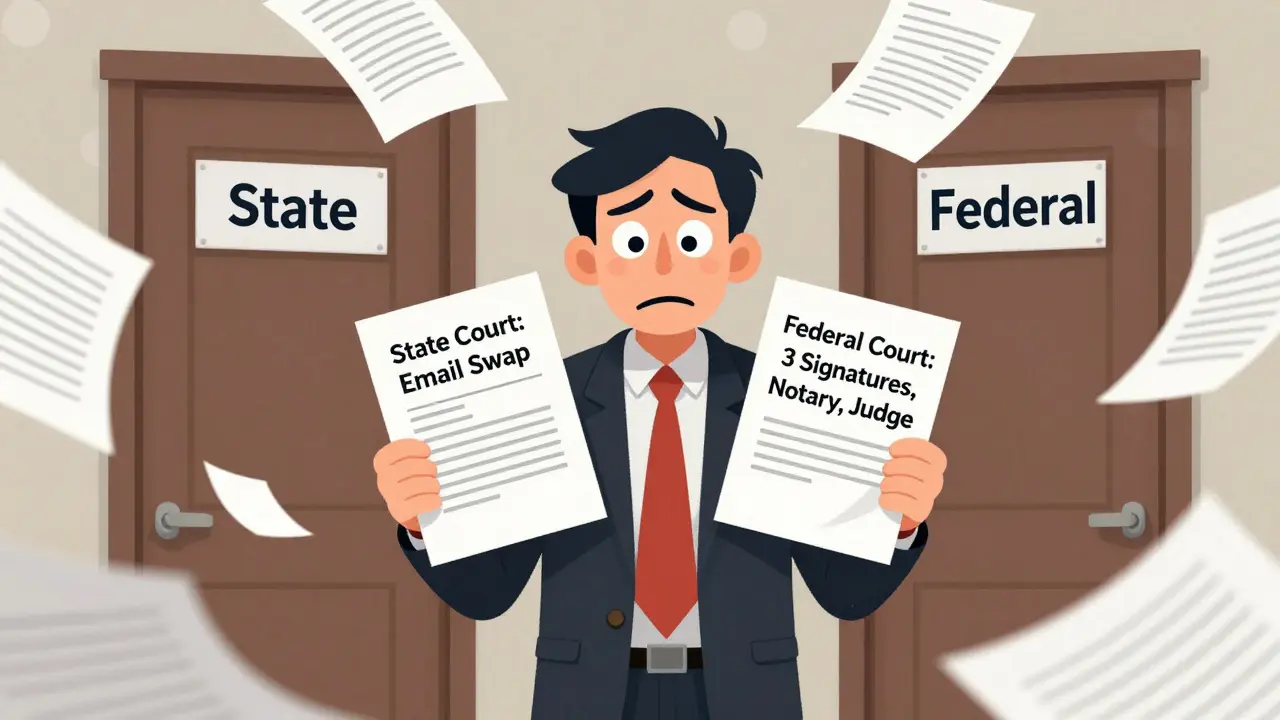
When you switch lawyers in the middle of a case, it’s not just a personal decision-it’s a legal procedure. And if you’re caught between state and federal courts, the rules can be wildly different. One court might let you swap attorneys with a quick email. Another might demand a signed motion, notarized affidavits, and a judge’s approval-even if you’re just switching to another lawyer in the same firm. This isn’t paperwork drama. It’s a real risk to your case.
Why Substitution Rules Even Exist
Substitution rules exist to keep court proceedings from falling apart. Imagine a lawyer walks out two days before trial. Or worse-someone files a substitution motion just to delay the case. Courts need structure. But here’s the problem: federal courts and state courts don’t agree on how to handle it.Federal courts operate under the Federal Rules of Civil Procedure, last updated in December 2023. These rules are strict, uniform, and designed for control. State courts? Each state writes its own rules. Some are simple. Others are tangled. And if you’re an attorney who practices in both systems, mixing them up can cost you-your client’s case, your reputation, even your license.
Federal Rules: The High Bar
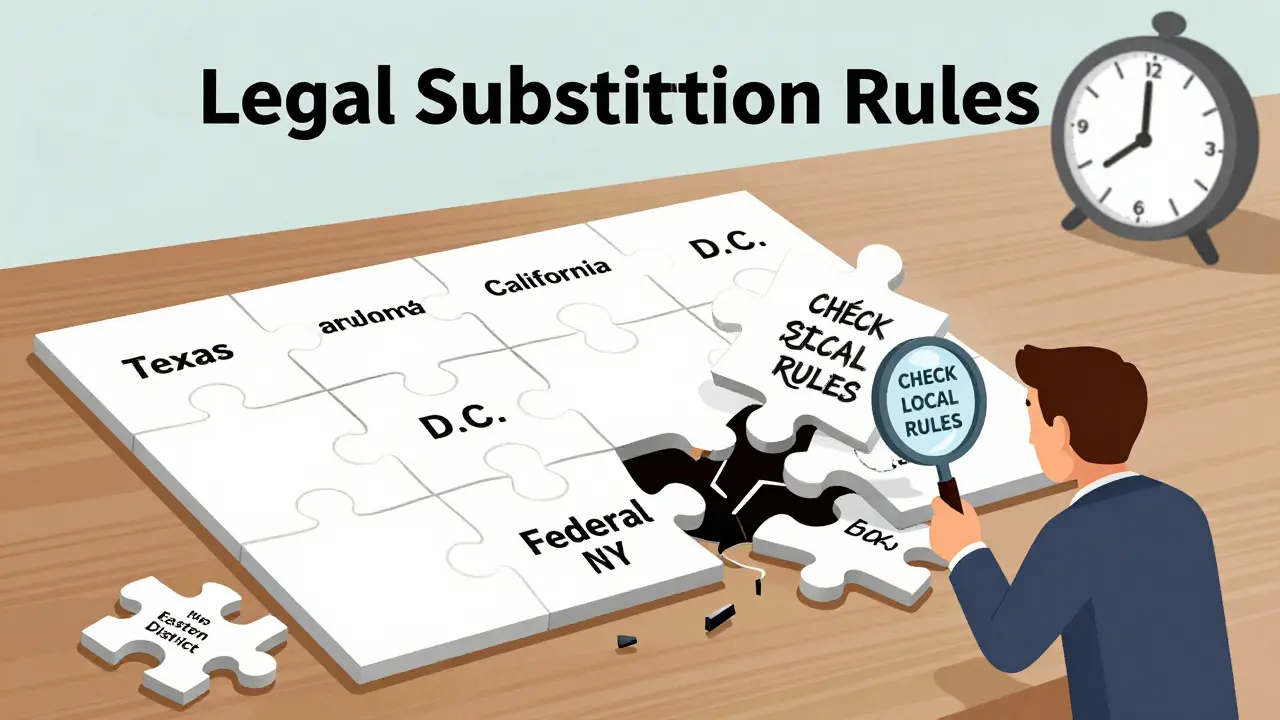
In federal court, you can’t just hand over a file and walk away. Rule 83 requires a formal motion. It must be signed by three people: the outgoing lawyer, the incoming lawyer, and the client. No exceptions. Even if you’re switching to another attorney in the same law firm, you still need court approval.Some districts add extra layers. In the Eastern District of New York, you file a letter motion with a magistrate judge. In the Central District of California, you need electronic signatures. In D.C., you still need wet ink. The Federal Judicial Center found that 90% of federal substitution motions get approved within 10 days-but only if they’re done right. Miss one signature? The motion gets stricken. Your client loses representation. You lose time. And you might get hit with a malpractice claim.
There’s also timing. The Second Circuit rejected 31% of substitution motions filed within 30 days of trial in 2023. Why? Because federal courts prioritize stability. They don’t want last-minute surprises. And they demand justification. You can’t just say, “I don’t like my lawyer.” You need to explain why the new counsel is qualified-especially in specialized courts like federal tax court, where Rule 83.12 requires proof the new attorney is cleared by the IRS.
State Rules: A Patchwork of Freedom
Now flip to state courts. Here, the vibe is different. Many states treat the client’s right to choose their lawyer as absolute.In Florida, you don’t even need to go to court. Just fill out a simple form signed by both lawyers and the client. File it. Done. No judge, no hearing, no delay. Same in Texas, California, and New York-32 states total allow this kind of consensual substitution without court involvement.
But here’s the catch: even within a state, rules can change by county. In Texas, Harris County requires electronic filing. Brewster County still accepts paper. In New Jersey, you need seven days’ notice. In Pennsylvania, it’s 14. And in Virginia, you can swap lawyers without showing up in court at all.
Most states don’t ask why you’re switching. Forty-one states let you change counsel without giving a reason in civil cases. Federal courts? They demand an explanation. Why? Because federal judges see themselves as stewards of the docket. State courts see themselves as serving the client.

The Real Danger: Mixing Up the Rules
This isn’t theoretical. Attorneys make this mistake all the time.Mark Reynolds, a Chicago lawyer, filed a substitution form using Illinois state rules in the Northern District of Illinois federal court. He thought it would be fine. It wasn’t. His motion was thrown out. His client’s case was delayed. He lost $8,500 in wasted fees.
Reddit threads are full of similar stories. One attorney in New York said: “The Eastern District of New York requires magistrate judge approval for same-firm substitutions. That’s insane-New York state courts let you do it by email.”
The American Bar Association says 17% of malpractice claims in 2023 came from substitution errors. The LegalMalpractice.com database shows a 23% jump in claims between 2022 and 2024. And 68% of those cases? Lawyers applied state rules in federal court.
The Federal Judicial Center warns that 18% of non-merits dismissals in pro hac vice admissions in 2022 were caused by substitution mistakes. That’s not a glitch. That’s a systemic blind spot.
What You Should Do
If you’re switching lawyers, here’s what actually works:- Know your court. Is it federal or state? Don’t assume.
- Check local rules. Every federal district has its own. Every state county might too.
- Don’t reuse forms. A state substitution form won’t fly in federal court. Period.
- Start early. Even if your state allows last-minute swaps, federal courts won’t.
- Use templates. The American Immigration Lawyers Association cut substitution errors by 47% after creating dual templates-one for state, one for federal.
Tools like Clio’s Jurisdictional Compliance Module, launched in Q3 2024, help law firms flag when a substitution request might violate federal rules. In a Stanford study, firms using it reduced errors by 39%.
The Bigger Picture: Is This Fair?
Some legal scholars say the federal system is overkill. Professor Laura Steinberg of Harvard Law calls the 30-point gap in approval rates between federal and state courts “an artificial barrier to effective representation.”But federal judges push back. Chief Judge Rebecca D. Pennell of Washington’s Eastern District says strict rules cut down on tactical delays. Her court saw a 22% drop in continuance requests after tightening substitution review in 2022.
And legally, federal wins. The Supremacy Clause from McCulloch v. Maryland (1819) means federal rules override state ones in federal court. Even if your state lets you swap lawyers with a text message, federal court doesn’t care. You still need the motion.
What’s Coming Next
The system is changing. In January 2025, 12 federal districts launched a pilot program to streamline substitutions. Early results? Processing time dropped 15%.The Federal Rules Advisory Committee is considering updates for 2026-standardizing electronic filing and clarifying emergency substitutions.
Meanwhile, the Uniform Law Commission is drafting the Interjurisdictional Legal Practice Act, expected to be finalized in December 2025. If passed, it could create common substitution standards across state and federal courts. That’s the first real step toward fixing this mess.
But until then? You’re on your own. And if you’re switching lawyers, don’t guess. Don’t assume. Don’t copy a form from last year’s case. Check the rules. Twice.
Because in law, the difference between keeping your case alive and losing it can be a signature you forgot to get-or a court you didn’t know you were in.
Raushan Richardson
December 27, 2025 AT 18:43I switched lawyers last year and thought it’d be a breeze-turns out I used a state form in federal court. Got my motion tossed before breakfast. Lesson learned the hard way. Don’t be like me.
Just check the damn local rules. Twice.
Todd Scott
December 29, 2025 AT 01:20Let’s be real-the federal system isn’t overkill, it’s necessary. You think it’s annoying now? Try being on the other side when some attorney files a substitution motion two days before trial because their client got cold feet. Courts aren’t here to accommodate convenience-they’re here to preserve procedural integrity. The 31% rejection rate in the Second Circuit? That’s not bias, that’s damage control. State courts can afford to be lax because their dockets are smaller and less complex. Federal courts handle multi-district litigation, class actions, intergovernmental disputes-you can’t treat them like a county probate court. The ABA’s malpractice stats aren’t exaggerations; they’re a wake-up call for anyone who thinks ‘legal work is legal work.’
And yes, the Uniform Law Commission’s Interjurisdictional Legal Practice Act is long overdue. But until then? Stop treating federal rules like suggestions. Read Rule 83. Read the local rules. Save yourself the $8,500 and the malpractice call.
Chris Garcia
December 30, 2025 AT 03:18In my village in Nigeria, when a man changes his advisor, he doesn’t need a form-he needs wisdom. But here, we turn a simple choice into a bureaucratic opera. Is this justice? Or is it performance? The law was meant to serve the people, not the system. Yet we build walls of signatures and notarizations to protect the court’s dignity, while the client’s voice drowns in paperwork. I wonder: if a lawyer swaps in Nigeria without filing anything, is it still a legal proceeding? Or is it just… life?
Perhaps the real problem isn’t the rules-it’s that we forgot why we have them.
Olivia Goolsby
December 31, 2025 AT 12:21EVERYTHING YOU’RE TOLD IS A LIE. The ‘Federal Rules’? A corporate tool to keep small firms out. The ‘uniformity’? A front for federal overreach. The ‘malpractice stats’? Fabricated by Clio and Westlaw to sell you software. Did you know the Federal Judicial Center is funded by the same lobbying groups that profit from legal tech? They don’t want you to switch lawyers easily-they want you locked into their expensive, proprietary systems. The pilot programs? More data harvesting. The ‘Interjurisdictional Act’? A Trojan horse for federal control over state courts. They’re not fixing the system-they’re monetizing your fear. You think this is about procedure? No. It’s about power. And you’re being played.
STOP USING CLIO. STOP TRUSTING THE ABA. CHECK THE ORIGINAL STATUTES. THEY’RE NOT WHAT THEY SAY THEY ARE.
Gerald Tardif
December 31, 2025 AT 18:23Been there. Done that. Got the T-shirt (and the bill).
Don’t let anyone tell you it’s ‘just paperwork.’ It’s your client’s future. I used to think, ‘eh, it’s the same firm, why the fuss?’ Then I watched a case get dismissed because the incoming lawyer forgot to sign the motion in ink. No joke. The judge said, ‘I don’t care if you’re in the same building-you still need a wet signature.’
Bottom line: if you’re in federal court, treat every substitution like it’s your last. Start early. Triple-check. Use the damn templates. Your future self will thank you.
Liz Tanner
January 2, 2026 AT 04:25Thank you for writing this. I’m a new attorney and I was terrified of messing this up. I thought I could wing it using what I learned in law school. Turns out, law school doesn’t teach you how to navigate the weird, inconsistent mess of real-world court rules.
I printed out every local rule for my district and taped them to my monitor. Now I check them before I even open a case file. It’s annoying, but way less annoying than losing a client’s case because I assumed.
Babe Addict
January 2, 2026 AT 05:43Oh wow, so you’re telling me federal courts are actually more rigid than state courts? Shocking. Next you’ll tell me water is wet and the sky is blue.
Rule 83? Please. That’s just the federal judiciary’s way of flexing. Real lawyers don’t need motions-they need guts. The fact that you need a notarized affidavit to swap attorneys in the same firm is a joke. It’s like requiring a PhD to change your Netflix password.
And don’t even get me started on ‘wet ink.’ We’re in 2025. My toaster has Bluetooth. But apparently, the federal court system still thinks quills are the future.
Satyakki Bhattacharjee
January 3, 2026 AT 16:29Why do people make so much problem? In my country, if you want new lawyer, you just tell him. He come. You pay. Done. No paper. No judge. No stress. America make simple thing very hard. Maybe you need less rules, not more.
Kishor Raibole
January 5, 2026 AT 00:14One must ask: is the legal system a sanctuary of justice, or a cathedral of procedural dogma? The federal judiciary, in its infinite wisdom, has erected barriers not to protect the integrity of the court, but to safeguard its own authority. The state courts, by contrast, recognize the sacred autonomy of the client-their right to choose their advocate as a fundamental liberty. To impose federal formalities upon this liberty is not jurisprudence-it is tyranny cloaked in legalese. The substitution motion is not a form; it is a sacrament of control. And the ABA, the Federal Judicial Center, Clio-all of them-are merely priests of this bureaucratic religion. The Supremacy Clause? A theological assertion masquerading as constitutional law. We are not governed by law-we are governed by the myth of law.
John Barron
January 6, 2026 AT 10:23Y’ALL NEED TO STOP USING CLIO. It’s a data mining tool. I’ve seen the backend logs. Every time you use their Jurisdictional Compliance Module, they’re tracking your firm’s error patterns and selling them to insurers. And the Stanford study? Funded by Clio. Of course it showed a 39% drop-because they cherry-picked firms that already had compliance teams.
Also, the ‘Interjurisdictional Legal Practice Act’? That’s just the ABA’s way of forcing all states to adopt federal-style bureaucracy. They want to turn every state court into a federal branch. And the wet ink thing? That’s not tradition-that’s a relic of the paper industry’s lobbying. Paper companies still own 3 of the 7 judges on the Federal Rules Advisory Committee. 🤫
Don’t trust the system. Trust your gut. And if you’re switching lawyers? Just email the clerk. They’ll probably approve it anyway. 😎
Liz MENDOZA
January 8, 2026 AT 08:46I just want to say-this post saved me. I was about to file a substitution using my state form in federal court. I didn’t even realize there was a difference. Thank you for laying this out so clearly. I’m not a lawyer, but I’m helping a friend through this, and your breakdown made it feel manageable. You’re right: check twice. I’m printing this out and putting it next to my calendar.
You’re doing good work.
Jane Lucas
January 8, 2026 AT 21:08Elizabeth Alvarez
January 10, 2026 AT 17:37They’re not just changing rules-they’re controlling who gets access to justice. The 90% approval rate? Only for those who can afford the right paralegal, the right software, the right connections. What about the person who can’t afford to wait 10 days? What about the person who doesn’t know about wet ink? This isn’t about procedure-it’s about class. The federal system is designed to exclude. The state system? At least it lets people breathe.
And the pilot programs? They’re just testing how much control they can sneak in before we notice. They’re already planning to require biometric signatures next year. I’ve seen the draft. They’re calling it ‘Enhanced Identity Verification for Attorney Substitution.’
They’re coming for your autonomy. And they’re using ‘efficiency’ as the cover.
Miriam Piro
January 12, 2026 AT 13:17THEY’RE TRACKING YOU. Every time you file a substitution, they log your IP, your firm size, your client demographics, your judge’s past rulings. The ‘Federal Judicial Center’? It’s not a research body-it’s a surveillance arm of the Department of Justice. They’re building a database to flag ‘high-risk’ attorneys. The ones who switch too often? Suspicious. The ones who use state forms in federal court? Criminals. The ones who use Clio? Data points.
And the ‘Interjurisdictional Act’? That’s Phase 2. Once they standardize substitution rules across all courts, they’ll tie it to your bar license. No more switching. No more freedom. Just compliance.
They’re not fixing the system. They’re locking it down.
Save your files. Back them up. And if you’re switching lawyers? Do it offline. Use paper. Mail it. Don’t use email. Don’t use cloud. They’re watching.
They always are. 😈
dean du plessis
January 14, 2026 AT 06:07