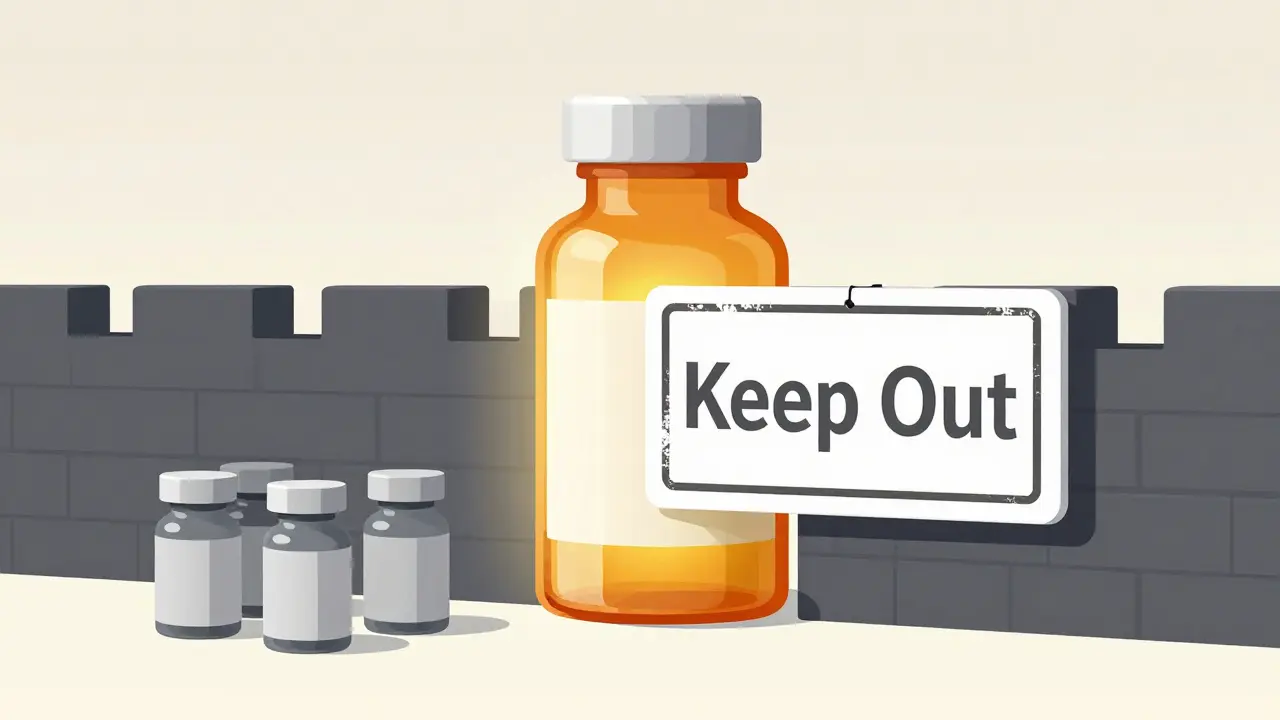
Imagine spending a decade and billions of dollars developing a life-saving drug, only to realize your patent is about to expire before the medicine even hits the shelves. For pharmaceutical companies, this is a nightmare scenario. Patents are great, but they start ticking the moment you file the application, not when you actually start selling the product. To fix this gap, governments created regulatory exclusivity is a period of market protection granted by regulatory agencies that prevents competitors from getting approval for generic versions of a drug. Unlike patents, which you have to fight for in court, this protection is essentially a "keep out" sign posted by the government upon approval.
The core difference between patents and exclusivity
It is easy to confuse patents with regulatory exclusivity, but they are two very different animals. A patent protects an invention-like a specific molecule or a way of delivering a drug. To keep that protection, the company must actively manage the patent and sue anyone who infringes on it. If a patent is challenged in court and overturned, the protection vanishes instantly.
Regulatory exclusivity is different. It doesn't protect an "invention"; it protects the drug product itself. It is granted automatically by agencies like the FDA (Food and Drug Administration) in the US or the EMA (European Medicines Agency) in the EU. Because the agency itself enforces the rules, a generic company can't even apply for approval during certain windows. It’s a much more predictable safety net for innovators.
| Feature | Patent Protection | Regulatory Exclusivity |
|---|---|---|
| Who grants it? | Patent Office (e.g., USPTO) | Regulatory Agency (e.g., FDA) |
| When does it start? | At the time of filing | At the time of drug approval |
| Enforcement | Company must sue in court | Agency refuses to approve generics |
| Scope | Specific claims/inventions | The drug product and its data |
Common types of exclusivity and how long they last
Not all drugs are treated equal. The length of the "keep out" period depends on what the drug is and who it helps. In the US, the framework is largely built on the Hatch-Waxman Act is a 1984 law that balanced the need for new drug innovation with the need for affordable generic medicines . This law created several tiers of protection:
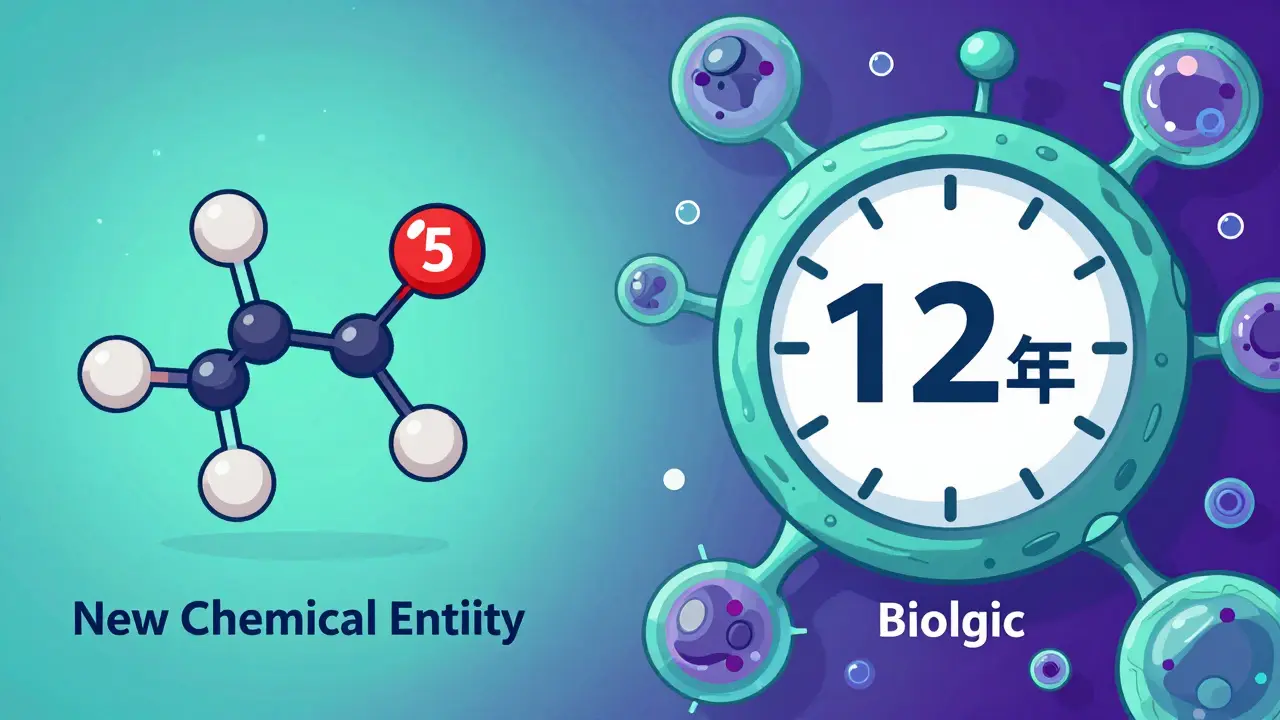
- New Chemical Entities (NCE): If you develop a totally new molecule, you generally get 5 years of exclusivity. For the first 4 years, the FDA won't even accept a generic application.
- Biologics: These are complex drugs made from living cells. Under the BPCIA (Biologics Price Competition and Innovation Act), these get a massive 12 years of protection. This is because biologics are incredibly expensive and difficult to develop.
- Orphan Drugs: To encourage companies to treat rare diseases (affecting fewer than 200,000 people in the US), the Orphan Drug Act provides 7 years of market exclusivity.
- Clinical Changes: If a company does new clinical trials to change a drug's label or find a new use, they might get an additional 3 years of protection.
The Global Perspective: US vs. EU and Japan
If you're moving a product globally, the rules change fast. The US is quite aggressive with its 12-year biologics term, but Europe uses a different system known as the "8+2+1" rule. In the EU, you get 8 years of data exclusivity (where generics can't use your trial data) and 2 years of market exclusivity (where they can't sell the drug), with a potential extra year if you find a new medical use for the drug.
Japan takes a different route, often providing a 10-year data exclusivity period for new chemical entities. These differences mean a drug might be available as a generic in Europe while still being locked down by exclusivity in the US, leading to a fragmented global market where prices vary wildly based on local laws.
The economic impact: Why this matters for your wallet
Why should the average person care about these legal technicalities? Because exclusivity directly controls the price of your medication. When a company has a legal monopoly, they can charge significantly higher prices to recoup their R&D costs. Data from IQVIA shows that drugs under active exclusivity often command prices 3.2 times higher than their generic counterparts.
Take the case of Humira. By layering patents on top of a 12-year biologics exclusivity period, the manufacturer was able to keep competitors out of the US market until 2023, even though some of its patents expired as early as 2016. This strategy allowed the drug to generate nearly $20 billion in US sales in a single year. While this rewards the innovator, critics like Public Citizen argue that it keeps drug prices unsustainably high for patients.
Managing the exclusivity clock
For a pharma company, managing these dates is a full-time job. It's not as simple as looking at a calendar; it involves coordinating legal, regulatory, and commercial teams. Most big firms now employ dedicated exclusivity managers to track expiration dates across different countries.
The primary tool for this in the US is the FDA's Purple Book, which lists licensed biological products and their exclusivity status. However, the process is still complex. For example, qualifying for orphan drug status requires proving the disease is rare at the exact moment of approval. If the population of patients increases or the definition of the disease changes, that protection can be jeopardized.
The future of market protections
The tide is starting to shift. Governments are under pressure to lower healthcare costs, and they are looking at these exclusivity periods as a primary target. In the EU, there are proposals to reduce data exclusivity from 8 years down to 6 to get generics to patients faster. In the US, some legislators want to trim biologics protection from 12 years down to 10.
We are also seeing the rise of "irreproducible" therapies. For some advanced cell therapies, regulatory exclusivity is almost meaningless because the products are so complex and unique that a competitor couldn't create a "biosimilar" version even if the exclusivity period ended. In these cases, the biological nature of the product provides more protection than the law ever could.
Does regulatory exclusivity end when a patent expires?
Not necessarily. They are independent. If a patent expires but the regulatory exclusivity period is still active, the FDA still won't approve a generic. Conversely, if exclusivity ends but a patent is still valid, a generic company might get FDA approval but still be blocked from selling the drug because they would be infringing on the patent.
What is the difference between data exclusivity and market exclusivity?
Data exclusivity prevents a generic competitor from using the original manufacturer's clinical trial data to support their own application. Market exclusivity is a broader ban that prevents the regulatory agency from actually granting approval to any competitor, regardless of whose data they use.
Why do biologics get 12 years of protection compared to 5 for NCEs?
Biologics are much larger, more complex molecules made in living cells, making them harder and more expensive to develop and manufacture than small-molecule chemical drugs. The longer window is intended to give companies more time to earn back those massive investments.
Can a company extend their regulatory exclusivity?
Generally, no. Unlike patents, which can sometimes be extended through specific adjustments, regulatory exclusivity periods are fixed by statute. The only common way to get more time is to secure a different type of exclusivity, such as by finding a new clinical indication for the drug.
What happens if a drug is granted both Orphan and NCE exclusivity?
In many cases, the drug can benefit from both. If the periods overlap, the longer one effectively dictates the market protection. Companies often strategically pursue multiple exclusivity pathways to ensure they have the maximum possible window of protection.
Rakesh Tiwari
April 12, 2026 AT 11:09Oh great, so we just let corporations hold a legal monopoly for a decade while people suffer because they can't afford their meds. Truly a pinnacle of human ethics right here.
Simon Jenkins
April 12, 2026 AT 22:05The sheer audacity of this system is simply breathtaking! It is a theatrical performance of greed played out on a global scale, where the script is written by lobbyists and the audience is just expected to pay the admission fee with their own lives. Absolutely tragic!
Julie Bella
April 14, 2026 AT 00:13This is just wrong!! how can we let these big pharamas steal our money and health with these fake rules :((( its a total scam and we need to stop it now!! 😡
Camille Sebello
April 15, 2026 AT 15:54Greed... pure greed!!! Disgusting!!
Trey Kauffman
April 16, 2026 AT 07:33Ah, the classic dance between innovation and exploitation. We call it 'incentivizing research' because calling it 'legalized price gouging' doesn't look as good on a corporate brochure.
Will Gray
April 18, 2026 AT 07:20The EU trying to cut their terms is just a move to weaken our biological superiority. These globalists want us all on the same generic sludge so they can control the supply chain from one central office in Brussels. Wake up!
Victor Parker
April 19, 2026 AT 23:13Basically just a way for the elites to keep the good stuff for themselves while we get the scraps 🙄
Franklin Anthony
April 20, 2026 AT 05:05its actually kind of funny how we pretend the purple book is for transparency when its really just a map for the next big payday for big pharma and the agencies are all in on it together
Sarina Montano
April 22, 2026 AT 04:18The intersection of regulatory law and molecular biology is honestly such a wild ride. If you look into the biosimilar pathway, the 'interchangeability' designation is where the real battle happens because it allows pharmacists to swap drugs without a doctor's intervention. It's a fascinating layer of complexity that often overrides the simple exclusivity clock because the clinical burden for proving biosimilarity is so gargantuan that companies essentially create a natural moat around their products even without the FDA's help. This creates a strange paradox where the law provides a safety net but the science provides the actual wall.
Peter Meyerssen
April 23, 2026 AT 05:54The ontological dichotomy between patent law and regulatory exclusivity is simply a manifestation of late-stage capitalism 🙄. It's a paradigm shift in the socio-economic utility of medicine 💅
Ben hogan
April 24, 2026 AT 21:24Typical corporate shill post. This barely scratches the surface of the systemic failure of the Hatch-Waxman act which was a compromise that served nobody but the lobbyists.
Emily Wheeler
April 26, 2026 AT 12:50I truly believe that while the current system is flawed and often feels cold, there is a deeper philosophical necessity to balance the immediate need for affordable care with the long-term vision of scientific progress, because if we completely remove the incentive for high-risk research, we might find ourselves in a world where we have cheap versions of old drugs but no new cures for the diseases that are still killing us, which is a tragedy in its own right, so perhaps we can find a middle ground where the government funds the R&D and keeps the patents in the public domain for everyone's benefit.
Danny Wilks
April 28, 2026 AT 03:07It is quite interesting to see how the different jurisdictions handle this. In some cultures, the social contract emphasizes collective health over corporate profit, which makes the aggressive 12-year window in the States seem almost archaic compared to the more fluid systems seen in parts of Asia or Europe where the goal is often a more rapid transition to generic availability to lower the burden on the national healthcare budget.
Kelly DeVries
April 28, 2026 AT 14:13lol just let the patents expire and stop pretending the 12 year thing is about science its just about money
Lynn Bowen
April 29, 2026 AT 12:14The regional differences mentioned here really highlight how much of our health depends on where we happen to be born.