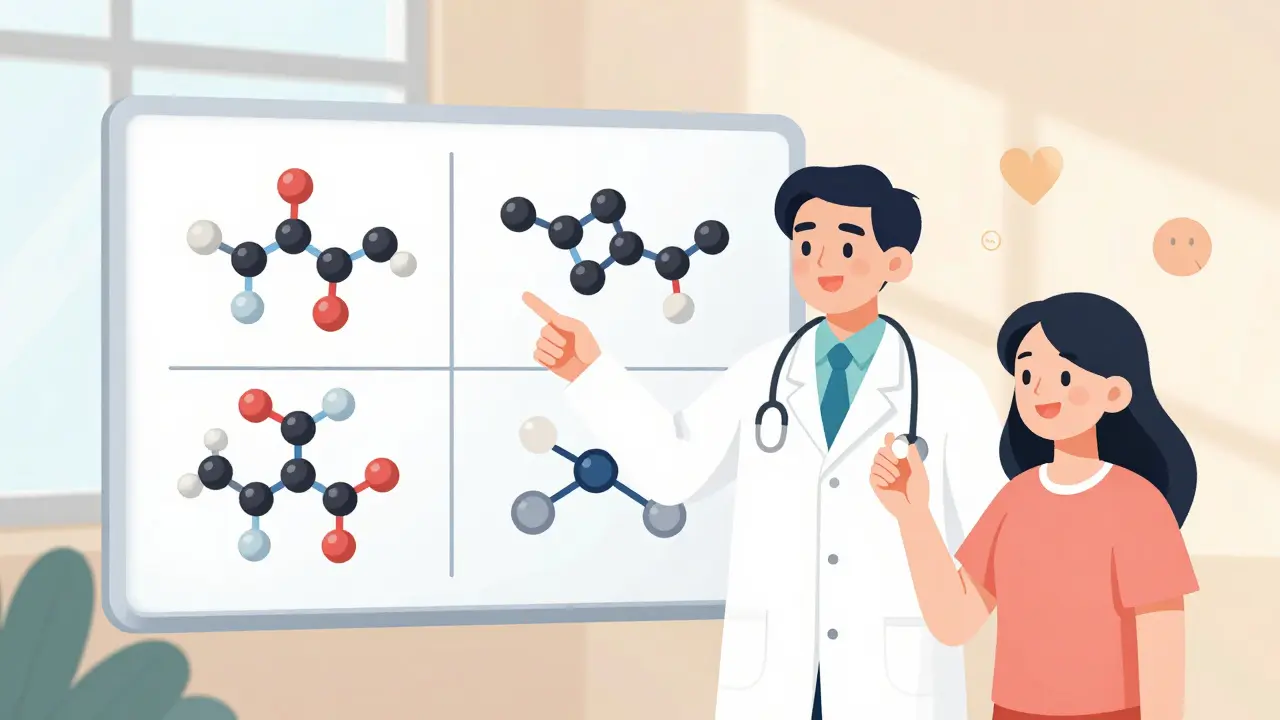
Every day, millions of patients in the U.S. fill prescriptions for generic drugs-90% of all prescriptions, to be exact. Yet many clinicians still hesitate to prescribe them confidently, even though generics are just as safe and effective as brand-name drugs. Why? Because provider education on generics is still inconsistent, incomplete, or missing altogether.
Why Clinicians Still Doubt Generics
It’s not that doctors don’t want to save patients money. Most do. But a 2017 review found 68% of physicians had at least some concern about whether generics truly matched brand-name drugs in performance. That’s not because the science is shaky-it’s because the education never caught up. The FDA requires generics to have the same active ingredient, strength, dosage form, and route of administration as the brand. They must also prove bioequivalence: the 90% confidence interval for absorption (AUC) and peak concentration (Cmax) must fall between 80% and 125% of the brand. That’s not a guess. It’s a strict, measurable standard. Yet a 2020 survey of over 1,200 prescribers showed 45% mistakenly believed generics had to contain identical inactive ingredients. Another 38% thought manufacturing quality was lower. And 27% thought generics could have up to 25% less active ingredient. These aren’t minor misunderstandings-they’re foundational errors that shape prescribing habits.The Real Impact: Adherence and Cost
When clinicians prescribe generics confidently, patients take their meds more often. Studies show patients are 35% more likely to start a new medication if it’s generic. That’s not just about savings-it’s about outcomes. In chronic conditions like hypertension, diabetes, or depression, missing doses isn’t a small thing. It leads to hospitalizations, complications, and higher long-term costs. One Harvard study found that when providers explicitly told patients, “This generic is just as good as the brand,” patient-reported side effects dropped by 18%. That’s the nocebo effect in action-when patients expect a drug to cause problems, they often feel them, even if the drug is identical. Provider endorsement breaks that cycle. And the cost savings? Massive. Generics make up just 23% of U.S. prescription drug spending but fill 90% of prescriptions. Over the past decade, they’ve saved the system $2.2 trillion. Yet many clinicians still default to brand names, often because they’re more familiar with them or because their training never emphasized generics as equal alternatives.Where Education Falls Short
Medical schools teach generic names. But in clinics, attending physicians still say “Lopressor” instead of “metoprolol.” Residents hear brand names in rounds, see them on formularies, and get handed samples labeled with brand names. It’s no wonder they’re confused. A 2022 poll of 4,200 physicians on Sermo showed 63% wanted more continuing education on generic equivalence. Internal medicine specialists were the most eager-78% said they needed it. Meanwhile, cardiologists and neurologists showed the highest resistance to switching, with 82% and 79% respectively citing concerns about efficacy. The problem isn’t just knowledge-it’s context. A 2020 ASPE study found only 35% of primary care doctors routinely discussed generic options with patients, mostly because they didn’t have time. And when they did, they often didn’t have the right tools. Many still rely on outdated fact sheets or vague handouts that don’t address real patient concerns.What Works: Evidence-Based Education
Not all education is equal. Static PDFs and one-hour webinars? They fade fast. A 2021 JAMA Internal Medicine study compared two approaches: one group got printed materials. The other got interactive, case-based sessions over six months. At the six-month mark, the interactive group retained 42% more knowledge. That’s the difference between remembering something and using it. Successful programs share three traits:- They’re hands-on. Clinicians practice explaining equivalence to simulated patients.
- They’re repeated. Four 90-minute sessions spaced over months beat one 6-hour lecture.
- They’re embedded. Educational prompts appear in the EHR when a brand-name drug is selected-suggesting a generic alternative with a single click.
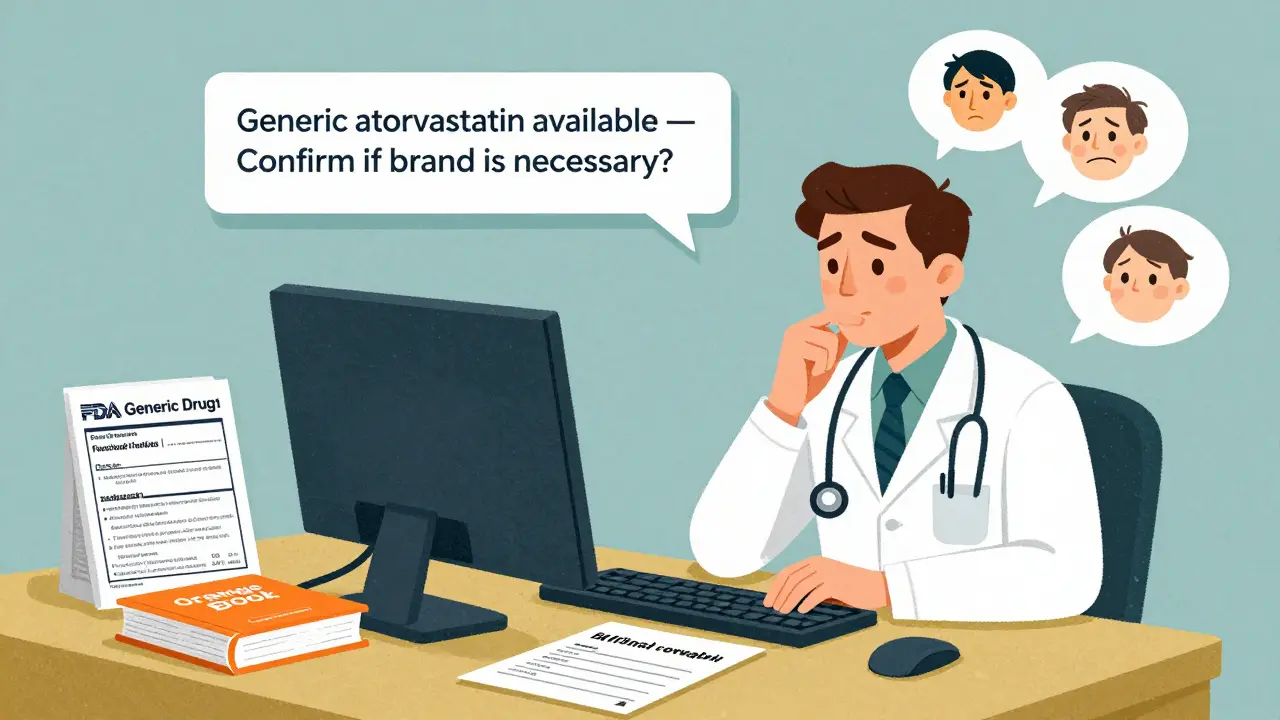
Tools and Resources You Can Use Today
You don’t need a big hospital program to get started. The FDA has free, ready-to-use materials:- Generic Drug Facts Handout (148KB PDF): Clear, one-page overview of bioequivalence and safety.
- Generic Drugs and Health Equity Handout (958KB PDF): Addresses patient concerns about cost, access, and stigma.
- Orange Book: The official list of therapeutic equivalence ratings. Look for “A” ratings-those are interchangeable.
State Laws and What They Mean
Pharmacists can substitute generics in 34 states without asking the prescriber. But 16 states require you to write “dispense as written” if you don’t want substitution. That’s not just paperwork-it’s communication. If you don’t specify, your patient might get a different version than you intended. And don’t confuse generics with biosimilars. Biosimilars are for complex biologic drugs like insulin or Humira. They’re not interchangeable by default. Only 31% of providers in a 2023 FDA survey could correctly explain the difference. That’s a dangerous gap.What’s Coming Next
The future of provider education is personal. UnitedHealthcare’s 2024 pilot uses AI to track prescribing patterns. If you’re writing a lot of brand-name prescriptions for conditions where generics are proven, the system sends you a tailored module-maybe a 10-minute video on bioequivalence in diabetes meds, or a case study on patient adherence. By 2025, CMS will start including generic prescribing rates in the Merit-based Incentive Payment System (MIPS). That means your reimbursement could be tied to how often you choose cost-effective, evidence-based generics. And the FDA is testing virtual reality training. Imagine putting on a headset and walking through a conversation with a skeptical patient who says, “I’ve always taken the blue pill. This one’s white-I’m not sure.” The system gives you real-time feedback on your response. Early results show a 41% boost in provider confidence.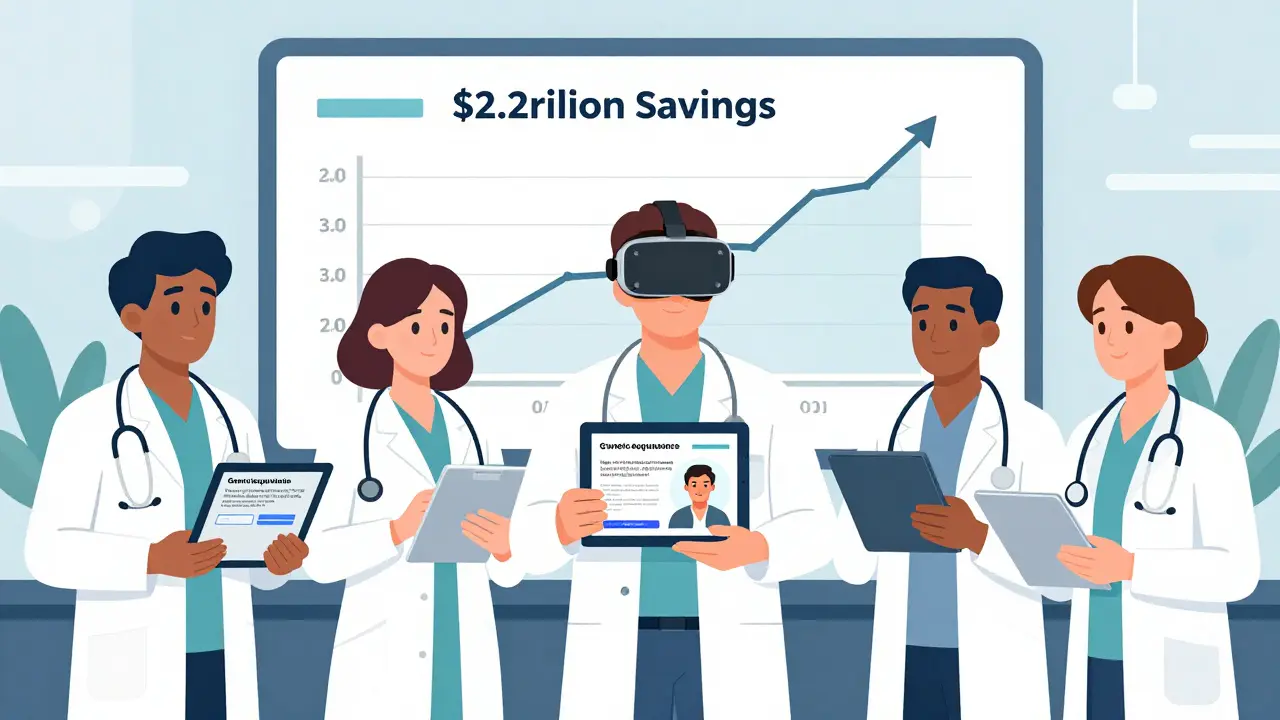
Where It Still Falls Short
Not every effort works. A Tennessee Medicaid program spent $1.2 million on physician education in 2020 and saw only an 8% increase in generic use. Why? The materials weren’t tied to the EHR. Doctors didn’t see them when they were prescribing. Education without integration is noise. And there’s still resistance in specialties where outcomes feel more fragile-psychiatry, neurology, endocrinology. Some clinicians argue that even tiny variations in inactive ingredients matter, especially for drugs like levothyroxine. But the FDA and most major studies say no: bioequivalence standards are designed to prevent that. The 5.3% higher failure rate cited by one critic has been challenged by multiple independent analyses and doesn’t reflect real-world data from large health systems.What You Can Do Right Now
Start small. Pick one medication you prescribe often-say, metformin or lisinopril. Look up its generic equivalent. Print the FDA’s one-pager. Keep it on your desk. Next time you write a prescription, say it out loud: “This is the generic version. It’s the same as the brand, just cheaper.” Don’t assume the patient knows. Don’t assume they’ll ask. Ask your pharmacy: “Do you have a substitution protocol?” If they do, make sure you know what it is. If they don’t, ask why. And if your clinic doesn’t have EHR prompts or training? Suggest it. Bring the FDA toolkit to your next grand rounds. Share the UCSF story. Ask: “What’s stopping us from doing better?”Final Thought
Generics aren’t a compromise. They’re the standard. They’re not second-rate-they’re rigorously tested, widely used, and proven safe. The gap isn’t in the drugs. It’s in the education. When you believe in generics, your patients do too. And when they do, they take their meds. They stay healthier. They spend less. And you, as the clinician, become the reason why.Are generic drugs really as effective as brand-name drugs?
Yes. The FDA requires generics to have the same active ingredient, strength, dosage form, and route of administration as the brand. They must also prove bioequivalence-meaning the body absorbs them at the same rate and to the same extent. The 90% confidence interval for absorption must fall between 80% and 125% of the brand. Thousands of studies confirm that generics perform the same in real-world use.
Why do some doctors still prefer prescribing brand-name drugs?
Many were trained using brand names and aren’t exposed to updated education on generics. Others worry about patient skepticism or fear rare cases of variability-even though regulatory standards make this extremely unlikely. In some specialties like neurology or psychiatry, ingrained habits and lack of familiarity with generic alternatives lead to continued brand use, even when it’s unnecessary.
Can pharmacists substitute generics without my approval?
In 34 states, yes-pharmacists can substitute a generic if it’s rated “A” by the FDA’s Orange Book. But in 16 states, you must write “dispense as written” on the prescription to prevent substitution. Always check your state’s rules. If you’re unsure, ask your pharmacy or check your state board of pharmacy website.
What’s the difference between a generic and a biosimilar?
Generics are exact copies of small-molecule drugs-like metformin or atorvastatin. Biosimilars are highly similar versions of complex biologic drugs-like insulin or Humira. They’re not identical because biologics are made from living cells, not chemicals. Biosimilars require additional testing and are not automatically interchangeable unless designated as “interchangeable” by the FDA. Only 31% of providers can correctly explain this distinction.
How can I learn more about generic drug equivalence?
Start with the FDA’s Generic Drugs Stakeholder Toolkit, which includes free fact sheets, videos, and interactive modules. The Orange Book is the official source for therapeutic equivalence ratings. You can also access free CME modules through the Generic Pharmaceutical Association (GPhA) or the Institute for Clinical and Economic Review (ICER). Many academic medical centers now offer case-based training-ask your institution if they provide it.
Will using generics affect my reimbursement or quality scores?
Starting in 2025, Medicare’s Merit-based Incentive Payment System (MIPS) will include generic prescribing rates as a quality metric. Clinicians who prescribe more generics may see higher scores and better reimbursement. Even now, many health systems track generic use as part of cost-efficiency goals. Choosing generics isn’t just good for patients-it’s becoming part of standard performance expectations.
Liberty C
January 21, 2026 AT 22:45Let’s be real-this entire discussion is a Band-Aid on a hemorrhage. The FDA’s bioequivalence standards are a joke masked as science. The 80-125% window? That’s not equivalence-that’s a casino. I’ve seen patients crash on generics after years on brand, and no, it’s not ‘nocebo.’ It’s pharmacokinetic betrayal disguised as regulation. And don’t get me started on the inactive ingredients-those ‘inert’ fillers? They’re not inert. They’re chemical landmines for sensitive populations. This isn’t education-it’s corporate propaganda dressed in white coats.
They call it ‘cost-saving.’ I call it rationing with a smiley face.
And you wonder why people distrust the system?
shivani acharya
January 22, 2026 AT 16:05oh honey. you think this is about education? nah. it’s about pharma’s backroom deals. the brand-name companies pay off the big hospitals, the med schools, the EHR companies-everything. that’s why the pop-ups don’t show up unless you’re on some ‘cost-efficiency’ program. and the ‘generic = same’ lie? please. i’ve had my thyroid meds switch and my heart started racing like i’d chugged espresso. they told me it’s ‘within range.’ well, my body isn’t a spreadsheet, sweetheart.
and now they’re gonna tie reimbursement to generics? classic. punish the poor for being sick. next they’ll charge you for breathing.
they’re not fixing education. they’re fixing blame.
Margaret Khaemba
January 23, 2026 AT 15:41I love that this post actually gives actionable tools-like the FDA handouts and UCSF’s EHR hack. I’m a nurse in rural Kansas, and I’ve been using the one-pager with patients for months now. It’s wild how many just need someone to say, ‘This is safe’ out loud. One lady cried because she’d been skipping her blood pressure meds for years thinking the generic was ‘cheap junk.’ Now she takes it every day. No magic. Just clarity.
Also-big shoutout to the Orange Book. I didn’t even know it existed until last year. Free, official, and actually useful? Revolutionary.
Let’s keep sharing these wins. Small changes add up.
Malik Ronquillo
January 23, 2026 AT 22:15man. i’ve been prescribing for 18 years. i used to only write brands. then one day i switched a patient to generic lisinopril. he called me two weeks later saying he felt ‘like a new man.’ no side effects. no weirdness. just cheaper. and i was an idiot for doubting it.
the real problem? lazy docs. not the drugs.
stop overcomplicating it. if it’s got the same active ingredient and the FDA says it’s good-use it. your patient’s wallet will thank you.
and no, i don’t care if your med school taught you ‘Lopressor.’ metoprolol is metoprolol.
Alec Amiri
January 24, 2026 AT 00:42you think this is about education? it’s about control. the system wants you to believe generics are equal so you’ll stop asking questions. but ask yourself-why do brand-name companies spend $500M a year on ads while generics spend $0? why do they have the same packaging, same color, same logo? because they’re not trying to sell you a drug-they’re selling you a brand. and you’re the product.
the FDA doesn’t test for long-term effects. they test for absorption. that’s it. what about the 20-year outcomes? what about cumulative effects of different fillers? nobody cares. because money talks.
you’re being manipulated. and you’re okay with it.
Lana Kabulova
January 25, 2026 AT 01:05Okay so-this is the most important thing I’ve read all year. I’m an endocrinologist. I used to avoid generics for levothyroxine because ‘they’re different.’ Then I looked at the data. The 2019 meta-analysis from JAMA Endocrinology? 12,000 patients. No clinically significant difference. None. Zero. I’ve switched 80% of my patients. One guy had a TSH spike-turned out he switched brands every month. That’s not the generic’s fault-that’s patient inconsistency.
Stop blaming the drug. Start blaming the chaos.
Also-why is no one talking about the fact that 70% of prescribers don’t even know what ‘A’ rating means? That’s criminal. We need mandatory CE. Now.
Philip House
January 25, 2026 AT 19:00Generics are fine. I’m not opposed. But let’s not pretend this is a moral victory. The real issue is that healthcare in this country has been reduced to a spreadsheet. We’re optimizing for cost, not care. If we had universal coverage and proper reimbursement models, we wouldn’t need to push generics as a ‘solution.’ We’d just prescribe what’s best.
Instead, we turn patients into cost centers. We tell them ‘this is just as good’ because we’re too broken to fix the system.
Generics aren’t the problem. The system is.
And yes-I still prescribe brand when I think it matters. Not because I’m stubborn. Because I’m not a robot.
Ryan Riesterer
January 26, 2026 AT 09:54Per FDA 21 CFR 314.94, bioequivalence is defined as the absence of a significant difference in rate and extent of absorption under ordinary conditions of use. The 80–125% CI is statistically derived from a log-normal distribution of AUC and Cmax. The 90% CI requirement ensures that the 95% prediction interval for individual patients falls within 70–143%, which is clinically acceptable for 99.8% of therapeutics.
Studies show variance in generic performance is lower than intra-patient variability from non-adherence.
Emotional resistance to generics is a cognitive bias, not a pharmacological concern.
Education must address the heuristics, not the pharmacokinetics.
Akriti Jain
January 28, 2026 AT 00:19so the FDA says it's safe... but who owns the FDA? 🤔
pharma, right? 😏
and the 'orange book'? lol, that's just a pretty name for a list that says 'trust us' 😂
my cousin took generic sertraline and started hallucinating. they said it was 'stress'.
now she's on a $400 brand pill. insurance won't cover the generic anymore because 'it's not safe'.
but the brand? same exact ingredients. just different filler. and a logo.
they're not trying to help us.
they're trying to make us pay more. 💸
and you're all just nodding along like good little bots 🤖
Mike P
January 29, 2026 AT 23:25Let me tell you something-I’m a veteran. I’ve been on generic warfarin since 2010. Switched to brand once because my VA doctor said ‘better for you.’ Guess what? My INR went wild. Had to be hospitalized. Went back to generic. Stable for 14 years. Same lab numbers. Same life.
So don’t give me this ‘some people are sensitive’ crap. If your patient has a reaction, it’s not the generic. It’s your lack of monitoring.
And if you’re still prescribing brand because you’re scared? You’re not protecting your patient-you’re protecting your ego.
Generic. Not a compromise. The standard. Get over it.
Lauren Wall
January 30, 2026 AT 11:12Stop pretending this is about science. It’s about money. The system wants you to think generics are equal so you’ll stop asking why brand drugs cost 20x more. The FDA doesn’t test for long-term psychological effects. They test for absorption. That’s it. You’re being sold a lie wrapped in data.
And now they’re going to penalize you if you don’t prescribe them? That’s not education. That’s coercion.
Oren Prettyman
January 30, 2026 AT 22:17The entire premise of this article is fundamentally flawed. The notion that ‘education’ can overcome decades of institutional bias, pharmaceutical lobbying, and the psychological architecture of brand loyalty is naive. The problem is not that clinicians don’t know the bioequivalence standards. The problem is that the system rewards brand-prescribing through formulary incentives, sample distribution, and EHR design. Education without structural reform is performative. It is theater. It is a distraction from the real issue: the commodification of health. Until we dismantle the profit-driven incentives that prioritize revenue over patient autonomy, no handout, no pop-up, no VR simulation will matter. The drugs are fine. The system is not.
Hilary Miller
February 1, 2026 AT 21:33I work in a community clinic. We started using the FDA handout last month. Patients love it. One guy said, ‘So this is just the same pill but cheaper? Why didn’t anyone tell me that before?’
We printed 50 copies. Gone in two weeks.
Simple. Clear. No jargon.
Why isn’t this in every clinic? Why do we make it so hard?
Keith Helm
February 2, 2026 AT 18:22While the empirical evidence supporting the therapeutic equivalence of generic medications is robust, the sociopolitical context in which these agents are introduced into clinical practice remains profoundly problematic. The institutionalized preference for branded pharmaceuticals is not merely a cognitive artifact of medical training but a symptom of a broader epistemic hegemony wherein corporate interests dictate clinical norms. The proposed educational interventions, while ostensibly benign, function as technocratic pacification mechanisms-offering the illusion of agency while preserving the underlying power structures that commodify health outcomes. Until the regulatory apparatus is de-coupled from market imperatives, the discourse surrounding ‘generic adoption’ will remain a distraction from the true pathology: the medical-industrial complex.