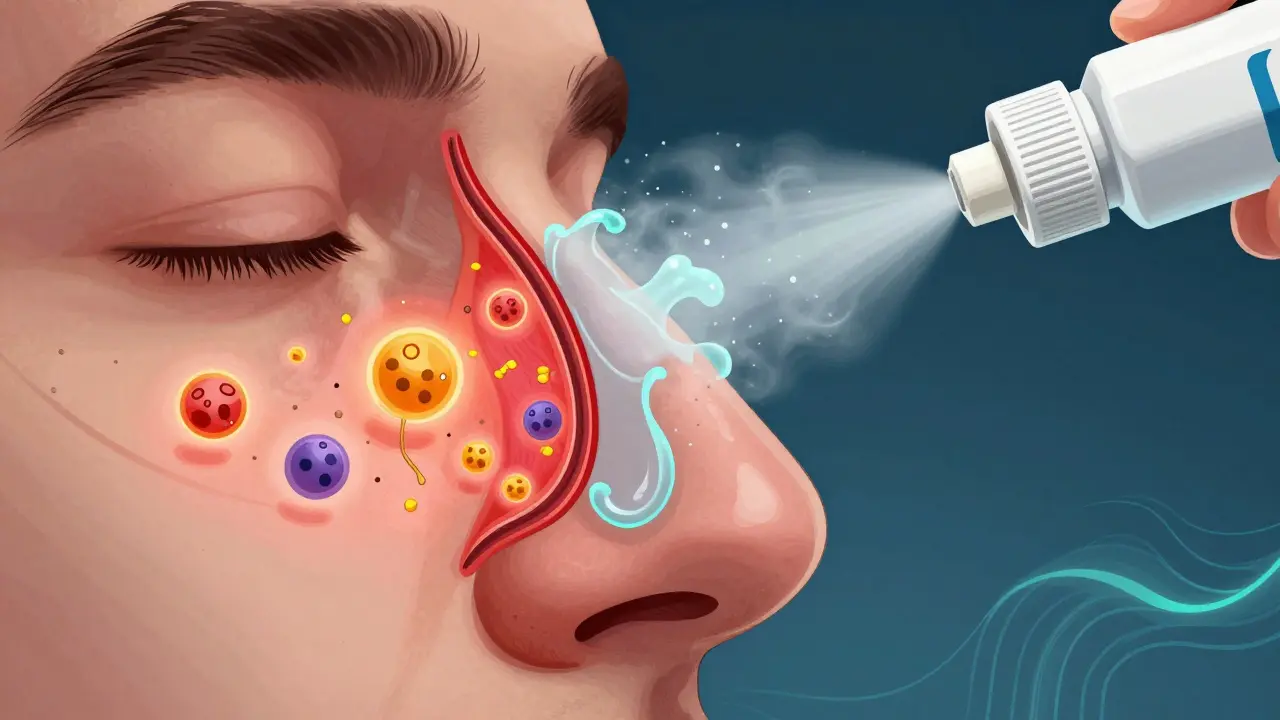
When your nose won’t stop running, your eyes water nonstop, and even breathing feels like a chore, you’re not just having a bad day-you’re dealing with allergic rhinitis. And if you’ve tried antihistamines or decongestants without lasting relief, there’s a good chance you’re missing the real culprit: inflammation. That’s where nasal steroid sprays come in. Unlike quick-fix solutions, these sprays don’t just mask symptoms. They go after the root cause: the swollen, overreactive tissue inside your nose.
What Exactly Are Nasal Steroid Sprays?
Nasal steroid sprays, also called intranasal corticosteroids (INSs), are not the same as the steroids athletes misuse. These are local, low-dose anti-inflammatory drugs designed to work only in your nasal passages. They don’t affect your whole body like oral steroids might. Instead, they target the lining of your nose-the exact place where allergens like pollen, dust, or pet dander trigger an overreaction from your immune system.
When you breathe in an allergen, your body releases chemicals like histamine, leukotrienes, and cytokines. These aren’t just one-trick ponies-they team up to cause swelling, mucus overproduction, itching, and sneezing. That’s why antihistamines alone often fall short. They block histamine, sure, but they don’t touch the other players in this inflammatory chain. Nasal steroid sprays? They shut down the whole group. Studies show they reduce levels of all these inflammatory signals, not just one.
Over 100 million people worldwide suffer from allergic rhinitis. And according to the American Academy of Otolaryngic Allergy, nasal steroids are one of the first-line treatments doctors recommend. Why? Because they work on all four major symptoms: nasal congestion, runny nose, sneezing, and itching. No other single treatment does that as effectively.
How Do They Actually Work?
Think of your nasal lining like a fire alarm that’s gone off too many times. Every time you’re exposed to pollen or dust, it screams-swelling up, producing mucus, making you sneeze. Over time, the alarm gets hypersensitive. This is called the “priming effect.” Your nose becomes more reactive, even to small triggers.
Nasal steroid sprays calm that alarm system down. They don’t just mute the sound-they rewire how the alarm responds. The active ingredients (like fluticasone, mometasone, or budesonide) penetrate the nasal tissue and interfere with the signaling pathways that cause inflammation. They reduce the number of immune cells (like eosinophils and T cells) that flood into the nose during an allergic reaction. They also block the release of over 20 different inflammatory molecules.
This isn’t just theory. A 2022 review in U.S. Pharmacist compared nasal steroids to oral antihistamines, nasal antihistamines, and leukotriene blockers. The steroid sprays won-every time. Even when antihistamines were combined with leukotriene blockers, they still couldn’t match the full-spectrum relief of a nasal steroid. That’s because steroids address the inflammation, not just one symptom.
Why They Beat Antihistamines and Decongestants
Let’s cut through the noise. You’ve probably heard of Claritin, Zyrtec, or Sudafed. They’re everywhere. But here’s the truth: they’re not always the best choice.
- Antihistamines (oral or nasal): Great for sneezing and runny nose. Weak on congestion. Azelastine (an antihistamine spray) helps with dripping nose, but doesn’t shrink swollen tissue like steroids do.
- Decongestant sprays (like oxymetazoline): These give instant relief-like flipping a switch. But use them for more than 3 days, and your nose gets hooked. Rebound congestion sets in. You end up using more, then more, then... stuck in a cycle.
- Nasal steroid sprays: Take longer to kick in, but they fix the problem without dependency. They’re safe for daily use, even long-term. No rebound. No addiction.
And here’s the kicker: nasal steroids also help with itchy, watery eyes. That’s because the inflammation in your nose triggers nerve signals that affect your eyes. Reduce nasal inflammation, and eye symptoms often improve too.

Real-World Results: What Patients Actually Experience
On Drugs.com, Flonase (fluticasone) has a 7.2 out of 10 rating from over 1,800 users. About 62% say it worked well. The biggest complaints? Dryness (24%) and nosebleeds (18%).
But here’s what most people don’t tell you: those side effects aren’t random. They’re usually from how you use the spray.
One Reddit user from r/allergies wrote: “I thought Flonase didn’t work until I stopped spraying straight back. Once I aimed it toward the outer wall of my nose, the burning stopped. And within two weeks, I could breathe again.”
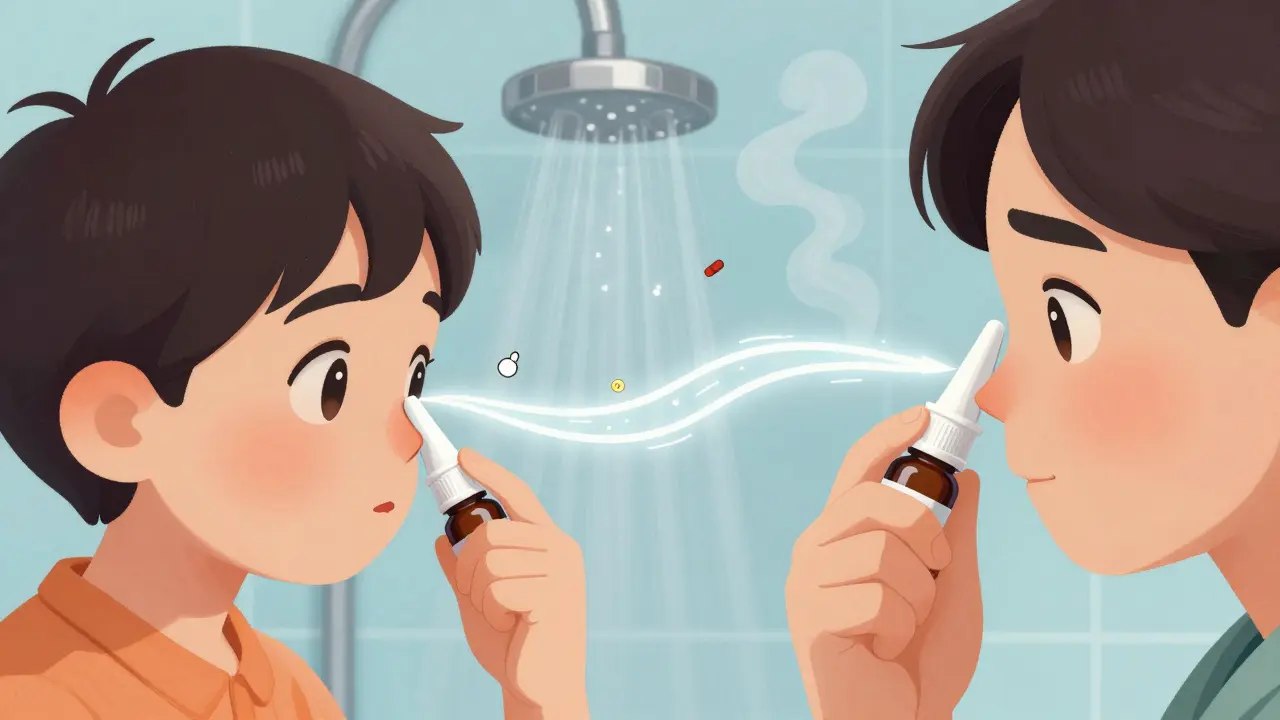
That’s the key. Most people point the nozzle straight back, toward the thin, sensitive septum-the wall between your nostrils. That’s why you get dryness, irritation, or worse, tiny nosebleeds. The correct technique? Aim the spray toward the outer wall of your nose, not the center. Tilt your head slightly forward. Breathe in gently. Don’t sniff hard. That’s how you avoid irritation and get the medicine where it needs to go.
Another common mistake? Using it only when symptoms flare up. That’s like trying to put out a fire after it’s already burned down. Steroids need consistent use. Most people start feeling better after 3-5 days. Full relief? That takes 2-4 weeks of daily use. Don’t give up after three days.
Dosing and Age Guidelines
These sprays aren’t one-size-fits-all. Dosing changes by age:
- Ages 2-5: One spray in each nostril once daily.
- Ages 6-11: Start with one spray each nostril daily. If symptoms don’t improve after a week, increase to two sprays.
- Adults and teens 12+: Usually one or two sprays per nostril daily. Some brands allow twice-daily use for severe cases.
Always check the label. Some formulations are FDA-approved for kids as young as 2. Others are only for adults. Never assume a spray is safe for your child just because it’s OTC.
Pro tip: Use the spray after a warm shower or hold your head over a steamy sink for 5-10 minutes. Moist air helps soften the nasal lining, reduces irritation, and improves absorption.
What You Should Know Before Starting
Nasal steroid sprays are safe for long-term use. That’s not marketing hype-it’s backed by decades of data. Unlike decongestants, they don’t cause dependency. Studies tracking users for over a year show no significant systemic side effects. The dose is so low and targeted that almost none of it enters your bloodstream.
Still, a few things to watch:
- Minor side effects: Dryness, stinging, nosebleeds. These usually fade after the first week.
- Rare risks: Nasal septal perforation (a tiny hole) is possible-but only if you spray directly into the center of your nose repeatedly. Proper technique makes this nearly impossible.
- Don’t stop cold: If you’ve been using it for weeks, don’t quit suddenly. Your inflammation might flare back. Talk to your doctor about tapering if needed.
And no, these sprays don’t cause weight gain, mood swings, or adrenal suppression like oral steroids might. That’s a myth.
Which Brands Are Available?
You’ve got options-both prescription and over-the-counter:
- Flonase (fluticasone propionate): The most popular OTC option. Holds 28% of the U.S. prescription market.
- Nasacort (triamcinolone acetonide): Also OTC. Good for people who prefer a non-fluorinated formula.
- Nasonex (mometasone furoate): Prescription-only. Often used for more severe cases.
- Rhinocort (budesonide): Available OTC in some countries. Known for being gentle on the nasal lining.
- Veramyst (fluticasone furoate): A newer, more potent version of Flonase. Often prescribed for kids.
They all work similarly. The differences? Delivery design, price, and how your nose tolerates them. If one irritates you, try another. Switching brands is common and perfectly safe.
When to Skip Them
Nasal steroids aren’t right for everyone:
- You have an untreated nasal infection or open sores in your nose.
- You’ve had recent nasal surgery (wait until cleared by your doctor).
- You’re on high-dose oral steroids and your doctor hasn’t adjusted your regimen.
- You’re pregnant or breastfeeding and haven’t consulted your OB-GYN.
If you’re unsure, talk to your doctor. But if you’ve tried antihistamines, decongestants, or saline rinses without lasting relief, nasal steroids are likely your next best step.
The Future of Allergy Treatment
Researchers are working on smarter delivery systems-sprays that release medicine only when they touch the nasal lining, or ones that use micro-droplets to avoid the septum entirely. Newer formulations are already reducing irritation by 40% compared to older versions.
But here’s the reality: even with new biologics and immunotherapy on the horizon, nasal steroids will remain the go-to for most people. Why? They’re affordable, effective, safe, and work for nearly everyone with moderate to severe allergies. They’re not flashy. But they work.
Bottom line? If your nose is constantly blocked, your eyes are itchy, and sneezing ruins your day-don’t just reach for the antihistamine. Give a nasal steroid spray a real shot. Use it daily. Use it right. Give it 3 weeks. You might be surprised how much better you feel.
How long does it take for nasal steroid sprays to work?
Most people start noticing improvement after 3-5 days of daily use. But full relief-especially for nasal congestion-usually takes 2 to 4 weeks. This is because steroids work by reducing inflammation, which takes time. Using them only when symptoms flare up won’t give you the best results.
Can kids use nasal steroid sprays?
Yes. Several brands, including Flonase Sensimist and Nasacort, are FDA-approved for children as young as 2 years old. Dosing is lower for kids: one spray per nostril daily for ages 2-5, and up to two sprays for ages 6-11. Always check the label and consult your pediatrician before starting.
Do nasal steroid sprays cause weight gain or mood changes?
No. Unlike oral steroids, nasal sprays deliver a very low dose directly to the nose. Less than 1% of the medication enters your bloodstream. Studies show no link to weight gain, mood swings, or hormonal side effects. The fear of steroid side effects often comes from confusion with oral or injected steroids.
Is it safe to use nasal steroid sprays every day for years?
Yes. Long-term studies spanning over 10 years show these sprays are safe for daily use. They don’t cause addiction, tolerance, or systemic side effects. The most common issues-dryness or occasional nosebleeds-are mild and usually manageable with proper technique.
Why do some people get nosebleeds from these sprays?
Nosebleeds happen when the spray hits the thin, sensitive middle wall of the nose (the septum). The fix? Aim the nozzle toward the outer wall of your nostril-not straight back. Tilt your head slightly forward and breathe in gently. Using the spray after a warm shower can also reduce irritation.
Can I use nasal steroid sprays with antihistamines?
Yes. Many people use them together. Antihistamines help with sneezing and itching, while steroids tackle congestion and underlying inflammation. There’s no dangerous interaction. In fact, doctors often recommend combining them for severe symptoms. Just avoid using nasal decongestant sprays alongside them.
bill cook
February 27, 2026 AT 12:30Bro I tried Flonase for 3 days and it did nothing. Then I stopped and started again. Still nothing. I think they’re just big pharma’s way of keeping us hooked on $30 bottles of nasal mist. I’m switching to essential oils. At least they smell good.
Byron Duvall
March 1, 2026 AT 01:15Did you know the FDA only approved these because Big Pharma paid off regulators? I read a blog that said the real reason they work is because they contain microchips that suppress your immune system’s ability to rebel. That’s why you don’t sneeze anymore - your body’s been hacked. Also, why are all the studies funded by GlaxoSmithKline? Coincidence? I think not.
Katherine Farmer
March 2, 2026 AT 15:02It’s amusing how Americans treat nasal steroids like a panacea while ignoring the fundamental issue: our modern environments are engineered to maximize allergen exposure. Air conditioning, synthetic carpets, sealed homes - these are the real culprits. The spray is a Band-Aid on a broken infrastructure. And yet, we’re all too busy Googling ‘best steroid spray’ to question why our homes are biologically hostile. The irony is thick enough to choke on.
Sumit Mohan Saxena
March 3, 2026 AT 14:38The clinical evidence supporting intranasal corticosteroids is robust and well-documented in peer-reviewed literature. Multiple randomized controlled trials, including meta-analyses from the Cochrane Collaboration, confirm superior efficacy over antihistamines for nasal congestion, particularly in moderate-to-severe allergic rhinitis. The mechanism is well-understood: suppression of IL-4, IL-5, and eotaxin-mediated eosinophil recruitment. Proper administration technique - lateral aiming, not midline - reduces mucosal trauma by over 70%. Consistency is non-negotiable; pharmacokinetics require 7–14 days for steady-state tissue concentration. Do not discontinue prematurely.
Brandon Vasquez
March 4, 2026 AT 03:42I used to think these sprays were overhyped too. Then I started using them right - aimed outward, not straight back. Took about two weeks. Now I can sleep without my head feeling like a balloon. No drama. Just better breathing. Stick with it.
Vikas Meshram
March 4, 2026 AT 12:02You people are idiots. The fact that you need a spray to fix your nose means you’re already broken. Real men used to just blow their noses and go outside. Now we have 20-year-olds with allergies to dust mites in their IKEA couches. And you’re paying $30 for a chemical that’s basically a steroid. You’re not allergic to pollen - you’re allergic to modern life. And you’re too lazy to fix it. Also, your grammar is terrible. It’s ‘your nose’ not ‘you’re nose.’
Ben Estella
March 5, 2026 AT 10:24Why are we letting the government approve this? I mean, it’s literally a steroid. Next thing you know they’ll be spraying our water with it. This is how they control us. They give us a little relief so we don’t ask why we’re allergic to everything. China started this. I read it on a forum. We need to boycott all nasal sprays. Use salt water. Or better yet - move to Alaska.
Jimmy Quilty
March 6, 2026 AT 02:04Look I’m not saying the science is wrong but have you ever considered that maybe these sprays are just making us more sensitive over time? Like, the more you use them, the more your body says ‘oh cool, we’re being suppressed, let’s ramp up the reaction next time.’ I’ve been on this stuff for 5 years and now I sneeze if someone looks at me funny. Coincidence? I think not. Also, I think my nosebleeds are from the government drones.
Miranda Anderson
March 7, 2026 AT 22:10It took me months to figure out how to use these properly. I was spraying straight back like everyone else, and I thought the product was garbage. Then I watched a 10-minute YouTube video about nasal anatomy - turns out the septum is super thin and sensitive. When I started aiming toward the outer wall, everything changed. Not only did the burning stop, but my eyes stopped itching too. It’s wild how such a small tweak made a massive difference. I wish I’d known this sooner. I wasted so much money and time being frustrated.
Gigi Valdez
March 8, 2026 AT 22:52Thank you for this comprehensive overview. The distinction between local and systemic steroid effects is critical and often misunderstood. The data supporting long-term safety is compelling, particularly when contrasted with the documented risks of prolonged decongestant use. The emphasis on technique is not merely helpful - it is essential. I will be sharing this with my patients.
Sneha Mahapatra
March 10, 2026 AT 09:40It’s funny how we treat our bodies like machines that need fixing instead of ecosystems that need balance. I used to take these sprays every day. Then I started eating local honey, sleeping with windows open, and reducing sugar. My allergies didn’t disappear… but they became quieter. Like a song you used to hate, but now you just hum along. The spray helped me get to a place where I could listen. Not fix. Just listen. 🌿
Full Scale Webmaster
March 11, 2026 AT 22:14Okay so I’ve been on this for 18 months. I had chronic sinusitis, eye pressure, brain fog - I was a zombie. Flonase saved me. But then I got curious. Why does my nose feel like it’s on fire after I spray? I started digging. Turns out the preservative - benzalkonium chloride - is a known irritant. I switched to a preservative-free version (Nasonex without BKC) and now I feel like a new person. No more burning. No more nosebleeds. Just peace. I’ve been telling everyone. You’re not allergic to pollen - you’re allergic to the bottle. The whole system is rigged. Pharma doesn’t want you to know this. But now you do. Spread the word.
Lisa Fremder
March 12, 2026 AT 05:58I’ve been using this since 2017 and I’ve never had a single problem. If you’re having side effects you’re probably doing it wrong. Americans are too soft. We need to stop whining and just use the damn spray right. Also stop drinking cold brew. That’s what’s really causing your allergies.
Justin Ransburg
March 14, 2026 AT 02:35Thank you for writing this. I’ve been recommending nasal steroids to patients for years, but most give up too soon. The 2–4 week window is the hardest part. I always tell them: ‘It’s not a magic trick. It’s a slow burn.’ If you’re consistent, you’ll get your life back. And if you don’t? Try a different brand. Not all sprays are created equal. Keep going.