
What’s Really Going Around This Season?
You wake up with a fever, a sore throat, and a headache. Is it the flu? Is it COVID? Or just a bad cold? In 2026, the lines between these illnesses are blurrier than ever - but the differences still matter. During the 2024-2025 season, influenza surpassed COVID-19 in hospitalizations and deaths across the U.S., something not seen since 2020. That doesn’t mean COVID is gone. It means we’re now dealing with two major respiratory viruses that act differently, spread differently, and need different responses.
Testing: Don’t Guess - Test
Trying to tell flu and COVID apart by symptoms alone is a trap. Both cause fever, cough, fatigue, and body aches. But here’s what sets them apart: loss of taste or smell happens in 40-80% of COVID cases, but only 5-10% of flu cases. That’s a clue - not a diagnosis.
Since late 2024, most U.S. hospitals use multiplex PCR tests that check for influenza A/B, SARS-CoV-2, and RSV all at once. These tests cut diagnosis time by nearly two days compared to testing one virus at a time. Rapid antigen tests are still common in clinics and at home, but their accuracy varies. Flu antigen tests catch about 75-85% of cases. COVID antigen tests catch 80-90%. That means a negative result doesn’t always mean you’re clean - especially if you’re still feeling awful.
If you’re high-risk - over 65, pregnant, or have heart or lung disease - get tested even if your symptoms are mild. The CDC now recommends combined testing for anyone with respiratory symptoms during peak season (November-March). At-home combined tests like BinaxNOW’s flu/COVID kit are now widely available and validated for 89% accuracy on both viruses.
Treatment: Timing Is Everything
Antivirals work - but only if you start them early.
For influenza, oseltamivir (Tamiflu) is the go-to. It cuts hospital stays and complications by 70% if taken within 48 hours of symptoms. Zanamivir, a newer inhaled antiviral, got emergency FDA approval in January 2025 with 92% effectiveness against the dominant H1N1 pdm09 strain. But here’s the catch: 37% of U.S. hospitals ran short of flu antivirals in December 2024. If your doctor prescribes it, fill it fast.
For COVID-19, Paxlovid (nirmatrelvir/ritonavir) remains the top choice. It cuts hospitalization risk by 89% if taken within five days of symptoms. In 2025, the FDA expanded eligibility to include people with mild symptoms who have risk factors like diabetes or obesity - even if they’re otherwise healthy. But only 63% of commercially insured patients got full coverage for Paxlovid, compared to 87% for Tamiflu. Insurance still treats them differently.
Antibiotics? They don’t work on viruses. But bacterial pneumonia is more common with flu - 38% of hospitalized flu patients got antibiotics, versus 22% of COVID patients. That’s because flu often opens the door for secondary infections. COVID tends to cause pure viral pneumonia. So if you’re hospitalized with flu and your fever won’t break, antibiotics might be needed. With COVID, they usually aren’t.
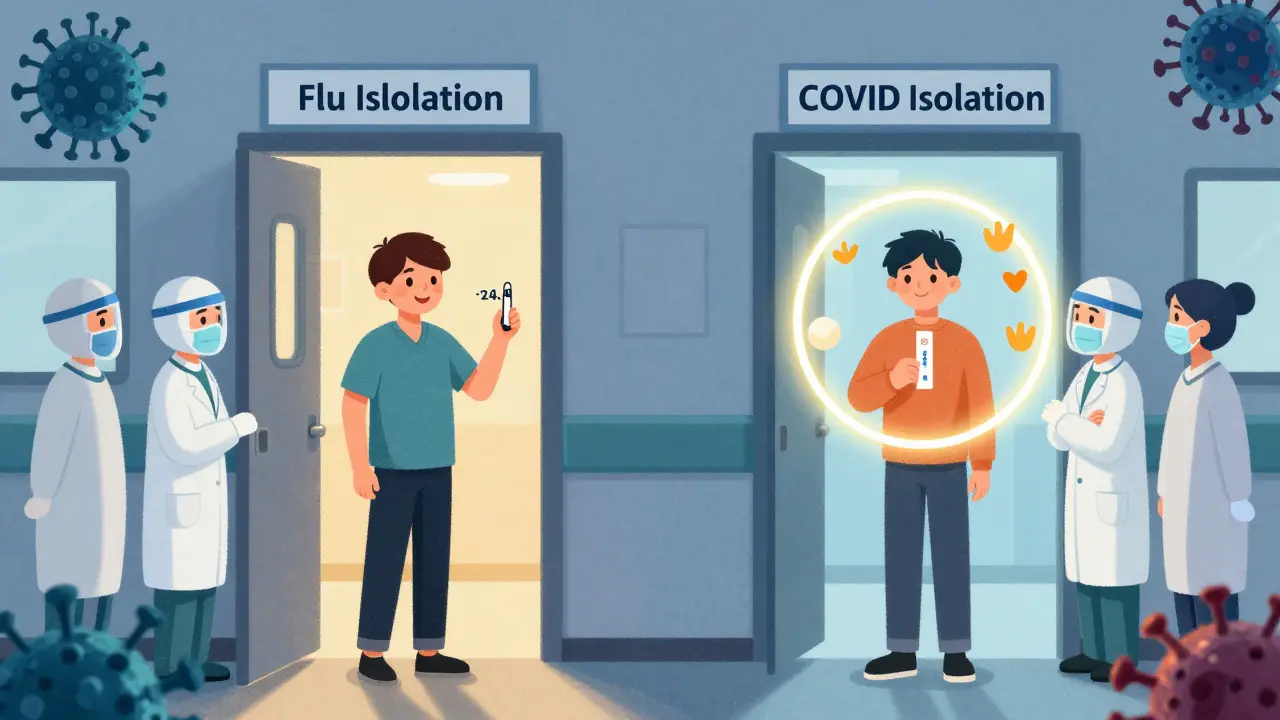
Isolation: Same Rule, Different Rules
The CDC says: isolate for five days. That’s the same for both. But the details? Totally different.
With flu, you’re most contagious one day before symptoms start and for 5-7 days after. Kids can shed the virus for up to two weeks. You can end isolation after 24 hours without fever - no meds, just natural cooling. No test needed.
With COVID, especially the XEC variant, you’re contagious for 8-10 days on average. You can spread it before you even feel sick - two to three days before symptoms. The CDC now requires a negative rapid antigen test on day five to end isolation. If you’re still positive? Keep going. No exceptions. That’s because SARS-CoV-2 hangs around longer in your system.
Healthcare settings treat them differently too. In hospitals, 92% of COVID patients require staff to wear N95 masks. For flu, it’s 68%. Why? Because even though flu is more common right now, COVID spreads more easily in closed spaces. And it causes more hospital-acquired pneumonia - 28% of COVID patients got it, compared to 12% of flu patients.
Who’s at Highest Risk?
Flu hits hard, but it often hits people without pre-existing conditions. In 2025, 42% of hospitalized flu patients had no chronic illnesses. That’s higher than in past years. Vaccination helped - 67% of flu patients had gotten the flu shot in the past year.
COVID patients? They’re more likely to have underlying problems. Chronic kidney disease, cancer, autoimmune disorders, or taking immunosuppressants all raise your risk. Only 49% of hospitalized COVID patients had been vaccinated in the past year.
Men are more likely to end up in the hospital with COVID than women. With flu, gender doesn’t matter as much. Age still matters for both - but older adults are at higher risk for severe outcomes from either virus. That’s why getting both vaccines is still the smartest move.
What’s Changing in 2026?
The CDC’s 2025-2026 outlook warns: don’t get comfortable. A new immune-evading variant could flip the script again. If one emerges, hospitalization rates could spike back to 9.5 per 100,000 by January 2026 - higher than last year’s peak.
But the big shift isn’t just in the virus. It’s in how we manage it. Hospitals now use integrated respiratory pathogen systems that track flu, COVID, and RSV together. That’s helped cut unnecessary antiviral use by 35%. Clinicians got 8-12 hours of new training in 2025 to handle the overlap.
Testing tech keeps improving. The global market for respiratory diagnostics hit $14.3 billion in 2024. Companies like Roche, Abbott, and QuidelOrtho dominate, but new players are making faster, cheaper at-home panels. You can now buy a single test that tells you if you have flu, COVID, or RSV - and get results in 15 minutes.
The message from experts like Dr. Ashish Jha is clear: stop treating these as separate problems. We need systems that recognize both their similarities and their critical differences.
What Should You Do Right Now?
- If you have symptoms, test - don’t assume it’s just the flu.
- If you’re high-risk, call your doctor within 24 hours of symptoms. Don’t wait.
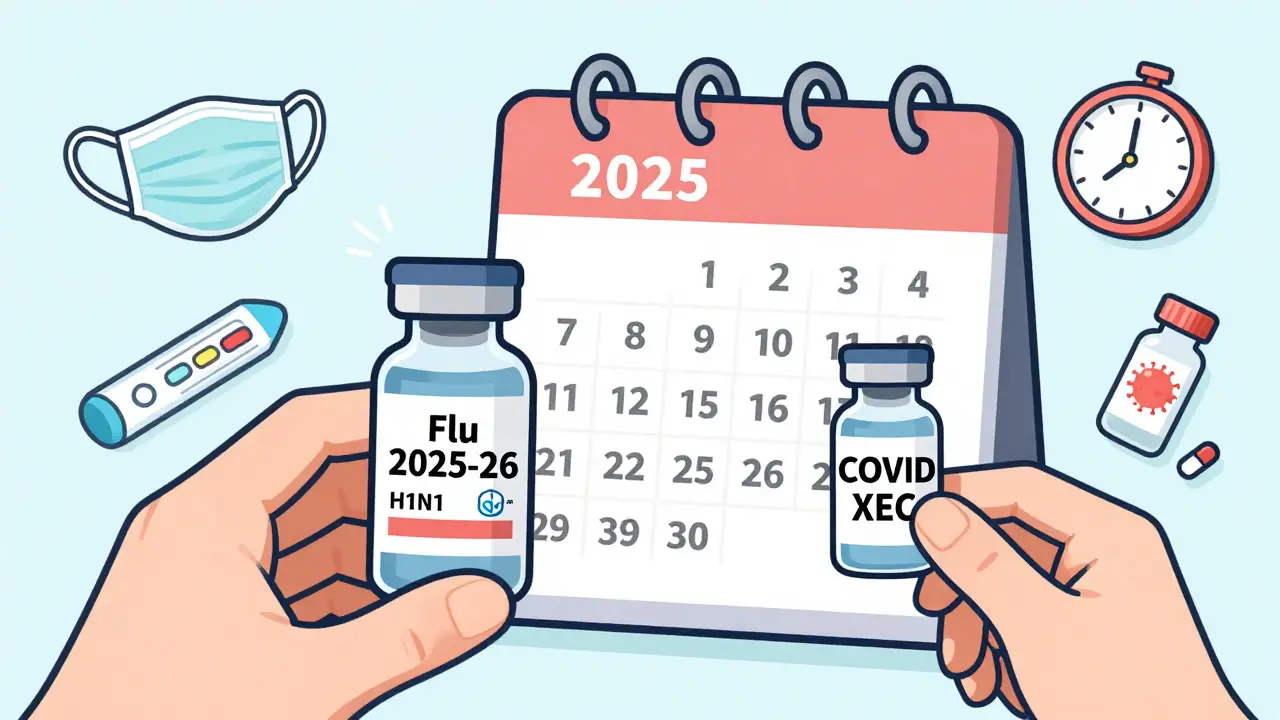
- Get both the flu and updated COVID vaccines. Coverage was 52.6% for flu and 48.3% for COVID last season. We need more.
- Isolate properly. For flu: 24 hours fever-free. For COVID: negative test on day five.
- Don’t hoard antivirals. Use them only if prescribed. Shortages still happen.
- Wear a mask in crowded indoor spaces during peak season. It still works.
Common Misconceptions
Myth: If I had COVID last year, I’m immune to flu.
Truth: Totally different viruses. No cross-protection.
Myth: Antivirals are useless if you’re not hospitalized.
Truth: They prevent hospitalization. That’s why they’re prescribed early.
Myth: I feel better, so I’m not contagious anymore.
Truth: With flu, you might still shed virus. With COVID, you might still test positive. Don’t rush back to work or school.
Myth: The CDC changed the rules so often, I don’t know what to believe.
Truth: The rules changed because we learned more. That’s science working.
Can I get flu and COVID at the same time?
Yes. Co-infections happen. During the 2024-2025 season, about 4% of patients tested positive for both viruses. These cases tend to be more severe, with longer hospital stays and higher oxygen needs. If you’re hospitalized with respiratory illness and symptoms aren’t improving, doctors will check for both.
Do I need to retest after five days of isolation?
Only for COVID. For flu, you can stop isolating after 24 hours without fever and without fever-reducing meds. For COVID, you need a negative rapid antigen test on day five. If it’s still positive, keep isolating until day seven or until you test negative. This is because SARS-CoV-2 lingers longer in the body than flu viruses.
Are at-home tests reliable for both viruses?
Combined at-home tests like BinaxNOW’s flu/COVID kit are now FDA-approved and show 89% sensitivity for both viruses. That’s good enough for most people. But if you’re high-risk and test negative but still feel terrible, get a lab PCR test. False negatives happen - especially early in infection.
Why is Paxlovid harder to get than Tamiflu?
Insurance coverage. In 2025, 87% of patients with commercial insurance got full coverage for Tamiflu, but only 63% did for Paxlovid. That’s because Paxlovid is newer, more expensive, and has more drug interactions. Some pharmacies also limit supply. Talk to your doctor early - they can help navigate coverage or find alternatives.
Should I still get vaccinated if I’ve had both flu and COVID this year?
Yes. Immunity from infection doesn’t last long, and viruses keep changing. The 2025-2026 flu vaccine targets the H1N1 pdm09 strain still circulating. The updated COVID vaccine covers the XEC subvariant and related strains. Getting both vaccines even after infection reduces your risk of reinfection and severe illness.
What if I can’t afford testing or antivirals?
Many public health clinics offer free or low-cost testing. The CDC’s Respiratory Pathogen Resource Center lists free testing sites by zip code. Some pharmacies give free rapid tests with insurance. If you’re uninsured, ask your doctor about patient assistance programs - many drug manufacturers offer free antivirals to qualifying patients. Don’t skip care because of cost - early treatment saves lives.
Bottom Line
Flu and COVID aren’t the same. They’re not even close. But they’re both here - and both dangerous. The best defense isn’t panic. It’s awareness. Test when you’re sick. Treat early. Isolate correctly. Get vaccinated. And remember: what worked last year might not be enough this year. Stay informed. Stay prepared. And don’t let confusion keep you from acting.
Jennifer Phelps
January 13, 2026 AT 02:17Also why do people still think antibiotics help? I got prescribed them last year for a 'possible secondary infection' and ended up with a yeast infection. No thanks.
beth cordell
January 14, 2026 AT 14:13Craig Wright
January 15, 2026 AT 03:44Ben Kono
January 16, 2026 AT 20:36Cassie Widders
January 17, 2026 AT 09:18Konika Choudhury
January 19, 2026 AT 00:13Jose Mecanico
January 20, 2026 AT 19:36Abner San Diego
January 22, 2026 AT 14:13Monica Puglia
January 23, 2026 AT 12:52Cecelia Alta
January 24, 2026 AT 17:55steve ker
January 25, 2026 AT 16:05George Bridges
January 26, 2026 AT 09:30Rebekah Cobbson
January 26, 2026 AT 15:03Alice Elanora Shepherd
January 27, 2026 AT 10:16