Imagine picking up a prescription for a common generic medication, only to find out later that the pills are essentially chalk or, worse, a toxic cocktail of ingredients. It sounds like a plot from a thriller, but for millions, it's a reality. According to the World Health Organization, counterfeit medicines are an estimated 10% of the global pharmaceutical market. In some developing regions, that number jumps to 30%.
The problem is that generic drugs often have lower profit margins than branded ones, meaning manufacturers might not spend as much on fancy security. This creates a massive loophole for criminals. If you're a patient, a caregiver, or a pharmacist, knowing how to spot a fake isn't just about quality control-it's about survival. While no single check is 100% foolproof, a layered approach to verification can drastically reduce the risk of taking a falsified drug.
The Three Layers of Pharmaceutical Security
To understand how to verify a drug, you have to understand how they're protected. Security isn't just one seal; it's a series of barriers designed to trip up counterfeiters at different stages.
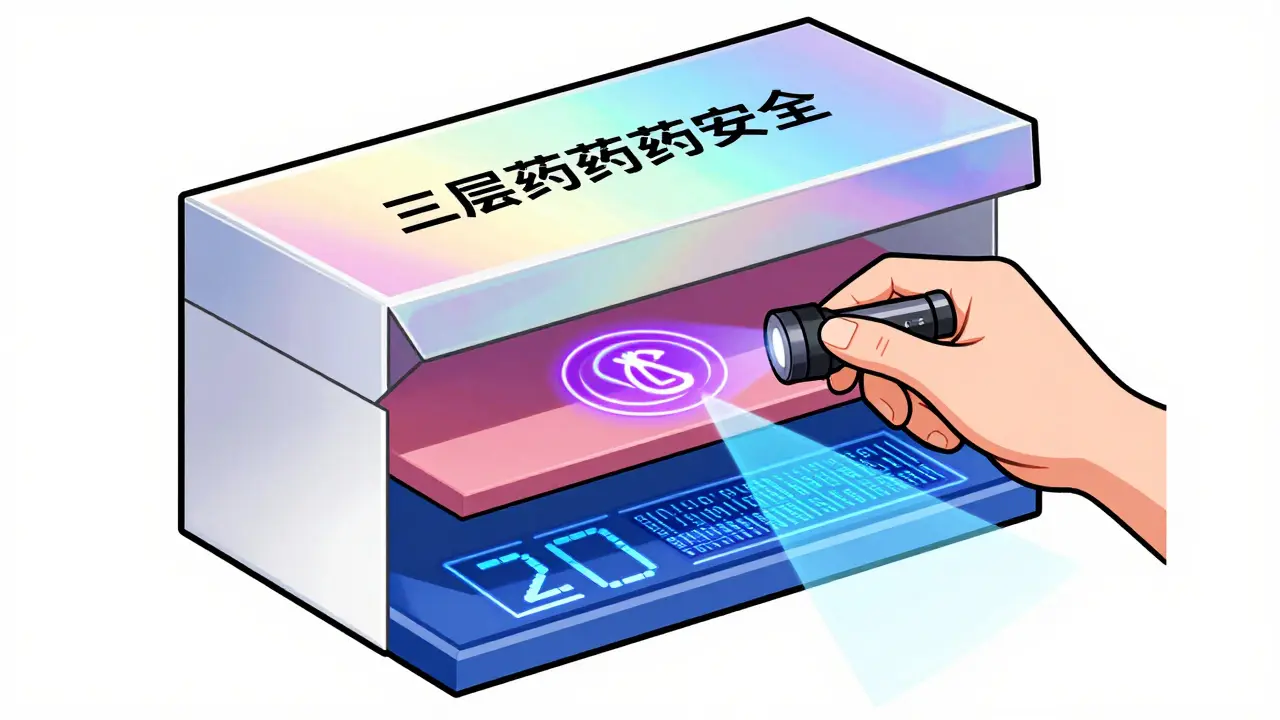
- Overt Features: These are things you can see with your own eyes. Think of them as the first line of defense. They include color-shifting inks or holograms. For instance, some high-end packaging uses Optically Variable Ink that changes color as you tilt the box.
- Covert Features: These are hidden markers that require a simple tool to see. A common example is UV-sensitive ink. If you shine a 365nm ultraviolet light on the box, a hidden logo or code might appear. Johnson & Johnson has used this on Tylenol packaging since 2015 to thwart fakes.
- Track-and-Trace Systems: This is the digital paper trail. Every single box gets a unique serial number. In the EU, the Falsified Medicines Directive (FMD) is a set of regulations that requires prescription medicines to have safety features, like a 2D data matrix code, to ensure the drug is legitimate from the factory to the pharmacy.
Visual Red Flags: What to Look For on the Box
Most pharmacists who catch fakes do it through "gut feeling" fueled by a keen eye for detail. You don't need a lab to spot basic errors. Look for inconsistencies in the printing. Counterfeiters often struggle with font precision. One pharmacist on Reddit noted that they caught a fake generic Nexium simply because the expiration date font looked slightly "off" compared to the authentic version.
Check for the following physical anomalies:
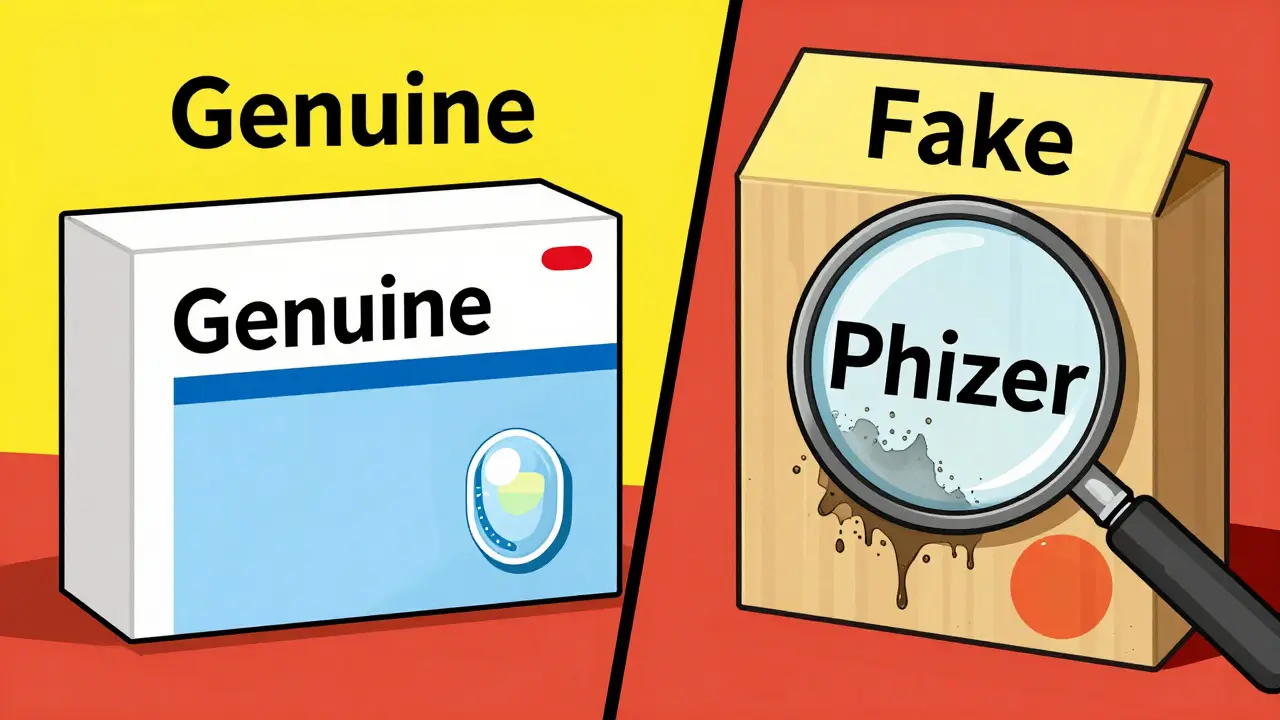
- Smudging or Bleeding: Authentic pharmaceutical printing is incredibly precise. If the ink is blurred or bleeding into the cardboard, be suspicious.
- Misspellings: It sounds obvious, but "Pfizer" spelled as "Phizer" happens more often than you'd think. Check the active ingredient names and the manufacturer's address.
- Seal Integrity: A loose or poorly glued seal is a major red flag. If the shrink-wrap looks like it was applied with a handheld heat gun rather than a factory machine, don't take the medication.
- Hologram Quality: Real holograms have crisp, 3D depth. Fakes often look like flat, shiny stickers that don't shift correctly when moved.
| Method | Ease of Use | Security Level | Equipment Needed |
|---|---|---|---|
| Overt (Visual) | Very High | Low to Medium | None (Eyesight) |
| Covert (UV/RFID) | Medium | Medium to High | UV Light / RFID Reader |
| Track-and-Trace | High | Very High | Barcode Scanner / Database |
| Spectroscopy | Low | Highest | NIR/Raman Spectrometer |
Advanced Verification: When the Box Isn't Enough
Here is the scary part: modern counterfeiters can now replicate packaging with up to 95% accuracy. If the box is perfect, you have to look at the chemistry. This is where NIR spectroscopy (Near-Infrared) comes in. It's the gold standard for field verification.
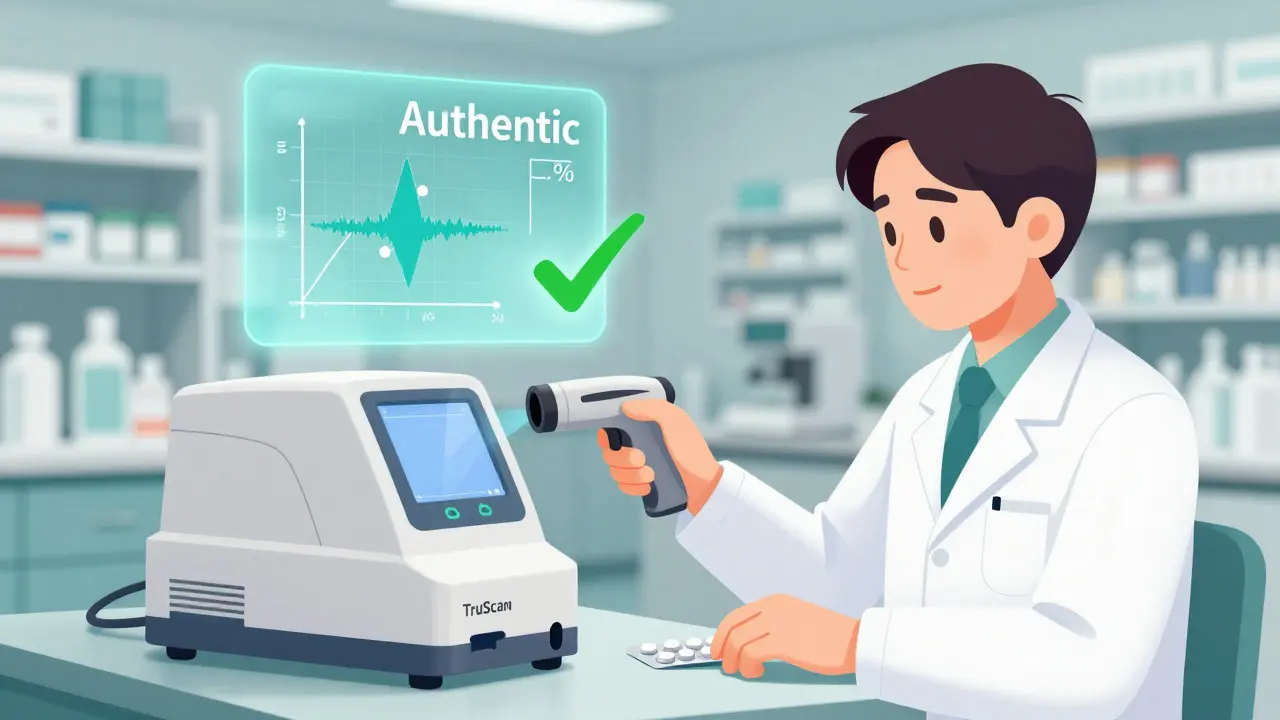
A device like the TruScan RM by Thermo Fisher allows a professional to scan a pill through its packaging. It doesn't look at the box; it looks at the molecular vibration of the drug. If the correlation coefficient is below 0.85 compared to a known authentic sample, it's almost certainly a fake. This method is incredibly effective at detecting moisture content variations or coating defects that a human would never see.
Then there is Raman spectroscopy. While NIR is great for general physicochemical checks, Raman is better for identifying the specific chemical constituents of the drug. However, it has a weakness: it struggles with dark-colored tablets because of fluorescence interference. That's why the most secure facilities use a "multi-method" approach, combining visual checks with digital tracking and spectroscopic analysis to hit a 98.7% detection rate.
The Challenges of Generic Drug Serialization
You might wonder why we don't just put a high-tech code on every single pill. The answer is money. Generic medicines make up about 90% of prescriptions in the US, but they account for only 22% of spending. Because the margins are so thin, some generic manufacturers are slower to adopt full serialization.
This creates a "verification gap." Many independent pharmacists report that while branded drugs are easy to track, generics can be a nightmare. In some cases, barcode scanning for generics fails 40-50% of the time because the serialization is inconsistent across different batches. This is why the US Drug Supply Chain Security Act (DSCSA) has been pushing for tighter tracing requirements, aiming for total visibility by 2026.
Step-by-Step Checklist for Pharmacy Staff
If you are responsible for receiving and dispensing generic medications, follow this workflow to minimize the risk of substandard or falsified medicines entering your inventory:
- Verify the Source: Only buy from authorized wholesalers. If a deal seems too good to be true (e.g., a 40% discount on a high-demand generic), it probably is.
- Inspect the External Packaging: Check for font consistency, spelling errors, and the quality of the hologram.
- Test the Security Features: Use a UV light to check for covert markers and ensure the 2D data matrix code scans correctly in your system.
- Compare with Reference Samples: Keep a "gold standard" sample of authentic packaging from a trusted batch to compare new shipments against.
- Audit the Pill: If the packaging is suspect, check the pill itself. Look for inconsistent coloring, crumbling edges, or a strange smell.
- Escalate if Necessary: If you suspect a fake, do not dispense it. Contact the manufacturer's authentication portal or a regional verification center.
Can I verify a generic drug at home?
To a limited extent, yes. You can perform basic visual checks for spelling, printing quality, and seal integrity. However, most covert and spectroscopic tools are expensive and reserved for pharmacies and hospitals. Your best bet is to buy from reputable, licensed pharmacies and report any packaging anomalies to your pharmacist.
Why are generics more likely to be counterfeited than branded drugs?
Generic drugs often have simpler packaging and lower profit margins, which means manufacturers may invest less in expensive security features like cryptographic 2D codes or complex holograms. Additionally, the supply chain for generics is often longer-passing through 5-7 distribution points compared to 3-4 for branded drugs-creating more opportunities for fakes to be swapped in.
What is the difference between a "substandard" and a "falsified" drug?
A falsified drug is a deliberate fake-it's designed to look like a real product but contains the wrong ingredients or none at all. A substandard drug is a genuine product that failed quality control, perhaps due to poor manufacturing or degradation during transport (like heat exposure). Both are dangerous, but falsification is a criminal act.
How accurate are the scanning apps used by pharmacies?
It varies. Large-scale systems like the European Medicines Verification System (EMVS) are incredibly reliable. However, in regions with poor network connectivity or inconsistent serialization, mobile apps can fail up to 35-45% of the time for generics. This is why digital scans should always be paired with a physical inspection.
What should I do if I think my medication is fake?
Stop taking the medication immediately. Contact your prescribing doctor and the pharmacy where you purchased it. Do not throw the packaging away, as it is the primary evidence needed for the FDA or other regulatory bodies to trace the counterfeit source.
Next Steps for Better Security
The industry is moving toward AI-enhanced verification. By 2028, it's expected that 70% of pharmaceutical checks will use a combination of AI and spectroscopy to spot fakes. If you run a small clinic, investing in a basic UV light and a high-quality magnifying glass is a low-cost way to start your own verification process.
For larger hospitals, the transition to blockchain-based tracking is the next logical step. Recent pilots have shown 99.2% accuracy in tracking products through multiple distribution tiers, almost entirely eliminating the "blind spots" where counterfeiters usually operate. Until that becomes standard, the human eye-trained to spot the smallest font error-remains one of the most important tools in the fight against fake drugs.
Lynn Smith
April 18, 2026 AT 04:42This is such a helpful guide! I never really thought about the printing quality of the boxes before, but it makes total sense that the fakes would have those little glitches.
Valorie Darling
April 19, 2026 AT 14:14honestly just buy from a big pharmacy and stop stressing... most of this sounds like overkill for a regular person lol
Quinton Bangerter
April 19, 2026 AT 21:26The "serialization gap" is a convenient excuse. I bet the lack of consistent tracking is a feature, not a bug, designed to let certain players move product without oversight. And blockchain? That's just the latest buzzword to make us feel safe while the real controllers keep the keys to the kingdom. You can't trust a digital trail when the people building the trail are the ones profiting from the chaos.
dallia alaba
April 20, 2026 AT 09:09From a clinical perspective, it is vital to emphasize the difference between substandard and falsified drugs. Many people assume any "bad" pill is a fake, but degradation due to poor cold-chain management is a massive issue in logistics. If you notice a change in the tablet's texture or a strange odor, even if the packaging is perfect, it could be a stability failure. Always check the storage conditions of the pharmacy you are using, as heat exposure can render a genuine drug useless or even harmful.
Don Drapper
April 21, 2026 AT 00:35The sheer audacity of these counterfeiters to jeopardize human life for the sake of a few percentage points in profit margin is absolutely abhorrent! It is a systemic failure of the highest order that we are left to play "detective" with our own life-saving medications. This isn't just a loophole; it is a catastrophic void in the regulatory framework that screams of incompetence!
Ms. Sara
April 21, 2026 AT 13:17I really appreciate the checklist for pharmacy staff. It's a great way to standardize the intake process. We should probably also be encouraging patients to report any weirdness they see at home, rather than just telling them it's a "limited extent" of what they can do. Empowerment leads to better outcomes.
julya tassi
April 23, 2026 AT 08:58I'm curious about the UV lights mentioned! 💡 Are they easy to find online or do you need a special medical grade one? I'd love to be able to check my own meds just for peace of mind! 😊
Tanya Rogers
April 25, 2026 AT 00:35The obsession with "gut feelings" as a viable methodology for pharmaceutical verification is quite quaint. One would assume that in a scientific era, we would rely exclusively on empirical data rather than the intuition of a retail employee. The irony of trusting a human eye to spot a font error while the chemistry remains an enigma is simply delicious.
Lesley Wimbush
April 25, 2026 AT 08:59Oh honey, I've always known that the fancy branded boxes were just for show, but the generic side is truly a wasteland of aesthetics. It's almost charming how they try to mimic the real thing with their little stickers. I only ever buy my high-end meds from the most exclusive boutiques anyway, so this is all very fascinating but ultimately irrelevant to my lifestyle.
aman motamedi
April 26, 2026 AT 16:55I believe the information provided here is most beneficial for the community. I wish to express my gratitude for the detailed explanation of the Falsified Medicines Directive.
Venkatesh Venky
April 27, 2026 AT 02:46The NIR spectroscopy part is super cool tech! It's like a molecular fingerprint. Even with the serialization lag, we can use these tools to optimize the supply chain and keep everyone safe. Let's keep pushing for better tech adoption in all regions!
Cynthia Didion
April 27, 2026 AT 11:35US standards should be the global benchmark. Period.
William Young
April 28, 2026 AT 14:17I agree that the human element is still key. No matter how many scanners we have, a trained professional who knows what a shipment should look like is the best defense. I've seen a few trainees ignore the labels because the computer said "green," but the packaging was clearly wrong. We must keep mentoring the next generation to look closer.