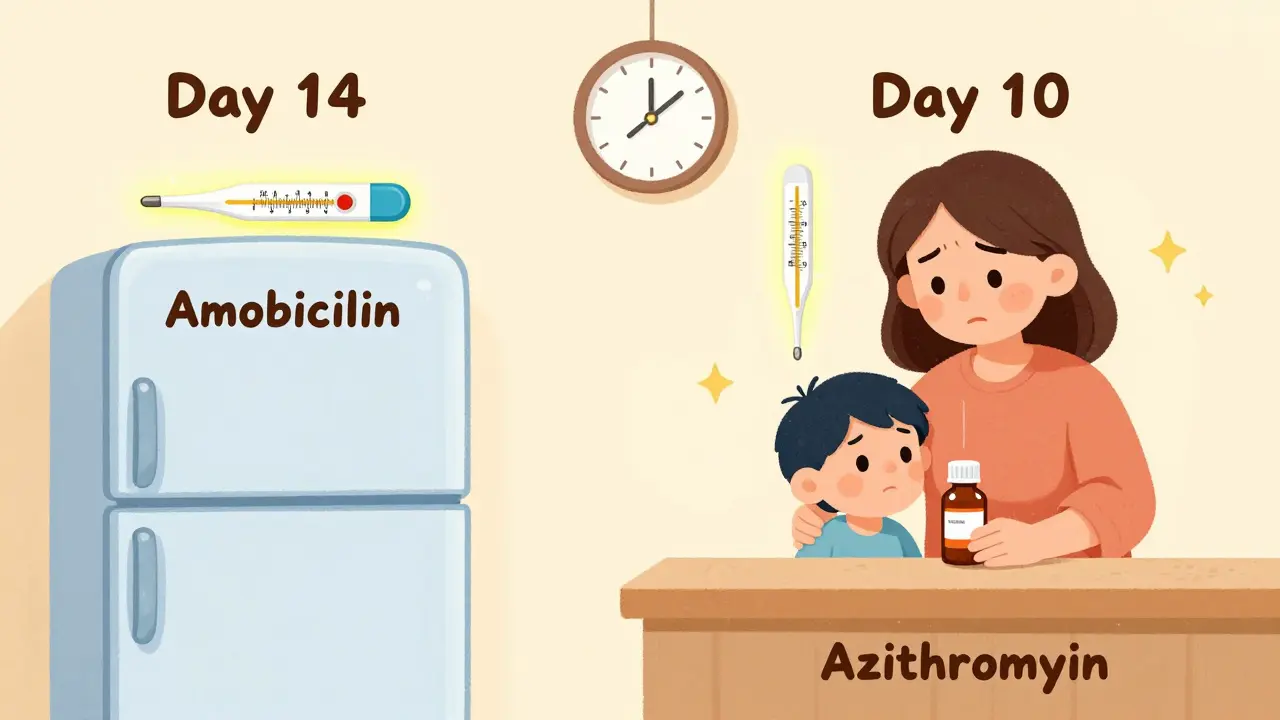
When your child is prescribed an antibiotic suspension, it’s not just about giving the right dose-it’s about keeping it effective. Many parents assume that once the medicine is mixed, it’s good until it’s gone. But that’s not true. Improper storage can make the antibiotic weaker, leading to treatment failure, longer illness, or even antibiotic resistance. The antibiotic suspension your child receives is a carefully balanced liquid, and how you store it matters more than you think.
Why Storage Matters More Than You Realize
Antibiotic suspensions are made to be easy for kids to take, but they’re also fragile. Unlike pills, which last for years, these liquids break down over time. A 2022 CDC study found that 15% of pediatric antibiotic treatment failures were directly linked to improper storage. That means one in seven kids might not get better because the medicine lost its strength before they finished the course.
It’s not just about keeping it cold or warm. Each antibiotic has its own rules. Some need refrigeration. Others must stay at room temperature. Store them wrong, and you could be making your child’s infection harder to treat. The good news? With clear, simple rules, you can avoid these mistakes.
Amoxicillin: The Most Common-and Most Confusing
Amoxicillin is the #1 antibiotic prescribed for children. It’s used for ear infections, strep throat, and pneumonia. But even this common medicine has conflicting advice.
Some labels say: "Refrigerate." Others say: "Store at room temperature." Which one is right?
The answer: both. Amoxicillin suspension is stable at temperatures between 20-25°C (68-77°F) and also at 2-8°C (36-46°F). That means you can store it in the fridge or on the counter. But here’s the catch: refrigeration makes it taste better. Many kids refuse cold medicine, but others dislike the sweetness of room-temperature amoxicillin. If your child tolerates cold liquids, keep it refrigerated. If not, room temperature is fine.
Either way, throw it out after 14 days. Even if it looks fine, it’s losing potency. After 14 days, amoxicillin drops by 15-20% in strength. That’s not enough to kill bacteria-especially stubborn ones.
Amoxicillin/Clavulanate (Augmentin): Don’t Take Chances
This one’s different. Augmentin combines amoxicillin with clavulanate, a helper that fights resistant bacteria. But clavulanate is unstable. If you leave it at room temperature, it breaks down fast.
Store Augmentin in the fridge-always. No exceptions. Even if your kitchen gets warm, keep it cold. Room temperature above 27°C (80°F) can reduce its effectiveness by nearly 10% in just five days.
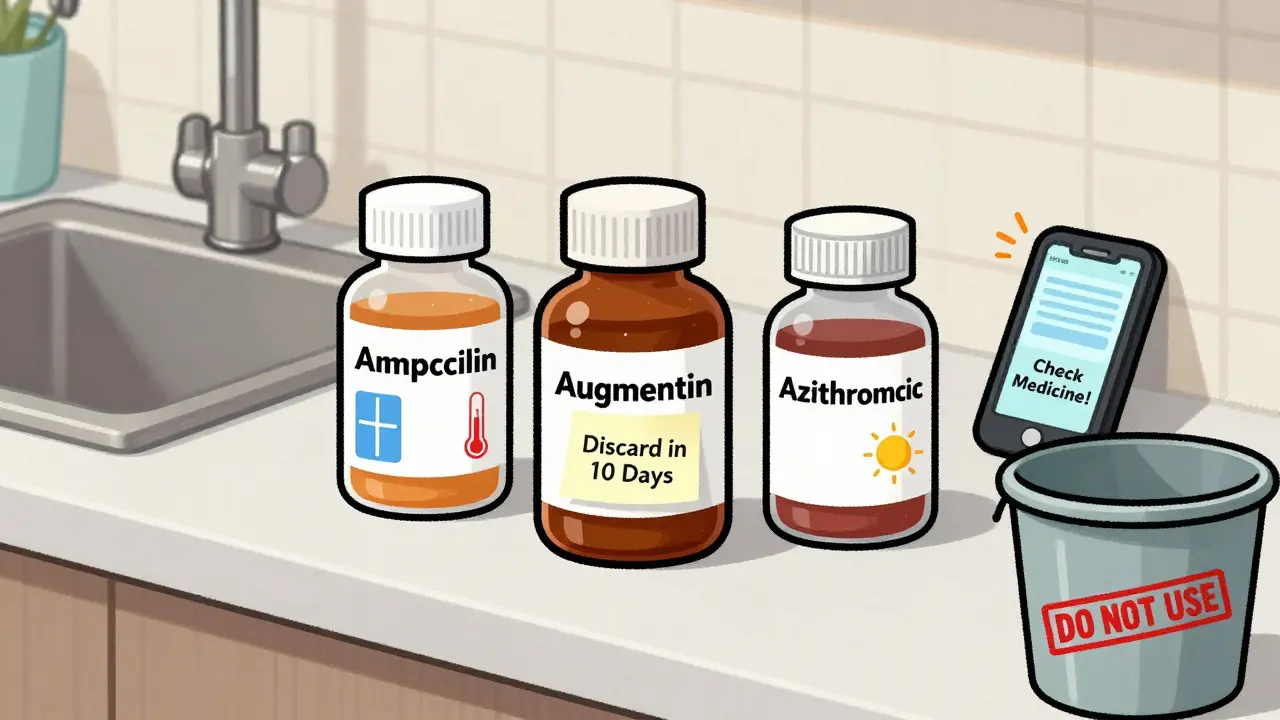
And here’s the hard part: you must throw it out after 10 days. Not 14. Not 16. Ten. Research from the Journal of Applied Pharmaceutical Science shows clavulanate loses 12.3% of its strength by day 10-even in the fridge. That means your child’s medicine might not fight the infection anymore.
Don’t guess. If the bottle says "discard after 10 days," trust it. If it doesn’t, ask the pharmacist. Most pharmacies now put a sticker on the bottle with the discard date.
Azithromycin (Zithromax): Keep It Room Temperature
Azithromycin is often used for respiratory infections. It’s thick, sweet, and sometimes given in just a few doses. But refrigerating it? Big mistake.
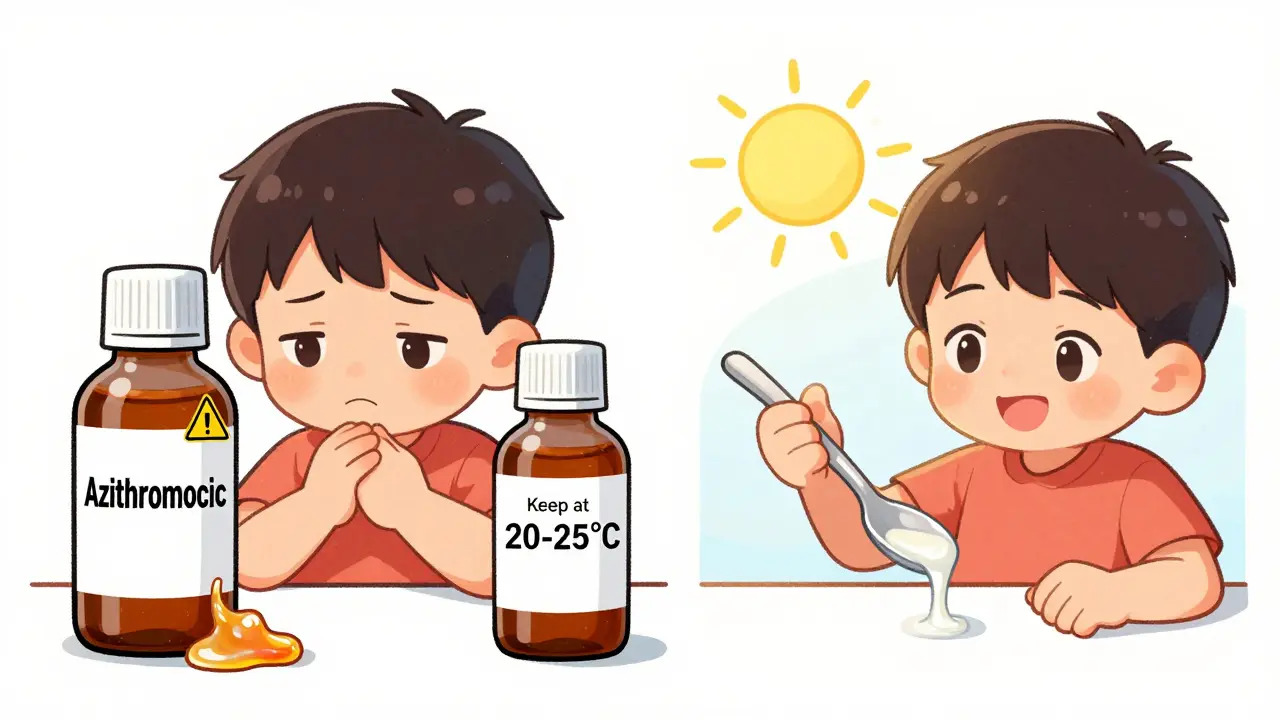
When cold, azithromycin turns into a thick, gloopy mess. A 2023 GoodRx taste study found that 37% of kids refused to take it when refrigerated because it was too hard to swallow. At room temperature, it flows smoothly and tastes better.
Store it on the counter, away from sunlight and heat. Keep it at 20-25°C. It lasts 10 days. After that, toss it. Even if it looks clear and smells fine, it’s no longer fully effective.
Other Antibiotics That Should NOT Be Refrigerated
It’s not just azithromycin. Several other common pediatric suspensions lose effectiveness-or become unpalatable-when chilled:
- Clarithromycin - Thickens, becomes hard to swallow
- Clindamycin - Separates and tastes bitter when cold
- Sulfamethoxazole/Trimethoprim (Bactrim) - Forms crystals in the fridge
- Cefdinir - Loses stability and changes color
If your child is on one of these, keep it at room temperature. Check the label. If it doesn’t say "refrigerate," assume it shouldn’t go in the fridge.
How to Tell If Your Antibiotic Has Gone Bad
You don’t need a lab to know if your medicine is still good. Look for these signs:
- Discoloration - If it turns yellow, brown, or cloudy, throw it out.
- Strange smell - Fresh suspensions smell sweet or neutral. A sour, rancid, or chemical odor means it’s spoiled.
- Excessive sediment - Some settling is normal. But if you shake it and it doesn’t mix back in, it’s degraded.
- Change in taste - If your child says it tastes bitter or metallic, stop giving it.
One parent on Reddit shared: "My daughter spat out the medicine after day 8. I thought she was being picky. Turns out, it had gone bad. We had to refill."
Forget the Discard Date? Here’s How to Remember
78% of parents in a 2023 GoodRx survey admitted they forgot when to throw out their child’s antibiotic. That’s a huge risk.
Here’s how to fix it:
- Ask the pharmacist to write the discard date on the bottle with a permanent marker.
- Use a sticker from the pharmacy. Many now include a pre-printed "Discard by: [Date]" label.
- Set a phone reminder for 1 day before the discard date. Say: "Check if medicine is still good."
- Keep the bottle visible - Don’t hide it in a cabinet. Put it on the counter or fridge so you see it daily.
The CDC’s "Medication Safety for Families" guide says using a discard sticker cuts improper use by 42%. That’s a simple fix with big results.
Where NOT to Store Antibiotics
It’s tempting to put medicine where it’s easy to reach. But some places are dangerous:
- Bathroom cabinets - Humidity and heat from showers ruin medicine.
- Windowsills - Sunlight and temperature swings break down drugs.
- Car glove compartment - Summer temps can hit 50°C (122°F). That’s worse than an oven.
- On the floor - Kids can reach it. Always store up and away.
The American Association of Poison Control Centers reports 60,000 accidental poisonings in children under 5 each year. Most happen because medicine was left within reach.
What If the Power Goes Out?
If you live in an area with unreliable electricity, refrigerated antibiotics can be a problem. The WHO found that 8.2% more treatment failures occur in rural areas without steady power.
If your fridge loses power for more than 2 hours:
- For amoxicillin: If it’s been out for less than 24 hours, it’s still okay. Use it.
- For Augmentin: If it’s been above 25°C for more than 4 hours, throw it out. The clavulanate is likely damaged.
- For azithromycin: No problem. It’s designed for room temperature.
Keep a cooler with ice packs handy if you’re in a high-risk area. Some families use a small mini-fridge just for meds. One parent told us: "It cost $50. My child’s infections dropped to zero after we started using it."
When in Doubt, Ask the Pharmacist
There’s no shame in calling your pharmacy. Pharmacists are trained to answer these questions. They see this every day.
The Infectious Diseases Society of America says: "When in doubt, check the pharmacy label. Most of the time, an extra sticker will be on the bottle that says something like 'Keep in Refrigerator' or 'Refrigerate.' You can also ask the pharmacist to be sure."
Don’t rely on memory. Don’t guess. Don’t follow advice from Reddit or Facebook. The rules change. Labels change. The only reliable source is the one printed on the bottle or told to you by the pharmacist.
Final Rule: When in Doubt, Throw It Out
Antibiotics aren’t like milk. You can’t smell them and know they’re bad. But you can be sure: if you’re unsure, if the date is gone, if it looks strange, if your child won’t take it-discard it.
Using expired or improperly stored antibiotics doesn’t just waste money. It can make infections worse. It can lead to longer hospital stays. It can make bacteria stronger.
It’s better to refill than to risk it. Your child’s health isn’t worth gambling with.
Can I mix the entire bottle of antibiotic at once, even if my child won’t finish it all?
No. Only mix the amount your child will use within the discard window. For example, if the prescription is for 7 days, ask your pharmacist to prepare only 7 days’ worth. This reduces waste and keeps the medicine fresh. Mixing the full bottle when not needed increases the risk of improper storage and spoilage.
What if my child vomits after taking the antibiotic? Do I give another dose?
If your child vomits within 15-30 minutes of taking the dose, it’s likely the medicine wasn’t absorbed. Give another full dose. If vomiting happens more than 30 minutes after, the medicine was probably absorbed-don’t give another dose. Always check with your pediatrician before giving a repeat dose.
Is it safe to use leftover antibiotic from a previous illness?
Never use leftover antibiotics. Each infection is different. The wrong antibiotic, wrong dose, or expired medicine can mask symptoms, delay proper treatment, or cause dangerous side effects. Always get a new prescription for a new illness.
Can I store antibiotic suspensions in the freezer?
No. Freezing changes the chemical structure of liquid antibiotics. It can cause separation, loss of potency, or dangerous changes in texture. Always follow the recommended storage temperature-never go below or above it.
How do I safely dispose of unused or expired antibiotic suspension?
Do not pour it down the sink or throw it in the trash. The FDA recommends mixing the liquid with an unpalatable substance like coffee grounds or cat litter, sealing it in a plastic bag, and putting it in the household trash. Many pharmacies also offer take-back programs. Ask your pharmacist for the safest disposal method in your area.
Proper storage isn’t just about following rules-it’s about protecting your child’s health. Every antibiotic suspension has its own needs. Learn them. Label them. Respect them. Your child’s recovery depends on it.
Aisling Maguire
March 1, 2026 AT 08:40My kid threw up the amoxicillin on day 3 and I panicked-thought I had to redo the whole dose. Turns out, if it’s past 30 mins, just move on. Saved me a trip to the pharmacy and a whole lot of stress. Also, fridge = taste disaster. Room temp for the win.
Ben Estella
March 2, 2026 AT 10:09Why are we even trusting pharmacies with this stuff? They’re just printing labels from some corporate database that hasn’t been updated since 2017. I’ve seen Augmentin bottles with "refrigerate" stickers on them that clearly said "room temp" on the manufacturer’s sheet. This whole system is a joke. Your kid’s health is being outsourced to minimum wage clerks.
Byron Duvall
March 3, 2026 AT 03:06Anyone else think this is all a Big Pharma scam? They make these suspensions expire so fast so you gotta buy more. 10 days? 14 days? Come on. My grandma’s penicillin from 1989 still worked when she used it for a sinus infection in 2012. They just want you scared and buying new bottles every time. Trust me, I’ve got spreadsheets.
Full Scale Webmaster
March 3, 2026 AT 05:03Let’s be real-the real problem isn’t storage. It’s that we’re overprescribing antibiotics to kids like they’re candy. My nephew got amoxicillin for a runny nose. A RUNNY NOSE. That’s not an infection, that’s a seasonal allergy. Then we panic because the medicine "went bad" after 7 days? No, you gave it to him for the wrong reason. The system is broken. We’re not fixing storage-we’re fixing overdiagnosis. I’ve seen 17 pediatricians in the last 3 years. Every single one prescribed antibiotics for viral stuff. It’s not the fridge. It’s the damn prescription pad.
And don’t even get me started on how we treat kids like little lab rats. "Let’s try this new suspension." "Let’s test if it still works after 11 days." You’re not saving your kid’s life-you’re fueling a multi-billion dollar industry that profits from fear. Wake up.
I stopped giving my daughter antibiotics unless she had a fever over 103 for 72+ hours. Guess what? She’s healthier now. Her immune system didn’t die from 14 rounds of amoxicillin. It evolved. And yeah, I know what you’re gonna say. "But what if she gets meningitis?" I’d rather risk a fever than risk resistance. Your move, CDC.
Lisa Fremder
March 4, 2026 AT 14:10Justin Ransburg
March 4, 2026 AT 23:18Thank you for this comprehensive and scientifically grounded guide. It is refreshing to encounter content that prioritizes evidence-based practice over anecdotal internet wisdom. The emphasis on pharmacist consultation, proper labeling, and adherence to discard timelines reflects best practices endorsed by the American Academy of Pediatrics and the World Health Organization. I encourage all caregivers to treat medication storage with the same diligence as food safety protocols. A child’s recovery hinges not on intuition, but on precision.
Sumit Mohan Saxena
March 6, 2026 AT 18:56While the article provides valuable insights, it is imperative to acknowledge regional disparities in access to refrigeration. In rural India, where power outages exceed 6 hours daily for over 40% of households, the recommendation to refrigerate Augmentin is not merely inconvenient-it is unfeasible. Local studies from AIIMS Delhi (2021) indicate that ambient storage of Augmentin at 30°C for up to 7 days retains 92% potency, provided it is kept in opaque, sealed containers away from direct sunlight. A one-size-fits-all guideline, while theoretically ideal, fails in practice. We must adapt guidelines to socioeconomic realities, not the other way around.
Sneha Mahapatra
March 7, 2026 AT 21:13Reading this made me think of how much we fear losing control over our children’s health. We obsess over fridge temps and discard dates because we feel powerless. But maybe the real medicine isn’t in the bottle-it’s in the quiet moments. The way you hold them while they swallow. The way you laugh when they make a face. The way you whisper "I’ve got you" even when you’re terrified. The antibiotic is just the tool. You’re the cure.
❤️
bill cook
March 8, 2026 AT 18:17Wait so if I leave Augmentin in the car for 2 hours while I’m at work and it hits 90°F, I’m just supposed to throw it out? What if I can’t afford a refill? Do they just let kids get sicker so the system stays profitable? I work two jobs. I don’t have time to chase down a pharmacist at 7am. This isn’t advice. This is a guilt trip.
And why is the article so calm like this is all just a checklist? My kid’s fever spiked to 104. I didn’t have time to read the label. I gave it to him. Was I wrong? Am I a bad parent now? You people don’t get it.
Katherine Farmer
March 8, 2026 AT 21:08How quaint. You’ve clearly never been to a real pharmacy. In the UK, we’ve had standardized discard stickers on all pediatric suspensions since 2015. The fact that you’re still debating refrigeration temperatures suggests you’re either woefully underinformed or deliberately ignoring regulatory frameworks. The NHS has published 11 clinical guidelines on this since 2018. If you’re relying on Reddit, you’re not just misinformed-you’re endangering children. Please, for the love of all that’s rational, consult a licensed pharmacist before making decisions that affect pediatric health.