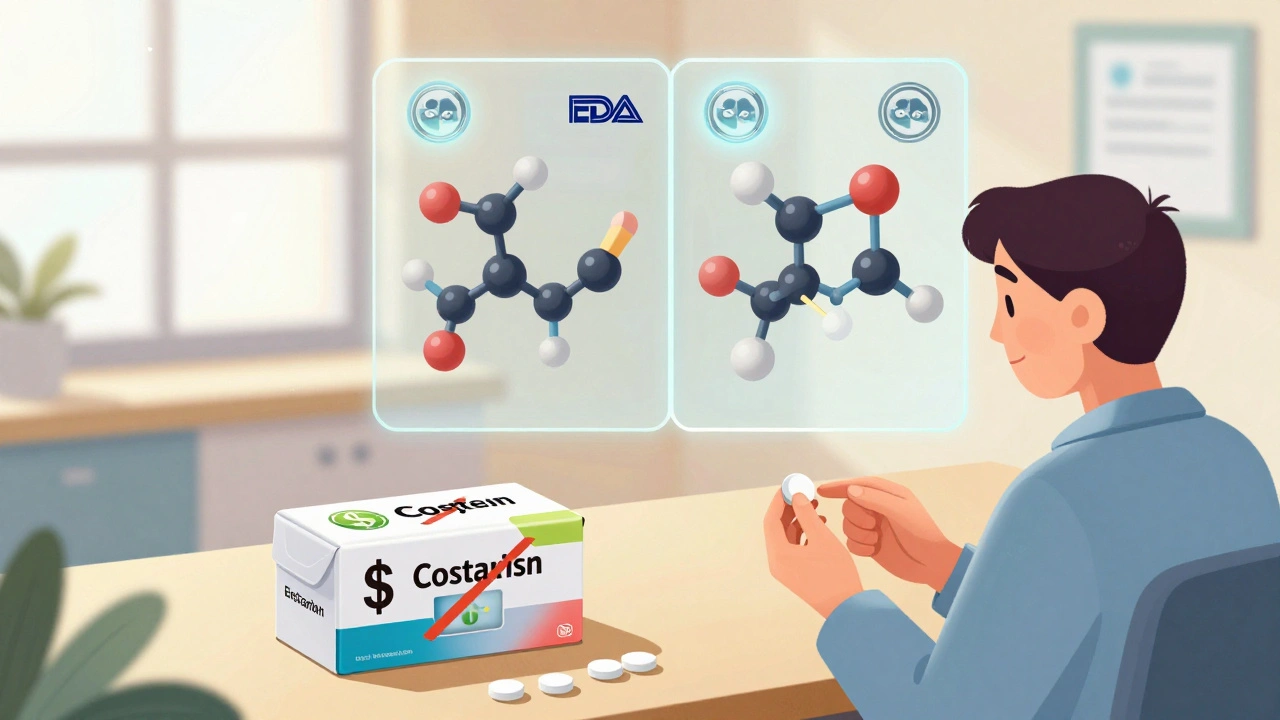
When you pick up a prescription for a generic drug, you might wonder: Is this really the same as the brand-name version? After all, it looks different, costs a fraction of the price, and doesn’t carry the same marketing hype. But here’s the truth: generic drugs aren’t just cheaper copies-they’re held to the same strict quality standards as brand-name drugs by the U.S. Food and Drug Administration (FDA). In fact, more than 90% of all prescriptions filled in the U.S. today are for generics, and they’ve saved the healthcare system $37 billion in 2022 alone.
What Makes a Generic Drug ‘Equivalent’?
The FDA doesn’t just approve any drug that looks similar to a brand-name product. For a generic to be approved, it must meet two key criteria: pharmaceutical equivalence and bioequivalence.
Pharmaceutical equivalence means the generic has the exact same active ingredient, strength, dosage form (like tablet, capsule, or injection), and route of administration (oral, topical, etc.) as the original. It also must be used for the same medical conditions. That’s non-negotiable. Even the labeling on the bottle must match in terms of indications and warnings.
But here’s where people get confused: inactive ingredients can be different. That’s why your generic pill might be white instead of blue, or shaped differently, or have a different filler. These don’t affect how the drug works. The FDA allows these changes because they don’t impact safety or effectiveness-just appearance and sometimes taste.
Bioequivalence is the real test. It means the generic drug must be absorbed into your bloodstream at the same rate and to the same extent as the brand-name drug. This isn’t guesswork. The FDA requires clinical studies, usually with 24 to 36 healthy volunteers, to measure blood levels over time. The key metrics are Cmax (peak concentration) and AUC (total exposure over time). The 90% confidence interval for both must fall between 80% and 125% of the brand-name drug’s values. If it’s outside that range, the FDA rejects the application.
How the FDA Tests Generic Drugs
The approval process doesn’t stop at blood tests. Every generic drug application-called an Abbreviated New Drug Application, or ANDA-must include detailed data on how the drug is made, stored, and tested.
Manufacturers must prove their product is stable. That means showing the drug doesn’t break down over time under normal storage conditions. This requires testing at room temperature for 12 to 24 months, plus accelerated tests at 40°C and 75% humidity for six months. If the drug degrades too quickly, it’s not approved.
Every batch of the drug is tested before it leaves the factory. That includes checking for identity (is it really the right drug?), strength (is there exactly 50mg of the active ingredient?), purity (is there no harmful contamination?), and quality (does it dissolve properly?). These tests follow standards set by the U.S. Pharmacopeia or methods the manufacturer has validated and submitted to the FDA.
For complex drugs-like inhalers, injectables, or topical creams-the rules get tougher. The FDA has created over 2,100 product-specific guidances for these cases. Why? Because you can’t just measure blood levels to prove an inhaler works the same. You need to test particle size, spray pattern, lung deposition, and even how the drug sticks to the device. These products require more than bioequivalence studies-they need advanced physical and chemical analysis.
Manufacturing Standards: No Exceptions
There’s no such thing as a ‘generic factory’ with lower standards. Every manufacturer-whether it’s a big pharma company or a small startup-must follow Current Good Manufacturing Practices (cGMP), codified in 21 CFR Parts 210 and 211. These rules cover everything: how raw materials are received and stored, how equipment is cleaned, how workers are trained, how production lines are monitored, and how finished products are tested.
The FDA inspects around 3,500 manufacturing sites every year-half of them overseas. And here’s something most people don’t know: about half of all generic drugs in the U.S. are made by the same companies that produce the brand-name versions. Often, they’re made in the same facility, on the same lines, just with different packaging. That’s not a loophole-it’s proof that quality isn’t tied to the brand name.
The Generic Drug User Fee Amendments (GDUFA), first launched in 2012 and renewed in 2022, give the FDA more funding and staff to review applications faster. Today, the goal is to review a complete ANDA in 10 months. In 2022, the FDA approved 892 original generic applications and issued 478 complete response letters-meaning those applications had issues that needed fixing before approval.

Why Some People Still Doubt Generics
Despite all the science, some patients report differences. You’ll hear stories on Reddit or from friends: “My generic seizure med didn’t work like the brand,” or “I switched my thyroid pill and felt off.”
These cases aren’t myths. They’re real-but rare. The most common issue involves drugs with a narrow therapeutic index-where even a small change in blood level can cause problems. Levothyroxine, used for thyroid disorders, is the classic example. A 2021 study in JAMA found that 12.3% of patients who switched between different generic versions needed a dose adjustment because their thyroid levels shifted.
That’s why the FDA recommends patients stay on the same generic brand if they’ve been stable on it. If you need to switch, your doctor should monitor your levels closely. But here’s the flip side: a 2022 Consumer Reports survey of 1,200 Americans found 89% were satisfied with their generic drugs, and 62% chose them specifically to save money.
On Reddit’s r/pharmacy thread from March 2023, 1,427 people shared their experiences. 83% said they noticed no difference between generic and brand-name drugs. The 17% who did notice issues mostly pointed to epilepsy or blood thinner medications-again, drugs where tiny changes matter.
The Bigger Picture: Cost, Access, and Trust
Generic drugs are the backbone of affordable healthcare. In 2022, they made up 90% of prescriptions but only 23% of total drug spending. That’s because a brand-name drug might cost $500 a month, while its generic costs $10. The savings aren’t just for patients-they’re for insurers, Medicare, Medicaid, and employers.
The U.S. generic drug market was worth $135.7 billion in 2022 and is projected to hit $180.3 billion by 2027. That growth isn’t accidental. It’s built on trust. The FDA’s Office of Generic Drugs, with 750 staff members, reviews every application with scientific rigor. Dr. Janet Woodcock, former director of the FDA’s drug center, put it plainly: “FDA-approved generic drugs have the same high quality, strength, purity and stability as brand-name drugs.”
The American Medical Association, the American Academy of Family Physicians, and other major medical groups have all confirmed this. They don’t just tolerate generics-they recommend them.
What’s changing now is how the FDA handles complex generics. The agency is investing $15.7 million in research to develop better testing methods for things like inhalers, patches, and injectables. They’ve held 18 public workshops with scientists and manufacturers to tackle these challenges. The goal? To make sure even the most complicated drugs meet the same gold standard.

What You Can Do
If you’re prescribed a generic drug, you can trust it. The system is designed to prevent substandard products from reaching you. But if you’re switching between generic brands and notice changes in how you feel-especially with thyroid, seizure, or blood thinner medications-talk to your doctor. Don’t assume it’s all in your head. Keep track of symptoms and ask for lab tests if needed.
And if you’re worried about cost, ask your pharmacist: “Is there a generic available?” In most cases, there is. And it’s just as safe as the brand.
Are generic drugs as safe as brand-name drugs?
Yes. The FDA requires generic drugs to meet the same strict standards for quality, strength, purity, and stability as brand-name drugs. Every generic must prove it’s bioequivalent-meaning it works the same way in your body. The same manufacturing rules apply to both.
Why do generic drugs look different from brand-name ones?
By law, generics can’t look exactly like the brand-name drug because of trademark rules. That’s why color, shape, and size can differ. But the active ingredient, dosage, and effectiveness are identical. The differences are only in inactive ingredients like dyes or fillers, which don’t affect how the drug works.
Can I trust generics made overseas?
Yes. The FDA inspects all manufacturing facilities-whether they’re in the U.S., India, China, or elsewhere-with the same standards. About half of all generic drugs sold in the U.S. are made overseas, and the FDA conducts thousands of inspections each year to ensure compliance. No drug is approved unless the facility passes inspection.
Why do some people say generics don’t work for them?
For most people, generics work just as well. But for drugs with a narrow therapeutic index-like levothyroxine, warfarin, or certain seizure medications-even small changes in blood levels can matter. If you switch between different generic brands and feel different, talk to your doctor. You may need a blood test to check your levels. But this doesn’t mean generics are unsafe-it means these specific drugs require close monitoring.
How does the FDA ensure generics stay safe after approval?
The FDA continues to monitor generic drugs after approval. They inspect manufacturing sites annually, review adverse event reports, and can recall products if quality issues arise. They also require manufacturers to submit ongoing stability data and notify the FDA of any changes to the manufacturing process. If a problem is found, the FDA can require testing, labeling changes, or even withdraw approval.
What’s Next for Generic Drugs?
The future of generics isn’t just about making more of the same pills cheaper. It’s about tackling harder problems. The FDA is now focusing on complex drugs-like biosimilars, long-acting injectables, and inhalers-that behave differently in the body. These aren’t simple chemical copies. They’re intricate systems, and proving equivalence takes more than blood tests.
That’s why the FDA is investing in new tools: better lab methods, advanced imaging, and real-world data collection. They’re also improving communication with manufacturers through the Pre-ANDA program, which lets companies get feedback before submitting a full application. This cuts down on delays and improves quality from the start.
One thing won’t change: the commitment to patient safety. Whether it’s a $5 tablet or a $500 inhaler, if it’s FDA-approved, it’s held to the same standard. You don’t need to pay more to get the same medicine. You just need to know the system works.
James Kerr
December 2, 2025 AT 06:41Love this breakdown. Seriously, I’ve been on generics for years and never had an issue. My blood pressure med? Same as the brand, half the price. Why pay more when the science says it’s the same?
sagar bhute
December 3, 2025 AT 19:31Stop lying to the public. The FDA is corrupt. I’ve seen generics that crumble in my hand. They cut corners overseas. This is a scam to make Big Pharma richer while we get junk.
Vincent Soldja
December 5, 2025 AT 08:02The data supports generic equivalence. Bioequivalence thresholds are rigorously enforced. Any anecdotal reports are statistically negligible.
Archie singh
December 7, 2025 AT 06:06Of course it’s the same. The FDA approves everything. You think they’re gonna let some Chinese factory ship poison to Americans? Wake up. This is propaganda.
shalini vaishnav
December 7, 2025 AT 19:25India makes 40% of the world’s generics. You think American standards apply there? Don’t be naive. Their labs are run by interns with no oversight. You’re playing Russian roulette with your thyroid.
vinoth kumar
December 9, 2025 AT 06:24I work in a pharmacy. People freak out over generic pills changing color. I show them the FDA’s bioequivalence reports and they’re shocked. Most don’t even know what AUC means. Knowledge is power.
bobby chandra
December 9, 2025 AT 23:08Generic drugs are the unsung heroes of American healthcare. While the rich buy branded luxury meds, the working class gets life-saving pills for a coffee price. This system? Brilliant. Fight for it.
Ignacio Pacheco
December 10, 2025 AT 22:56So let me get this straight - you’re telling me a pill made in a factory in Hyderabad that looks nothing like the original, costs 90% less, and has different fillers… is *exactly* the same? And I’m supposed to believe the math? Cool story.
Jim Schultz
December 12, 2025 AT 11:37Wait - you’re seriously citing a 2022 Consumer Reports survey? That’s a biased, low-sample, corporate-funded study. Meanwhile, the FDA’s own adverse event database shows a 27% spike in complaints for generic levothyroxine in 2021. Where’s your transparency?
Chloe Madison
December 14, 2025 AT 07:54As a clinical pharmacist with 18 years in the field - I can confirm: generics are safe, effective, and rigorously monitored. The FDA’s cGMP inspections are among the most stringent in the world. If your doctor recommends a generic - trust the science, not the fear.
Gene Linetsky
December 15, 2025 AT 03:47Did you know the same company that makes the brand-name drug also makes the generic? They just slap a different label on it. The FDA lets them do this because they’re all in bed together. You think that’s coincidence? It’s a monopoly.
Kidar Saleh
December 16, 2025 AT 06:48Coming from the UK, I’ve seen this debate for decades. The NHS relies on generics - and so do we. The science is clear. The fear is emotional. Don’t let marketing scare you out of saving money on medicine that works.
Cindy Lopez
December 17, 2025 AT 11:20For drugs with a narrow therapeutic index, switching between generic manufacturers can cause clinically significant fluctuations in serum levels. The FDA’s recommendation to maintain consistency is evidence-based and prudent.