
When you take a fiber supplement like Metamucil or Citrucel, you’re doing something good for your gut-lowering cholesterol, stabilizing blood sugar, keeping things regular. But if you’re also on daily medication, you might be accidentally making it less effective. Fiber doesn’t just help with digestion; it can also bind to drugs and sweep them out of your body before they have a chance to work. This isn’t speculation. It’s documented in medical journals and confirmed by experts at Harvard, Mayo Clinic, and WebMD.
Why Fiber Interferes With Medications
Fiber supplements don’t break down in your stomach or intestines. They pass through mostly unchanged, soaking up water, swelling up, and moving everything along faster. That’s great for constipation. But when a pill and a fiber capsule land in your gut at the same time, the fiber can trap the drug like a sponge soaking up liquid. This is called adsorption. The drug sticks to the fiber particles instead of being absorbed into your bloodstream. Some fibers also speed up how fast food and pills move through your intestines. If your body doesn’t have enough time to absorb the medication, you end up with less of it in your system. That’s dangerous if you’re taking something with a narrow therapeutic window-where even a small drop in dose can make the drug useless or cause side effects. Studies show this happens with thyroid meds like levothyroxine. One study of 13 hypothyroid patients found that taking fiber supplements with their thyroid pill led to a drop in drug absorption. Their LDL cholesterol went up-because their thyroid wasn’t working right. Another study found that ispaghula husk (a type of psyllium) reduced levothyroxine absorption by just 9%, which researchers called minor. But others saw bigger drops. The bottom line? You can’t predict how your body will react. So don’t risk it.Which Medications Are Most at Risk?
Not all drugs are affected the same way. Some are barely touched by fiber. Others? Big problems.- Levothyroxine (Synthroid, Levoxyl): This is the most well-documented case. Even small drops in absorption can throw your thyroid levels off. You might feel tired, gain weight, or get depressed-all signs your dose isn’t working.
- Metformin: Used for type 2 diabetes. Fiber can slow its absorption, which sounds good-but it can also make blood sugar control unpredictable. Doctors recommend separating them by at least 2 to 4 hours.
- Lithium: Used for bipolar disorder. Fiber can lower lithium levels, which could trigger mood swings or relapse. This isn’t something to guess about.
- Olanzapine (Zyprexa): An antipsychotic. One study showed reduced absorption when taken with psyllium.
- Carbamazepine: An anti-seizure and mood stabilizer. Fiber can interfere with its absorption, increasing seizure risk.
- Statins like lovastatin: One study found pectin fiber raised LDL cholesterol in patients taking this drug, meaning the statin wasn’t working as well.
What About Common Drugs Like Blood Pressure or Cholesterol Meds?
Good news: not all medications are affected. Drugs like clopidogrel (Plavix) and rosuvastatin (Crestor) can be taken with meals-even high-fiber ones-without issue. That’s because they’re absorbed in different parts of the gut or through different mechanisms. But here’s the catch: fiber supplements aren’t the same as eating broccoli or oatmeal. A bowl of bran cereal gives you maybe 5 grams of fiber. A single dose of Metamucil gives you 3 to 5 grams-concentrated, fast-acting, and designed to move through your system quickly. That’s why doctors treat supplements differently than food.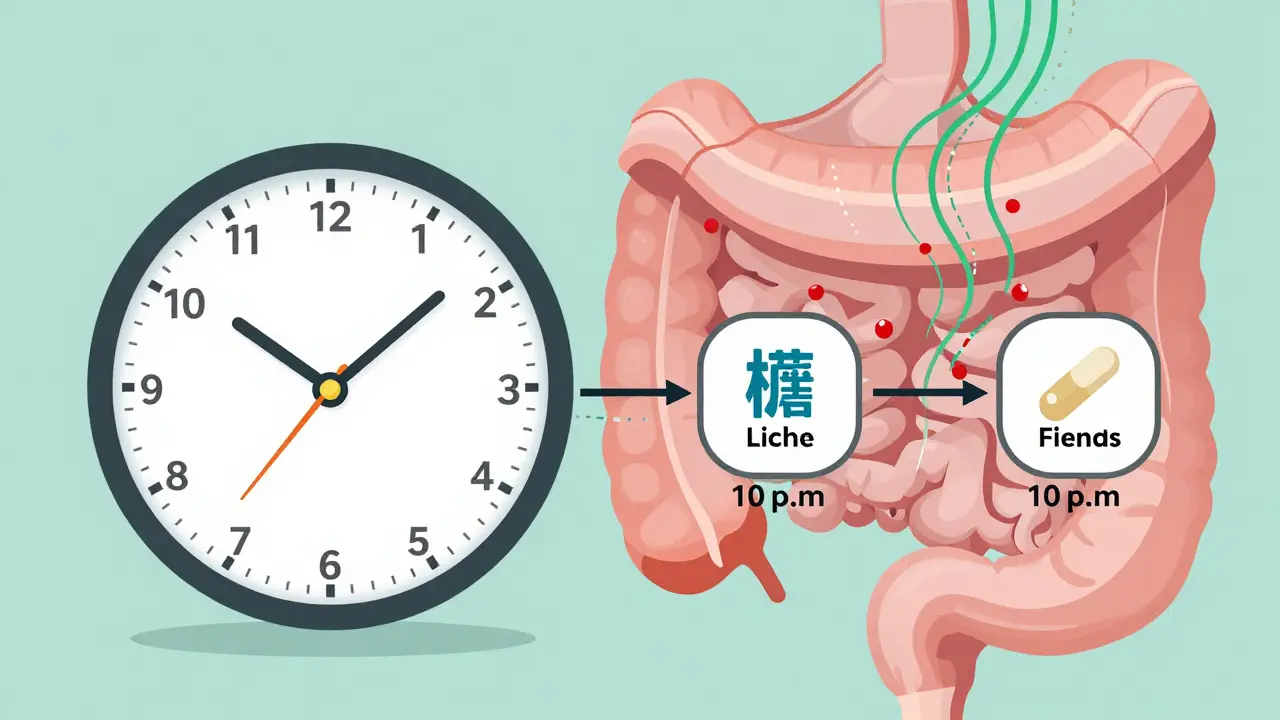
How Far Apart Should You Take Them?
This is the most important part. The answer isn’t vague. Experts agree: take fiber supplements at least 2 to 4 hours before or after your medication.- Harvard Health says: “Take your medication two to three hours before or after your fiber supplement.”
- WebMD states: “Take fiber products at least 2 hours from your other medications.”
- FreeRX Blog recommends 4 hours after for lithium, metformin, and olanzapine.
- Mayo Clinic confirms that fiber supplements can reduce absorption of thyroid, diabetes, and depression meds-and says timing is key.
- If you take your thyroid pill first thing in the morning on an empty stomach, wait until at least 10 a.m. or later to take your fiber supplement.
- If you take your metformin with dinner, don’t take your fiber at night. Wait until the next morning.
- If you prefer to take fiber at bedtime, avoid taking any meds within 4 hours of sleep. Fiber can cause bloating and gas-and that’s not great for sleep.
What About Fiber From Food?
Eating a salad, an apple, or a bowl of oatmeal won’t usually cause the same problems. Why? Because the fiber is mixed with other nutrients and water, and it moves through your system more slowly. Your body has time to absorb medications before the fiber kicks in. That said, if you’re eating a massive high-fiber meal-like a giant bowl of bran with beans, nuts, and berries-and you take your thyroid pill with it? You’re still at risk. The rule of thumb: if you’re eating a meal with more than 10 grams of fiber, treat it like a supplement. Wait 2 hours before or after taking meds.How to Make This Easy
You don’t need to remember complex rules. Just build a simple routine.- Morning: Take your thyroid pill or other critical meds on an empty stomach. Wait 2-3 hours. Then have breakfast with fiber-rich food. Take your fiber supplement after lunch.
- Evening: If you take metformin or lithium at night, take your fiber supplement in the morning. Don’t mix them.
- Always drink water: Fiber needs water to work safely. Take your supplement with at least 8 ounces of water. Otherwise, it can swell in your throat and cause choking.

Don’t Stop Taking Fiber
This isn’t a reason to quit fiber. In fact, you should keep taking it. The benefits are huge: lower heart disease risk, better blood sugar control, reduced stroke risk. Most Americans get only 15 grams of fiber a day. Women over 50 need 21 grams. Men need 30. You’re probably not getting enough. The trick isn’t avoiding fiber. It’s timing it right. Fiber supplements are tools-not enemies. Used correctly, they help you live longer and feel better. Used carelessly, they can undo your medication.What If You Forgot and Took Them Together?
If you accidentally took your thyroid pill with your Metamucil, don’t panic. One mistake won’t ruin your treatment. But don’t make it a habit. If you take a medication with a narrow therapeutic index-like levothyroxine, lithium, or carbamazepine-tell your doctor. They may want to check your blood levels sooner than usual. For most other drugs, just reset your schedule. Take your next dose at the right time, and keep them separated going forward.Final Tip: Talk to Your Pharmacist
Pharmacists are the unsung heroes of medication safety. They see hundreds of drug interactions every day. Bring them your full list of meds and supplements. Ask: “Which of these could be affected by fiber?” They’ll tell you exactly what to avoid and what’s safe. No guesswork. No risk.Can I take fiber supplements with my multivitamin?
It’s safer to separate them. Fiber can bind to minerals like calcium, iron, and zinc, reducing their absorption. Take your multivitamin at least 2 hours before or after your fiber supplement.
Is psyllium the worst fiber for drug interactions?
Psyllium (found in Metamucil) is one of the most common culprits because it’s widely used and highly absorbent. But other fibers like oat bran and soy fiber have also been shown to interfere. The type matters less than the timing-separating by 2-4 hours works for all.
Can I take fiber at night instead of in the morning?
Yes, but only if you’re not taking any meds within 4 hours of bedtime. Fiber can cause bloating and gas, which may disrupt sleep. If you take thyroid meds in the morning, nighttime fiber is fine. If you take metformin or lithium at night, avoid fiber then.
Do fiber gummies cause the same problems?
Most fiber gummies contain very little fiber-often less than 3 grams per serving. They’re unlikely to cause major interactions. But if you’re on a critical medication like levothyroxine, it’s still safer to separate them by a few hours. Don’t assume gummies are harmless just because they’re chewable.
What if I only take fiber once a week?
Even occasional use can interfere if you take your medication at the same time. One study showed reduced levothyroxine absorption even with a single dose of psyllium. If you’re on a medication that’s sensitive to absorption, treat every fiber dose like a potential interaction-no matter how rare.
Jane Wei
December 17, 2025 AT 20:47So I just took my Metamucil with my levothyroxine yesterday. Didn’t think it mattered. Now I’m dizzy and exhausted. Thanks, internet.
Radhika M
December 19, 2025 AT 00:47Hi dear, in India we take psyllium with milk at night. But if you on thyroid medicine, wait 4 hours. Simple. No problem. Drink water. Easy life.
Josh Potter
December 19, 2025 AT 16:29Bro. I take fiber gummies with my coffee and call it a day. If your meds are that fragile, maybe you’re on the wrong meds. Just saying.
Linda Caldwell
December 20, 2025 AT 18:23I’ve been taking my fiber at 3pm and my levothyroxine at 6am for 8 years. My TSH is perfect. Your body isn’t a lab rat. Trust your rhythm, not some algorithm.
amanda s
December 21, 2025 AT 20:01THIS IS WHY AMERICA IS FALLING APART. PEOPLE CAN’T EVEN TAKE A PILLS RIGHT. I SAW A GUY AT WALMART SWALLOW HIS METAMUCIL WITH HIS BLOOD PRESSURE MEDS. HE WAS SMILING. SMILING. WHAT IS THIS WORLD.
Kent Peterson
December 21, 2025 AT 21:32Harvard, Mayo, WebMD-three sources that also told us hydroxychloroquine was a miracle cure. Let’s not worship institutions that flip-flop on everything. The real issue? Pharma wants you dependent. Fiber’s cheap. Pills? Not so much.
Philippa Skiadopoulou
December 23, 2025 AT 16:58Separation of two to four hours is clinically supported. The mechanism is well documented in pharmacokinetic studies. No need for speculation.
CAROL MUTISO
December 25, 2025 AT 07:53It’s funny how we treat fiber like a villain when it’s just doing its job-cleaning house. We’re the ones who overdosed on pills and underfed our guts. Maybe the problem isn’t the fiber… it’s that we expect one pill to fix everything we broke with processed food, stress, and sleep deprivation.
Also, I take my fiber at night and my thyroid med at dawn. My poop is beautiful. My TSH is stable. My therapist says I’m ‘in alignment.’
Also, I once took them together. My heart raced for an hour. I cried. Then I laughed. Then I made a salad. Life goes on.
Jonathan Morris
December 26, 2025 AT 09:24Who funds these studies? Big Pharma owns WebMD. They want you to believe fiber is dangerous so you keep buying pills. They don’t want you healing naturally. The real enemy is not psyllium-it’s the medical-industrial complex.
Martin Spedding
December 26, 2025 AT 20:18took fiber n med together… woke up feelin like a zombie. oops. learnin the hard way. lol.
Pawan Chaudhary
December 27, 2025 AT 22:22Hey, I’m from India and I’ve been taking fiber with my metformin for years-no issues! Maybe everyone’s body is different? Just keep drinking water and stay positive!
Jessica Salgado
December 29, 2025 AT 15:36I used to take my fiber at night until I started having panic attacks at 2 a.m. Turns out, bloating + anxiety + a full colon = nightmare fuel. Now I take it after lunch. Best decision ever. Also, thank you for writing this. I didn’t know gummies were low-risk.
Anna Giakoumakatou
December 30, 2025 AT 02:36Oh wow. So the solution to modern medicine’s failure is… timing? How poetic. We’ve outsourced our biology to a clock and now we’re supposed to be grateful for the privilege of scheduling our survival. Bravo, science. Bravo.