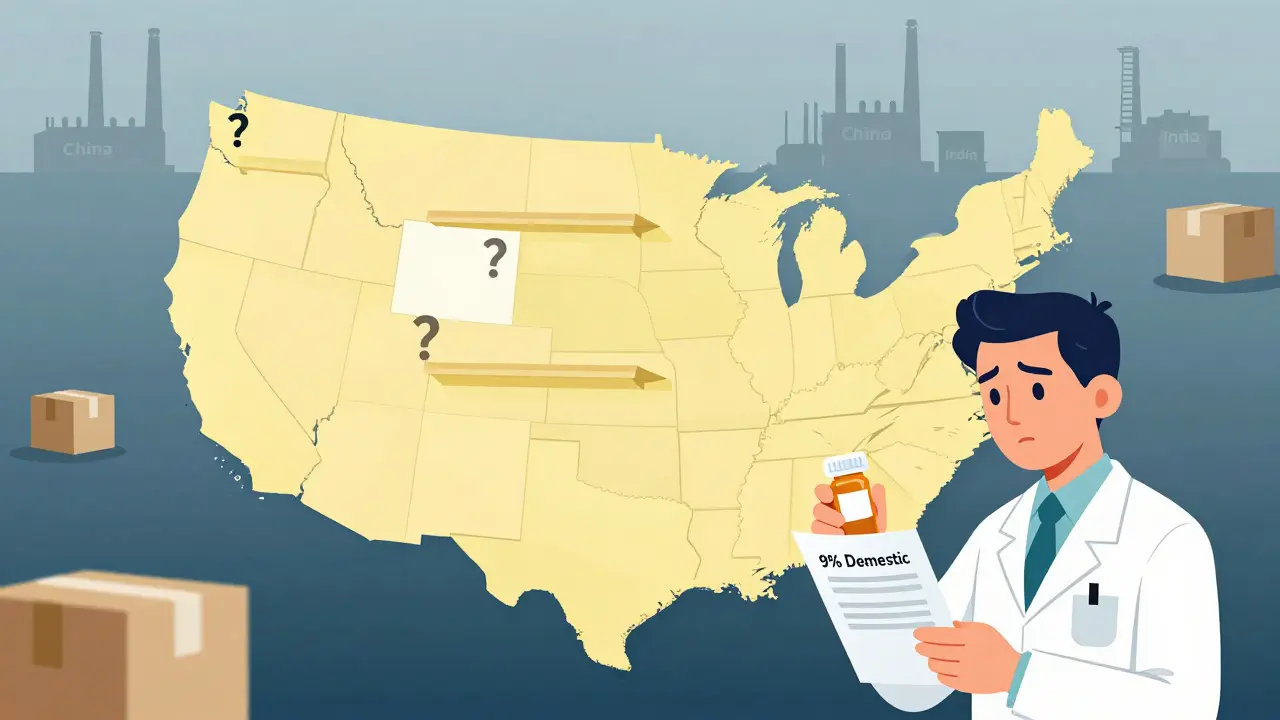
The way the U.S. Food and Drug Administration (FDA) approves generic medications has shifted dramatically between 2023 and 2025. If you are a manufacturer, a pharmacist, or just someone worried about medication costs, these changes matter. The core problem was simple but dangerous: the United States relied too heavily on foreign countries for its medicine supply. By 2025, only 9% of active pharmaceutical ingredient (API) manufacturers were located in the U.S., while China held 22% and India held 44%. More than half of all pharmaceuticals distributed in America were made overseas.
This vulnerability became a national security issue. In response, the FDA launched its most comprehensive overhaul of the Abbreviated New Drug Application (ANDA) pathway since 2012. The goal? To speed up approvals for generics made in the U.S. and to bring more production home. This article breaks down exactly what changed, who benefits, and what it means for your wallet and your pharmacy shelf.
The ANDA Prioritization Pilot Program Explained
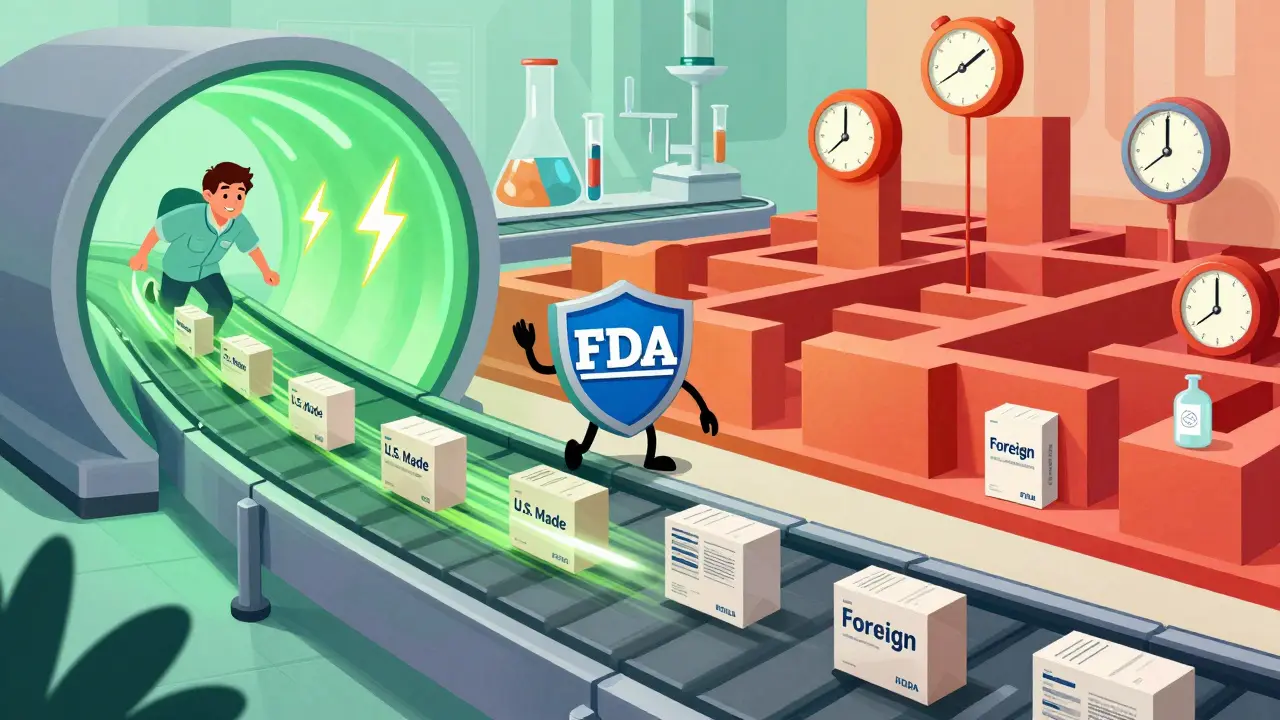
In October 2025, the FDA announced the ANDA Prioritization Pilot Program. This is not just a minor tweak; it is a strategic lever designed to reward companies that manufacture and test their drugs within the United States. Under this program, applications for generic drugs get expedited review timelines if they meet specific domestic criteria.
Why did the FDA do this? Dr. George Tidmarsh, Director of the FDA’s Center for Drug Evaluation and Research, noted that foreign inspections take 47% more preparation time and cost 32% more than domestic ones. By prioritizing U.S.-based operations, the agency aims to cut red tape and secure the supply chain. The program operates under Manual of Policies and Procedures (MAPP) 5240.3, which sets clear rules for who gets priority.
Here is how the prioritization works:
- Tier 1: Requires 100% U.S. manufacturing and testing. These applications target an 8-month review cycle, compared to the standard 12-15 months.
- Priority Focus: Applications for drugs on the FDA’s Drug Shortage List (which had 147 medications as of September 2025) and essential medicines identified by the Department of Health and Human Services (HHS) get extra attention.
- Eligibility Requirements: Manufacturers must prove their U.S. facilities comply with Current Good Manufacturing Practices (CGMP). They also need to conduct bioequivalence testing at FDA-registered labs and source APIs from U.S. facilities or those validated as equivalent to U.S. standards.
The results have been stark. Pilot-eligible applications receive initial reviews within 30 days, versus 60-90 days for standard submissions. Complete response letters are issued within 45 days instead of 120. The FDA estimates this cuts review times by 35-40% for qualifying apps.
First Generic Approvals: Speeding Up Competition
One of the biggest wins for consumers is the surge in first generic drug approvals. When a brand-name drug loses its patent, the first generic approved can slash prices significantly. The FDA maintained strong momentum here through mid-2025, approving nine first generic drugs including Ivermectin Tablet, Nimodipine Solution, and Azilsartan Medoxomil and Chlorthalidone Tablet.
Data from GoodRx shows that biosimilar and first generic approval numbers in 2025 were pacing 18.7% ahead of 2024’s trajectory. Meanwhile, novel drug approvals fell slightly behind 2024 by about 7.3%. This shift indicates a regulatory focus on getting cheaper alternatives to market faster rather than pushing new, expensive innovations.
What does this mean for prices? On average, prices drop by 78.3% within six months of the first generic entry compared to branded equivalents. For patients paying out-of-pocket, this is life-changing. For insurers and Medicare, it reduces overall spending.
Domestic vs. Foreign Manufacturing: The Trade-Offs
Moving production to the U.S. isn’t free. There are real advantages and disadvantages for manufacturers participating in the pilot.
| Factor | Pilot Program (U.S. Based) | Traditional Path (Foreign Based) |
|---|---|---|
| Time-to-Market | Average 11.2 months | Average 15.6 months |
| Approval Success Rate | 92% (fully domestic supply chains) | 68% (foreign components) |
| Initial Capital Investment | $120-180 million for medium-scale facility | Lower upfront costs |
| Per-Application Cost Add-on | $1.2-1.8 million for validation | Standard fees |
| Cost Advantage | Higher margin potential for small-volume drugs | 25-30% cost advantage for high-volume, low-cost generics |
The data shows that domestic manufacturing leads to faster time-to-market (28% faster) and fewer major deficiency letters (41% reduction). However, the capital investment is steep. A medium-scale generic production facility costs $120-180 million to establish. For high-volume, low-cost generics, foreign manufacturing still holds a 25-30% cost advantage. The pilot works best for small-volume, high-margin generics where domestic economics make sense.
Expert Opinions and Market Impact
Experts see both promise and peril in these changes. Dr. Rachel Sherman, former FDA Principal Deputy Commissioner, argued in January 2025 that the pilot is a "necessary recalibration" to fix supply chain vulnerabilities. But she warned it risks fragmenting the global ecosystem that has kept costs low for years.
Safety remains a top concern. Scott Brunner, CEO of the Alliance for Pharmacy Compounding, cautioned that deregulation efforts must not compromise patient safety, specifically regarding bioequivalence standards. On the clinical side, Dr. Aaron Kesselheim from Harvard Medical School published research in March 2025 showing that accelerated approvals maintained equivalent therapeutic outcomes. His study found a 95% confidence interval of 0.97-1.03 for primary efficacy endpoints, meaning patients got the same benefit regardless of the speed of approval.
However, there is a price tag for this resilience. The Medicare Payment Advisory Commission (MedPAC) estimated in June 2025 that domestic manufacturing requirements could increase generic drug costs by 12-18% initially. They project these costs will normalize after 3-5 years as domestic capacity scales up. The U.S. generic pharmaceutical market grew to $117.3 billion in 2024, a 6.2% year-over-year increase. First generics captured 18.7% of this market within six months of approval.

Challenges for Manufacturers
If you are running a generic pharma company, the transition is tough. Teva Pharmaceuticals reported that the 30-day initial review window helped them bring nimodipine solution to market eight months faster than projected. But they also cited significant hurdles in qualifying domestic API suppliers for complex formulations.
Smaller companies feel the pressure more. A survey by the Association for Accessible Medicines (AAM) of 127 manufacturers revealed that while 54% initiated domestic facility expansions, 31% delayed product developments due to transition costs. Documentation is another pain point. Verifying domestic compliance takes an average of 217 hours per application. The FDA’s technical assistance team has fielded over 1,200 inquiries since the pilot launch, with 78% related to API sourcing verification.
Common challenges include:
- API Quality Consistency: Cited in 67% of deficiency letters.
- Bioequivalence Study Design: Particularly difficult for complex generics (43% of issues).
- Stability Testing Protocols: Account for 38% of delays.
Despite these headaches, documentation quality improved. The FDA’s 2025 mid-year report noted a 41% reduction in major deficiencies related to manufacturing documentation compared to 2024. The learning curve averages 4-6 months for companies switching from foreign to domestic models.
Future Outlook: What Comes Next?
The FDA isn’t stopping here. Starting January 2026, the pilot program expands to include complex generics like nasal sprays, ophthalmic suspensions, and transdermal patches. Specific guidance for these categories is expected in November 2025. Additionally, the agency is implementing AI-assisted review protocols, promising a further 25% reduction in review times for pilot applications.
Long-term projections look optimistic for supply chain security. The FDA projects domestic API manufacturing will rise from 9% to 23% by 2028. The Congressional Budget Office estimates the program will become cost-neutral to taxpayers by 2027, with net savings of $4.2 billion annually by 2030 due to reduced drug shortages. However, international trade tensions loom. The European Generic Medicines Association filed a formal inquiry in July 2025 regarding WTO trade compliance, suggesting potential legal battles ahead.
For now, the strategy is clear: incentivize local production to prevent shortages, even if it means short-term cost increases. As the Pharmaceutical Supply Chain Resilience Act of 2025 moves through Congress, expect these policies to solidify into long-term law.
Will generic drug prices go up because of these new FDA rules?
Initially, yes. MedPAC estimates a 12-18% increase in costs as manufacturers absorb the higher expenses of U.S. production. However, these prices are expected to normalize over 3-5 years as domestic capacity grows and competition increases. Long-term, the goal is to stabilize supply and prevent emergency procurement costs associated with drug shortages.
What is the ANDA Prioritization Pilot Program?
It is an FDA initiative launched in October 2025 that offers expedited review timelines for generic drug applications manufactured and tested in the United States. It aims to strengthen domestic supply chains by rewarding companies that reduce reliance on foreign production, offering review cycles as fast as 8 months for fully domestic operations.
Are generic drugs approved under the pilot safe?
Yes. Research published in JAMA Internal Medicine by Dr. Aaron Kesselheim showed that accelerated approvals maintained equivalent therapeutic outcomes to traditionally approved generics. The FDA maintains strict bioequivalence standards, and the pilot focuses on speeding up administrative reviews, not cutting corners on safety testing.
Which drugs are prioritized for faster approval?
The FDA prioritizes applications for drugs currently on the Drug Shortage List and essential medicines identified by the Department of Health and Human Services. As of September 2025, there were 147 medications on the shortage list. Fully domestic manufacturing (Tier 1) also receives the fastest processing speeds.
How does this affect small generic manufacturers?
Small manufacturers face significant challenges. While 28% participated in the pilot, many cited immediate cost pressures. Establishing U.S. manufacturing requires massive capital ($120-180 million for medium facilities). Consequently, 31% of surveyed manufacturers delayed certain product developments due to these transition costs, though smaller companies often find better margins in niche, high-value generics.