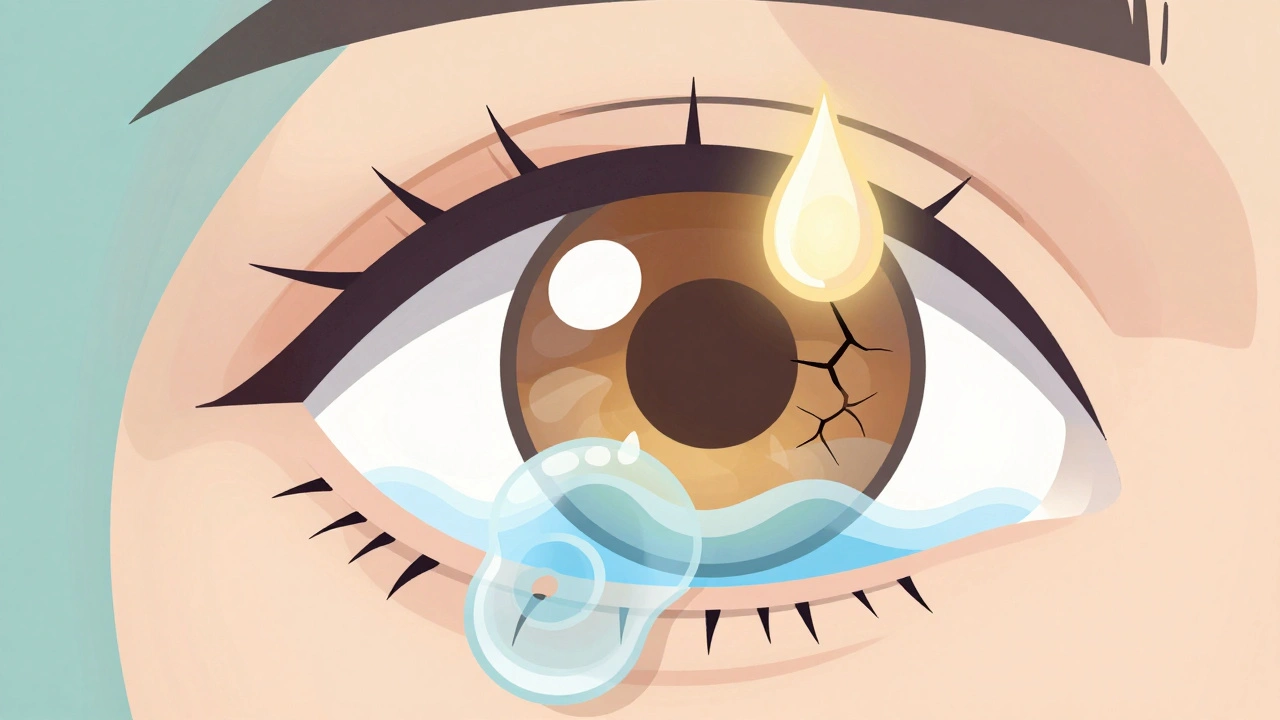
When your eyes feel gritty, burning, or like there’s sand in them-even when you’re crying-it’s not just irritation. It’s dry eye syndrome, a condition more common than most people realize. You might think it’s just from staring at screens too long, but the truth is deeper. Your eyes aren’t dry because they’re not making tears. They’re dry because the tears they make don’t work right.
What’s Really Going On With Your Tears?
Your tears aren’t just water. They’re a three-layered film that keeps your eyes smooth, clear, and protected. The outermost layer is oil, made by tiny glands in your eyelids. It stops tears from evaporating too fast. The middle layer is water-this is what actually hydrates your eye. The innermost layer is mucus, which helps the water stick to your eye’s surface. If any part of this system fails, your eyes suffer. There are two main types of dry eye. The first is aqueous tear-deficient dry eye (ADDE). This happens when your lacrimal glands don’t make enough watery fluid. It’s less common, affecting only about 10-15% of people with dry eye. It’s often linked to aging, autoimmune diseases like Sjögren’s syndrome, or medications like antihistamines. The second, and far more common, is evaporative dry eye (EDE). This accounts for 85-90% of cases. Here, your oil layer is broken down-usually because your meibomian glands are clogged. Without that oil, your tears evaporate in under 10 seconds. Normal tear breakup time is 15-35 seconds. When it drops below 10, your eyes start to burn.Why Artificial Tears Are the First Line of Defense
For most people, artificial tears are the go-to fix. They’re not a cure, but they’re the easiest way to get relief. These drops mimic your natural tear film, replacing what’s missing. But not all artificial tears are the same. Some are just saltwater. Others include thickening agents like carboxymethylcellulose or hyaluronic acid to help the drops stay on your eye longer. Hyaluronic acid at 0.15% can give you up to 4.2 hours of relief, while plain saline might only last 2.5 hours. Preservatives matter too. Most bottles contain benzalkonium chloride (BAK) to keep them sterile. But if you’re using drops more than four times a day, BAK can irritate your eyes and even damage the surface over time. That’s why preservative-free single-dose vials are better for frequent users. A 2020 study found that using BAK-containing drops more than 11 times a day increases the risk of corneal damage.Artificial Tears Don’t Work the Same for Everyone
If you have aqueous deficiency-your body isn’t making enough water-then artificial tears with high water content help a lot. They replace what’s missing. But if you have evaporative dry eye, water alone won’t fix it. You need oil. Some newer formulas now include lipid-based ingredients to rebuild that protective barrier. Brands like Systane Balance and Soothe XP are designed for this. But most over-the-counter drops still focus on water, which is why so many people say, “They help for a few minutes, then I’m back to square one.” User reviews on Amazon and Reddit back this up. One person with post-LASIK dry eye found relief only with preservative-free Refresh Relieva. Another switched from standard drops to Retaine HPMC and could finally wear contacts for 8 hours. But 38% of users report blurred vision right after applying drops. That’s because the formula hasn’t spread evenly yet. Wait five minutes before blinking hard or rubbing your eyes.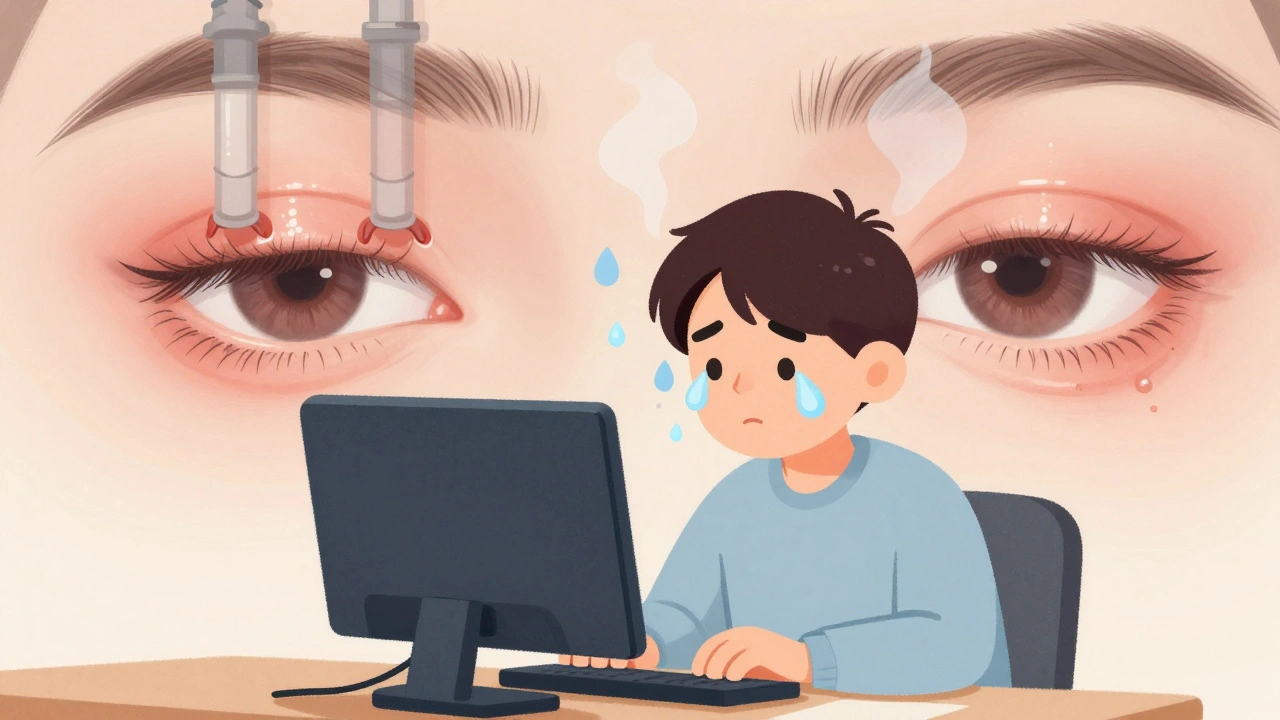
How to Use Artificial Tears the Right Way
Most people use them wrong. They tilt their head back too far, squeeze the bottle hard, and drop two or three drops at once. That’s unnecessary-and wasteful. One drop is enough. Here’s the correct method:- Tilt your head back slightly, looking up.
- With one finger, gently pull down your lower eyelid to make a small pocket.
- Hold the bottle 1 cm above your eye-don’t let it touch your eyelid or lashes.
- Squeeze gently so one drop falls in.
- Close your eye for 30 seconds. Gently press the inner corner of your eye (near your nose) to keep the drop from draining away too fast.
When Artificial Tears Aren’t Enough
If you’re using drops four or more times a day and still feel gritty, burning, or like your vision is foggy, it’s time to see a specialist. Artificial tears don’t treat inflammation. And dry eye isn’t just about dryness-it’s an inflammatory disease. High tear osmolarity (above 308 mOsm/L) triggers immune responses that damage your eye surface. That’s why some patients need prescription drops like cyclosporine (Restasis) or lifitegrast (Xiidra). These reduce inflammation and help your body make more natural tears over time. In 2023, the FDA approved Eysuvis, a new drop for short-term flare-ups. It works in as little as 15 minutes. For people with severe aqueous deficiency, a device called TrueTear uses gentle electrical pulses to stimulate tear production. It’s not for everyone, but it’s a breakthrough for those who don’t respond to drops.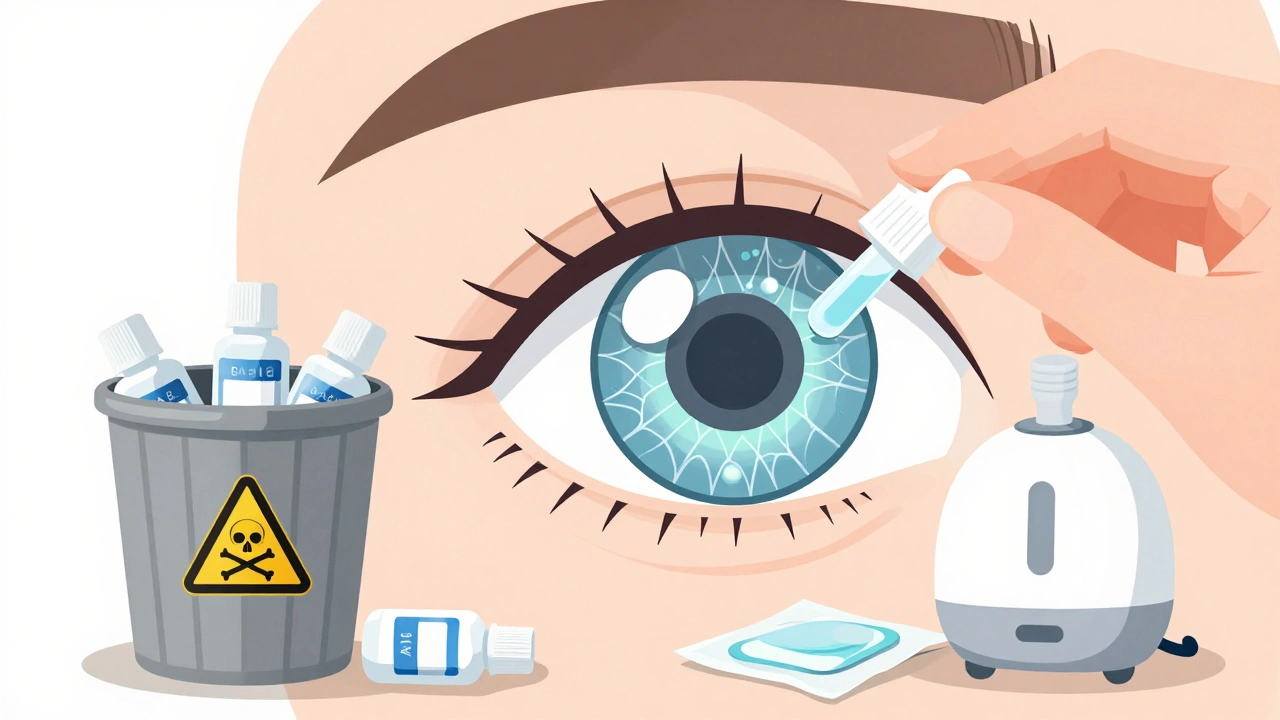
What You Can Do at Home
Beyond drops, simple habits help:- Use a humidifier at night, especially in winter.
- Take screen breaks every 20 minutes-look 20 feet away for 20 seconds.
- Apply warm compresses to your eyelids for 5-10 minutes daily. This melts blocked oil in your glands.
- Switch to preservative-free drops if you use them more than four times a day.
- At night, use a thicker ointment (like Vaseline-based products) to seal in moisture while you sleep.
The Bigger Picture
Dry eye syndrome isn’t going away. With people spending over 7 hours a day on screens and populations aging, cases are rising. By 2030, the global market for dry eye treatments is expected to hit $8 billion. But the real problem isn’t the cost-it’s the misunderstanding. Many think it’s just “dryness.” It’s not. It’s a complex breakdown of tear quality, gland function, and inflammation. If you’ve been using artificial tears for months and still struggle, don’t assume it’s normal. Talk to an eye care professional. Get your tear osmolarity tested. Ask about your meibomian glands. You deserve more than temporary relief.Are artificial tears safe to use every day?
Yes, but only if you choose the right kind. If you use them more than four times a day, switch to preservative-free single-dose vials. Bottled drops with benzalkonium chloride can damage your eye surface over time with frequent use. Always check the label for preservatives.
Why do my eyes water if I have dry eye?
It sounds counterintuitive, but it’s common. When your tear film is unstable, your eyes send a distress signal to produce more tears. But these reflex tears are mostly water-they lack the oil and mucus your eyes need. So you get watery, uncomfortable eyes instead of properly lubricated ones.
Can dry eye cause permanent vision loss?
In rare cases, yes. If left untreated for years, severe dry eye can lead to corneal scarring, ulcers, or infections. About 4.3% of chronic cases develop permanent damage. That’s why it’s important to see a specialist if symptoms persist beyond a few weeks, especially if you notice blurred vision, light sensitivity, or pain.
Do I need a prescription for dry eye treatment?
Not always. Most people start with over-the-counter artificial tears. But if those don’t help after 4-6 weeks, or if you have moderate to severe symptoms, you’ll likely need a prescription. Medications like Restasis, Xiidra, or Eysuvis target inflammation and tear production, not just surface lubrication.
What’s the difference between Systane and Refresh?
Systane products often include hyaluronic acid and lipid-based formulas designed for evaporative dry eye. Refresh is known for its preservative-free options and thicker gels for nighttime use. Systane Ultra targets both aqueous and evaporative types, while Refresh Relieva is better for sensitive eyes. Check the active ingredients-some are better for contact lens wearers, others for overnight relief.
Can dry eye be cured?
There’s no permanent cure yet, but it can be managed effectively. For many, combining artificial tears with warm compresses, lid hygiene, and lifestyle changes brings long-term relief. In some cases, especially with autoimmune causes, treatment can reduce symptoms to near-normal levels. Research into protein therapies and sustained-release inserts is promising for the future.
Jane Quitain
December 7, 2025 AT 07:20i just started using those preservative-free drops after my eyes felt like sandpaper all day… and wow. it’s like my eyeballs finally remembered how to be happy. no more blurry vision after 10 minutes 😭
David Brooks
December 7, 2025 AT 13:07OMG YES. I thought I was going blind from staring at Zoom calls all day. Then I tried the warm compress trick-like, literally a warm washcloth over my eyes for 5 mins-and I swear I cried (the good kind). My optometrist said my meibomian glands were basically napping. Now I do it every night like a ritual. My contacts haven’t felt this comfortable in YEARS. 🥹
Olivia Hand
December 8, 2025 AT 09:55Most people don’t realize dry eye isn’t a lack of tears-it’s a failure of tear *quality*. The oil layer is the unsung hero. When your meibomian glands get clogged with thickened sebum (thanks, screen glare and poor lid hygiene), your tears evaporate faster than a puddle in the Sahara. That’s why saline drops feel like a Band-Aid on a broken bone. The real fix? Heat, massage, and lipid-based formulas. Systane Balance? Lifesaver. Regular Refresh? Meh. And yes, refrigerating them helps-cold = thicker = longer retention. Also, blinking fully matters. Most people blink half-heartedly while scrolling. Your eyes need full closure to redistribute oil. Try it. You’ll notice.
Desmond Khoo
December 9, 2025 AT 04:50just switched to Refresh Relieva preservative-free and my life changed 😍 i used to need drops every hour, now i’m good for 3-4 hours. also started doing the 20-20-20 rule like a boss. my cat even judges me when i forget. 🐱👀
Louis Llaine
December 9, 2025 AT 19:51So let me get this straight. We’re spending billions on eye drops because people won’t just… look away from their phones? I mean, if your eyes hurt from staring at a screen for 12 hours straight, maybe the solution isn’t a $20 bottle of hyaluronic acid. Maybe it’s a 1990s-style digital detox. Just a thought.
Sam Mathew Cheriyan
December 11, 2025 AT 01:22you know what they dont tell you? the government put chemicals in the water to make us buy eye drops. its all a scheme. i stopped using them and started drinking filtered water with lemon and now my eyes are better. also i think the meibomian glands are fake. they made that up so optometrists can charge you $300 for a ‘gland expression’.
Nancy Carlsen
December 11, 2025 AT 17:56For anyone just starting out with dry eye-don’t feel alone. I was terrified I’d never wear contacts again. But combining warm compresses, preservative-free drops, and a humidifier in my bedroom? Game changer. And if you’re using drops more than 4x a day, please, please skip the preservatives. Your corneas will thank you. You’re not broken. You’re just in a modern world that forgot how to let eyes rest. 💙
Ted Rosenwasser
December 11, 2025 AT 20:54It’s amusing how casually people treat ocular surface disease like a minor inconvenience. The fact that you’re casually recommending over-the-counter drops as if they’re equivalent to pharmaceutical-grade lipid replacement therapy reveals a fundamental misunderstanding of tear film biochemistry. Hyaluronic acid at 0.15%? Pathetic. Real treatment requires analysis of tear osmolarity, meibography, and inflammatory biomarkers-not Amazon reviews from someone who cried after using ‘Soothe XP’.