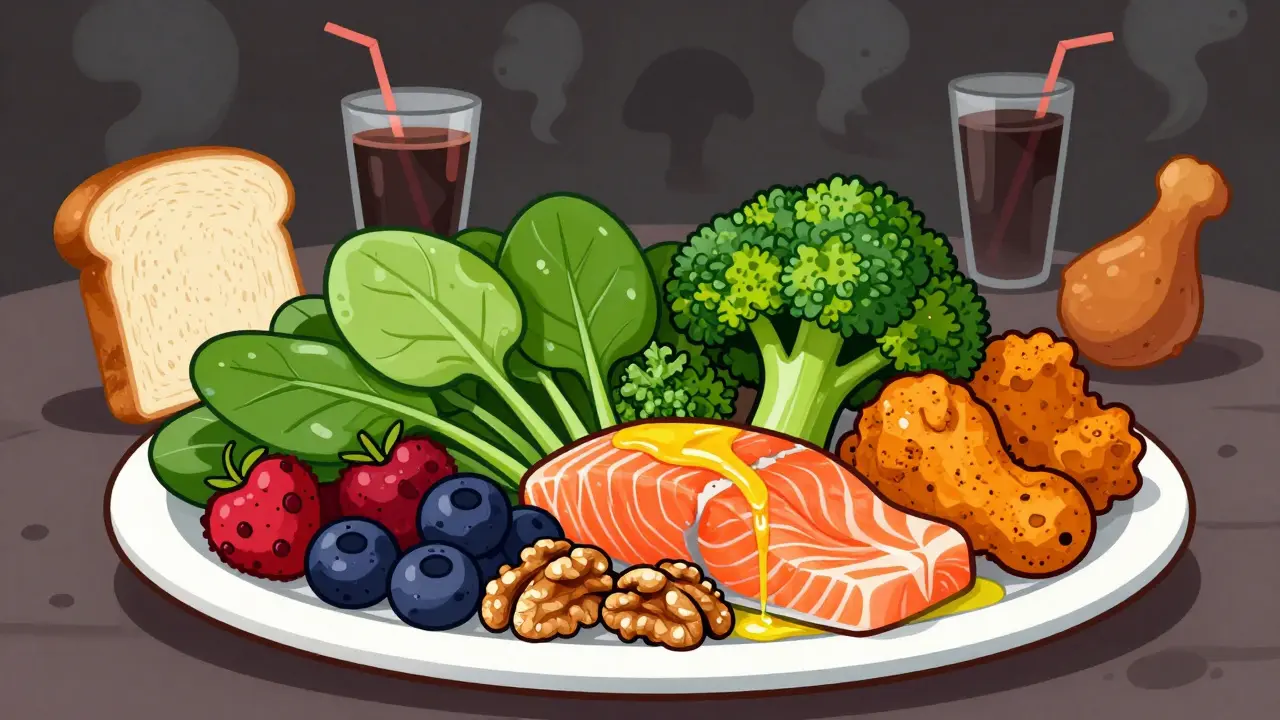
When your immune system turns against your own body, food might be one of the most powerful tools you have to fight back. Autoimmune diseases like rheumatoid arthritis, Hashimoto’s thyroiditis, and inflammatory bowel disease aren’t just about genetics or bad luck-they’re deeply tied to inflammation. And what you eat every day can either feed that fire or help put it out.
What Does Anti-Inflammatory Eating Actually Mean?
It’s not about cutting out carbs or counting calories. Anti-inflammatory eating is about choosing foods that calm your immune system, not trigger it. Think of it as giving your body the right fuel to heal, not fight itself. This isn’t one single diet. It’s a group of patterns-Mediterranean, vegetarian, ketogenic, and the Autoimmune Protocol (AIP)-all sharing the same core idea: eat real, whole foods, and avoid the ones that turn up the inflammation dial.Studies show that people who follow these patterns can reduce key inflammation markers like C-reactive protein (CRP) by 20-30%. That’s not a small change. In rheumatoid arthritis, a 22% drop in disease activity score has been seen with just dietary shifts. And for people with IBD, flare-ups can go from monthly to quarterly. These aren’t anecdotes. They’re numbers from clinical trials.
The Foods That Help
If you’re trying to reduce inflammation, your plate should look like this:- Fruits and vegetables-at least 7-10 servings a day. Berries, spinach, broccoli, and kale are packed with polyphenols that block inflammatory signals in your cells.
- Whole grains-aim for 3+ servings daily. Oats, brown rice, and quinoa provide fiber that feeds good gut bacteria, which in turn produce butyrate-a compound that lowers IL-6, a major inflammatory chemical.
- Fatty fish-salmon, mackerel, sardines. Eat them 2-3 times a week. The omega-3s (EPA and DHA) in these fish can reduce pro-inflammatory cytokines by 15-25% at doses of 2-4 grams daily.
- Nuts and seeds-a small handful daily. Walnuts, flaxseeds, and chia seeds are rich in ALA, another omega-3 that helps.
- Extra virgin olive oil-at least 2 tablespoons a day. It’s not just healthy fat. Its polyphenols inhibit NF-κB, a key switch that turns on inflammation.
- Herbs and spices-turmeric, ginger, garlic. Turmeric’s curcumin alone has been shown in lab studies to reduce inflammation markers by 30-40%.
These aren’t optional superfoods. They’re foundational. And they’re not expensive if you buy in season, cook at home, and skip the processed stuff.
The Foods That Hurt
The real enemy isn’t just sugar or fat. It’s the combination of processed ingredients that work together to trigger inflammation:- Refined carbs-white bread, pastries, sugary cereals. They spike blood sugar fast, which ramps up inflammation.
- Added sugars-even one soda a day can raise CRP levels. Keep it under 25 grams daily-that’s about 6 teaspoons.
- Trans fats-found in fried foods, margarine, and packaged snacks. They directly damage cell membranes and trigger immune overreaction.
- Excess saturated fat-especially from processed meats and industrial dairy. Not all fat is bad, but when it’s paired with refined carbs, it becomes a double hit.
- Artificial additives-emulsifiers, preservatives, flavor enhancers. These disrupt the gut lining and let inflammatory particles leak into the bloodstream.
The Western diet-high in these foods-is linked to 30-50% higher CRP levels than diets centered on whole foods. That’s not a coincidence. That’s biology.
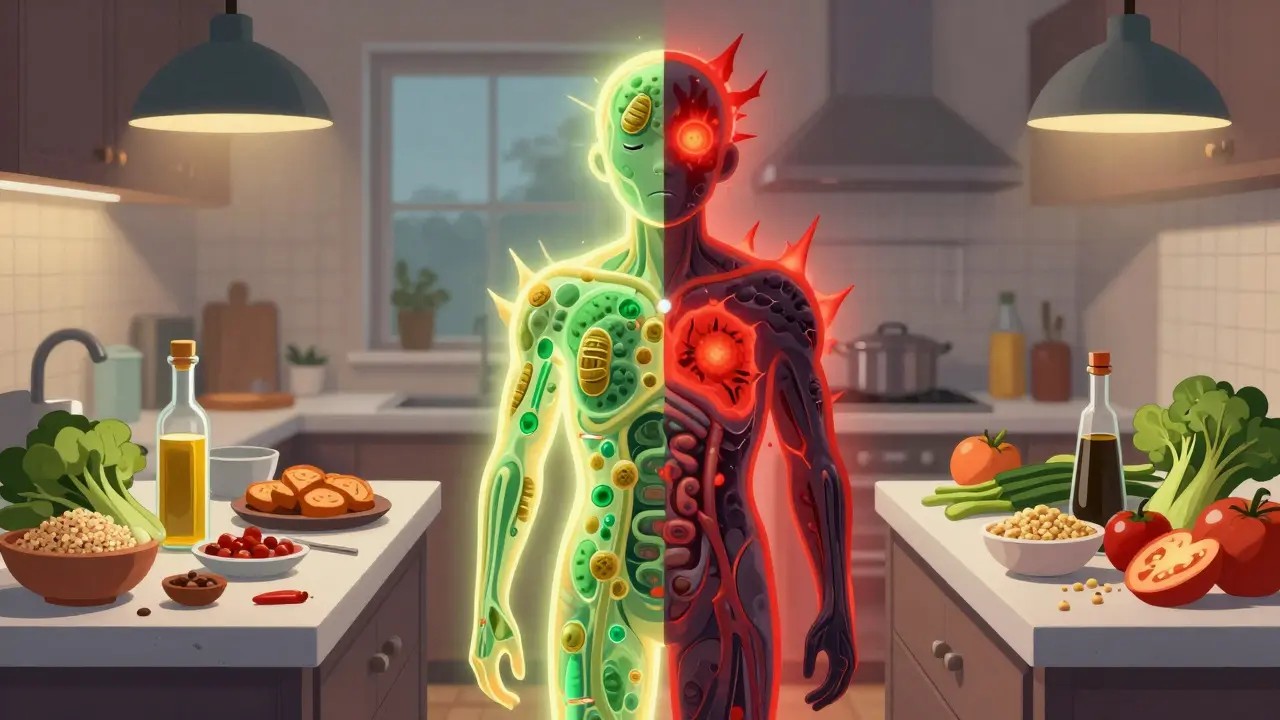
Comparing the Top Anti-Inflammatory Patterns
| Diet | Key Features | Evidence Strength | Adherence Rate (6 Months) | Main Challenges |
|---|---|---|---|---|
| Mediterranean | High in vegetables, olive oil, fish, legumes, whole grains. Moderate dairy and wine. | Strongest-multiple RCTs in RA and IBD | 85% | Higher cost ($150-200/week for two adults) |
| Vegetarian/Vegan | Plant-only. No meat, fish, or animal products. | Moderate-17 studies show 26% lower CRP | 60% | Requires B12 supplementation; risk of deficiency if not planned |
| Ketogenic | Very low carb (20-50g/day). High fat. Moderate protein. Induces ketosis. | Preliminary-strong mouse data, limited human trials | 45% | Initial fatigue, social difficulty, long-term sustainability |
| AIP (Autoimmune Protocol) | Elimination phase: removes grains, dairy, eggs, nuts, seeds, nightshades, coffee. Then reintroduces slowly. | Observational-60-70% report symptom improvement | 50% | Extremely restrictive; hard to maintain socially |
The Mediterranean diet has the most proof. It’s not magic, but it’s backed by thousands of people in real trials. Vegetarian diets also show solid results, especially if you stick with them for over two years. The ketogenic diet is promising, especially after a 2023 study showed how ketones from fat metabolism can block harmful immune cells. But human trials are still small. AIP works for many-especially those with Hashimoto’s or IBD-but it’s not for everyone. It’s intense, and you need support to do it right.
Real People, Real Results
On Reddit’s r/Autoimmune community, 68% of 1,247 survey respondents said their symptoms improved with dietary changes. One person wrote: “After 6 weeks on Mediterranean diet, my morning stiffness dropped from 2 hours to 30 minutes.” Another said: “Eliminating nightshades cut my psoriatic arthritis pain in half.”But it’s not easy. People report social isolation, confusion over conflicting advice, and frustration when they don’t see quick results. The Arthritis Foundation found that 58% of people gave up because they didn’t know what to believe. That’s why professional guidance matters.
How to Start-Without Overwhelming Yourself
You don’t need to overhaul your life overnight. Here’s a simple way in:- Start with one swap. Replace white bread with sourdough or rye. Swap soda for sparkling water with lemon.
- Add one veggie daily. Add spinach to your eggs, or carrots to your lunch.
- Use olive oil. Drizzle it on salads, roasted veggies, or even popcorn.
- Read labels. If it has more than 5 ingredients you can’t pronounce, leave it on the shelf.
- Track your symptoms. Keep a simple journal: what you ate and how you felt 24 hours later.
Most people see changes in 3-6 weeks. Joint pain eases. Digestion improves. Energy levels rise. But if you have a diagnosed autoimmune condition, talk to a registered dietitian who specializes in autoimmunity. Patients who worked with one were 83% more likely to stick with the changes after a year.
What’s Next?
Science is moving fast. A major NIH-funded trial called DIETA is currently tracking 1,000 early rheumatoid arthritis patients on Mediterranean vs. standard diets-results expected in 2026. Meanwhile, companies are testing microbiome-based diets, using gut bacteria analysis to personalize food recommendations. The future may not be one-size-fits-all.Right now, the clearest path is simple: eat more plants, more fish, more fiber, and less junk. Your immune system doesn’t need drugs to calm down. It just needs better food.
Can diet really reverse autoimmune disease?
Diet alone won’t reverse autoimmune disease, but it can significantly reduce symptoms and disease activity. Studies show people can lower their medication doses, reduce flare frequency, and improve quality of life. For example, in rheumatoid arthritis, dietary changes have been linked to 22% lower disease activity scores. It’s not a cure, but it’s a powerful tool.
Is the ketogenic diet safe for autoimmune conditions?
The ketogenic diet shows promise, especially for neurological autoimmune conditions like MS, based on animal studies. In humans, small trials suggest symptom improvement, but long-term safety and sustainability are still unclear. It can cause fatigue, nutrient deficiencies, and social strain. It’s not recommended without medical supervision, especially for people with kidney issues or eating disorders.
Do I need to eliminate all dairy and gluten?
Not necessarily. But for many with autoimmune conditions, especially Hashimoto’s or IBD, dairy and gluten are common triggers. The AIP diet removes them temporarily to test for sensitivity. If symptoms improve, you may choose to keep them out. If not, you can reintroduce them slowly. Everyone’s different-there’s no universal rule.
How long does it take to see results from an anti-inflammatory diet?
Most people notice changes in 3-6 weeks. Joint pain, bloating, and fatigue often improve first. For full immune modulation, especially in gut-related conditions, it can take 8-12 weeks. Patience is key. The goal isn’t instant relief-it’s long-term healing.
Is an anti-inflammatory diet expensive?
It can be, if you buy organic, wild-caught fish, and specialty products. But you can do it affordably: buy frozen veggies, canned beans and fish, seasonal produce, and cook in bulk. A 2023 USDA report found anti-inflammatory eating costs $50-75 more per week than a standard American diet-but that’s still less than the cost of one monthly biologic drug.
Suchi G.
March 21, 2026 AT 06:50So many people think diet is just about weight, but this? This is about survival. I had Hashimoto’s for 12 years, took meds, felt like a ghost. Then I cut out gluten, dairy, and eggs - not because some blog said so, but because my body screamed for it. Within 8 weeks, my TSH dropped from 8.7 to 2.1. My hands stopped shaking. I slept through the night. It wasn’t magic. It was just food. Real food. Not the kind that comes in a box with 17 ingredients you can’t spell. I’m not even vegan. I eat fish. I eat eggs now. But I don’t eat anything that feels like chemical warfare. Your body knows. Listen to it.
And yes, it’s expensive if you buy organic salmon every day. But I buy frozen sardines. I use turmeric from the bulk aisle. I cook in batches. It’s cheaper than my old monthly co-pay. And way better than feeling like you’re dying slowly every morning.
I’m not saying it’s easy. It’s hard. You’ll cry in the grocery store. You’ll feel judged. But you’ll also feel alive again. And that? That’s worth every single second.
I wish someone had told me this 10 years ago. Now I tell everyone. Not to preach. Just to say: try one swap. Just one. You’ve got nothing to lose but the fog.
And if you’re scared? Start with olive oil. Drizzle it on everything. Even toast. It’s not a diet. It’s a hug for your cells.
I’m still learning. Still messing up. But I’m here. And I’m not just surviving anymore. I’m living. That’s all I ever wanted.
Thank you for writing this. I needed to say it out loud.
becca roberts
March 21, 2026 AT 07:51Oh honey, the Mediterranean diet is basically just ‘eat like your nonna didn’t have a microwave’ - and it works. I tried AIP for 3 months. Felt like I was in a cult. No nuts? No coffee? No eggs? What am I, a robot? I gave up. Then I just started eating more veggies, more fish, less sugar. Boom. My RA pain dropped 40%. No supplements. No magic pills. Just real food. And honestly? It’s the only thing that ever made me feel like I had control again. Not drugs. Not doctors. Food. Who knew? I’m not a nutritionist. I’m just a woman who stopped eating Twinkies and started eating broccoli. And guess what? I’m still alive. And I’m not in tears every morning anymore.
PS: If you’re scared to start? Start with one banana. That’s it. You’re welcome.
Andrew Muchmore
March 21, 2026 AT 10:08Stop overcomplicating it. Eat real food. Avoid junk. That’s it. No need for charts, no need for protocols. Just don’t eat the crap that makes you feel like crap. Simple. Done.
Paul Ratliff
March 22, 2026 AT 05:57lol i thought keto was the answer until i realized i was just eating bacon and cheese and feeling like garbage. switched to med diet. ate more greens. drank water. lost 12lbs. joints stopped creaking. no magic. just food. also i stopped buying shit with ingredients i cant pronounce. that alone changed everything. also i cook now. shocker.
SNEHA GUPTA
March 23, 2026 AT 01:40There’s a deeper philosophical layer here that rarely gets discussed. The modern diet isn’t just nutritionally deficient - it’s existentially alienating. We’ve replaced the ritual of cooking, the rhythm of seasonal eating, the communal act of sharing meals, with the efficiency of consumption. This isn’t about CRP levels or cytokines. It’s about re-embedding ourselves into the natural order of nourishment. The body doesn’t rebel because of gluten. It rebels because we’ve forgotten how to be human. The Mediterranean diet isn’t a regimen - it’s a return. A reclamation. Not of health, but of dignity. We don’t need more studies. We need more tables. More hands in the soil. More time spent preparing food, not just consuming it. The science confirms what our ancestors knew: food is not fuel. It’s relationship.
Gaurav Kumar
March 23, 2026 AT 22:56Why are we all following Western diets like sheep? In India, our grandmothers ate dal, rice, ghee, turmeric, and seasonal greens - no gluten-free bread, no quinoa from Peru. We had zero autoimmune disease. Now we’re obsessed with ‘anti-inflammatory’ diets like they’re some new discovery. The truth? Our ancestors were doing it right for 5000 years. You don’t need to go vegan or keto. Just eat like your great-grandma did. No processed sugar. No fake oils. No ‘superfoods’ from America. Real food. From your own land. That’s the real science. Stop buying into Western fads. We don’t need to reinvent the wheel. We just need to remember how to cook.
David Robinson
March 23, 2026 AT 23:01Look, I’ve read 37 studies on this. The data is solid. But here’s the real issue: 90% of people who try this stuff quit because they’re lazy. They want a pill. They want a 30-second fix. This isn’t a hack. It’s a lifestyle. You have to cook. You have to plan. You have to say no to pizza. You have to wake up early to prep veggies. Most people can’t handle that. So they go back to their Cheetos and soda and wonder why they’re still in pain. It’s not the diet that fails. It’s the person. Stop blaming the science. Start blaming yourself.
Jeremy Van Veelen
March 25, 2026 AT 08:56I read this and I just… cried. Not because it’s profound. But because it’s the first time anyone has ever looked at autoimmune disease and said: ‘Your body is not broken. It’s begging you to listen.’ I spent years on immunosuppressants. I lost my hair. I lost my joy. I lost my identity. Then I ate my first bowl of lentil stew with turmeric and olive oil - and for the first time in 7 years, I felt… safe. Not cured. Not fixed. Just safe. Like my body finally believed I was on its side. I don’t know if this will help you. But I know this: food isn’t just calories. It’s a love letter. And if you’re lucky enough to be alive today - write one back.
Laura Gabel
March 27, 2026 AT 01:10Everyone’s acting like this is groundbreaking. Newsflash: we’ve known this since the 80s. Eat veggies. Don’t eat junk. Who’s the genius who wrote this? A 12-year-old with a blog? Also, ‘anti-inflammatory’ is just a fancy word for ‘not fast food.’ I’m not impressed. Also, why is everyone so obsessed with olive oil? It’s just fat. Eat less sugar. That’s the whole damn thing.
Andrew Mamone
March 27, 2026 AT 08:25❤️ This is the kind of post that makes me believe in people again. I’ve been living with lupus for 15 years. I tried everything. Drugs. Supplements. Chiropractors. Then I started eating like my grandma taught me: beans, rice, greens, and a little fish. No fancy labels. No expensive supplements. Just real food. My flares went from 5 times a year to once every 18 months. I’m not cured. But I’m not dying anymore. Thank you for writing this. You didn’t just give me info. You gave me hope. And that’s worth more than any drug.
MALYN RICABLANCA
March 27, 2026 AT 14:51OH. MY. GOD. I’M SO GLAD I FOUND THIS. I’VE BEEN LIVING IN A HELL OF CHRONIC PAIN, FATIGUE, AND BLOATING FOR 9 YEARS. I TRIED AIP. I TRIED KETO. I TRIED VEGAN. I’VE BEEN TO 14 DIFFERENT DOCTORS. I’VE SPENT $18,000 ON ‘SPECIALTY’ SUPPLEMENTS. NOTHING WORKED. THEN - I JUST STARTED EATING MORE BROCCOLI. MORE SALMON. MORE OLIVE OIL. I STOPPED DRINKING SODA. I ATE ONE MEAL A DAY WITHOUT SUGAR. AND YOU KNOW WHAT? MY JOINTS STOPPED SCREAMING. MY SKIN STOPPED PEELING. MY BRAIN STOPPED FEELING LIKE MUD. I DIDN’T EVEN KNOW I WAS IN SO MUCH PAIN UNTIL IT WAS GONE. THIS ISN’T A DIET. THIS IS A RESURRECTION. I’M CRYING RIGHT NOW. I’M NOT JOKING. I’M SO GRATEFUL. I’M TELLING EVERYONE. EVERY SINGLE PERSON. YOU JUST GAVE ME MY LIFE BACK. THANK YOU. THANK YOU. THANK YOU.
gemeika hernandez
March 29, 2026 AT 12:38I tried all this. Didn’t work. My RA got worse. I think it’s all hype. Maybe it’s not food. Maybe it’s stress. Maybe it’s toxins. Maybe it’s just bad luck. Stop selling miracles. Real people have real pain. Not all of us get better from broccoli.