Side Effect Risk Calculator
Your Health Profile
Risk Assessment
Based on real-world data: 78% of patients report side effects more frequent than listed in clinical trials (2022 patient surveys)
With your profile, your risk of experiencing side effects not captured in clinical trials is currently low.
Important: Clinical trials typically capture side effects occurring in 1 in 10 patients. Real-world data shows 2-5% of actual side effects go unreported to the FDA. Your report helps fill this gap.
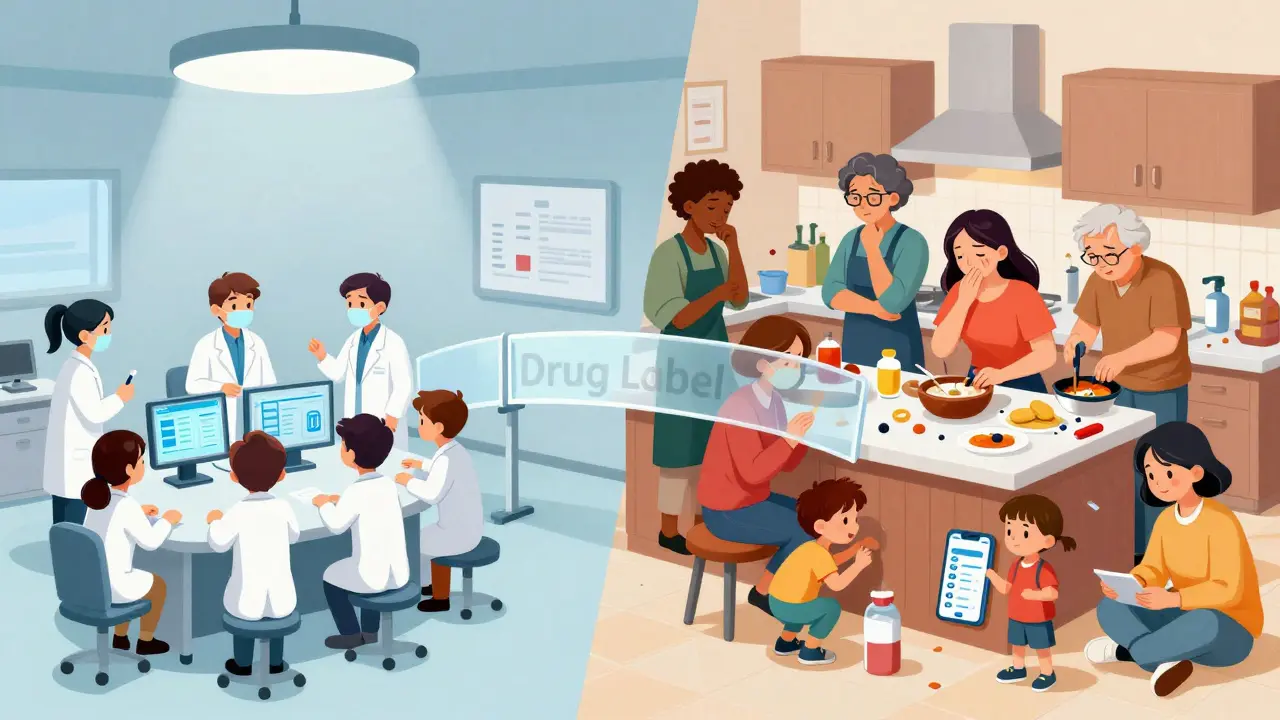
When you pick up a new prescription, the side effects listed on the label feel like a complete picture. But what you see on that paper is only part of the story. Clinical trial data gives regulators the green light to approve a drug, but it doesn’t show you everything that happens once millions of people start taking it. Real-world side effects tell a different, often more complex, story. Understanding the gap between these two types of data isn’t just for doctors or scientists-it matters to every patient.
Why Clinical Trials Don’t Show the Full Picture
Clinical trials are designed to answer one question: Does this drug work under ideal conditions? To get clear answers, researchers pick participants carefully. They exclude people with other illnesses, older adults, pregnant women, and those on multiple medications. This creates a clean test group, but it’s not the real world. For example, a phase 3 cancer trial might only include 381 people. That’s enough to spot side effects that happen in 1 in 10 or even 1 in 50 patients. But if a side effect only affects 1 in 500 people? It’s statistically invisible in a trial that small. That’s why drugs like rosiglitazone got approved in 1999-its link to heart attacks only became clear years later, when doctors started seeing it in real patients. The way side effects are recorded in trials is also tightly controlled. Doctors use a standardized system called CTCAE v5.0, which lists 790 specific adverse events with clear severity ratings. Patients report symptoms during scheduled visits-weekly at first, then monthly. If a side effect happens between visits, or if a patient forgets to mention it, it might not get recorded at all.What Real-World Data Reveals That Trials Miss
Real-world side effect data comes from everywhere: hospital records, insurance claims, patient apps, and voluntary reports to the FDA’s FAERS system. In 2022 alone, FAERS received over 2.1 million reports-up from 1.4 million just four years earlier. This data catches things trials never could. Take GLP-1 agonists, the popular weight-loss and diabetes drugs. Clinical trials reported nausea and vomiting as common side effects. But pharmacists on Reddit and patient surveys say the real experience is worse-78% of them noticed gastrointestinal issues were more frequent and longer-lasting than listed. One patient said, “The trial only asked about fatigue during office visits, but I experienced it worst at home in the evenings.” That kind of detail doesn’t show up in trials. Real-world data also uncovers long-term risks. The FDA’s 2020 warning about pioglitazone increasing heart failure risk came from 10 years of tracking over 190,000 patients. No clinical trial lasts that long. And when fluoroquinolone antibiotics were restricted in 2019, it was because real-world analysis of 1.2 million records showed rare but devastating nerve and tendon damage that only appeared after months of use.The Flip Side: False Alarms and Noisy Data
Real-world data isn’t perfect. Because it’s collected outside controlled settings, it’s full of noise. In 2018, a study suggested anticholinergic drugs caused dementia. It turned out patients who took those drugs were already more likely to have early dementia symptoms-so the drug wasn’t the cause, it was just being used by people who were already declining. Another problem? Underreporting. Experts estimate only 2-5% of actual side effects ever make it into FAERS. Why? Doctors are busy. A 2021 AMA survey found only 12% of physicians regularly report adverse events. Filling out a report takes an average of 22 minutes. Most don’t have time. And then there’s data quality. A 2022 FDA pilot found only 34% of adverse events recorded in electronic health records had enough detail to be useful for regulators. One note might say “patient felt weird.” Another says “grade 3 fatigue, persistent for 14 days, interfered with work.” Which one helps?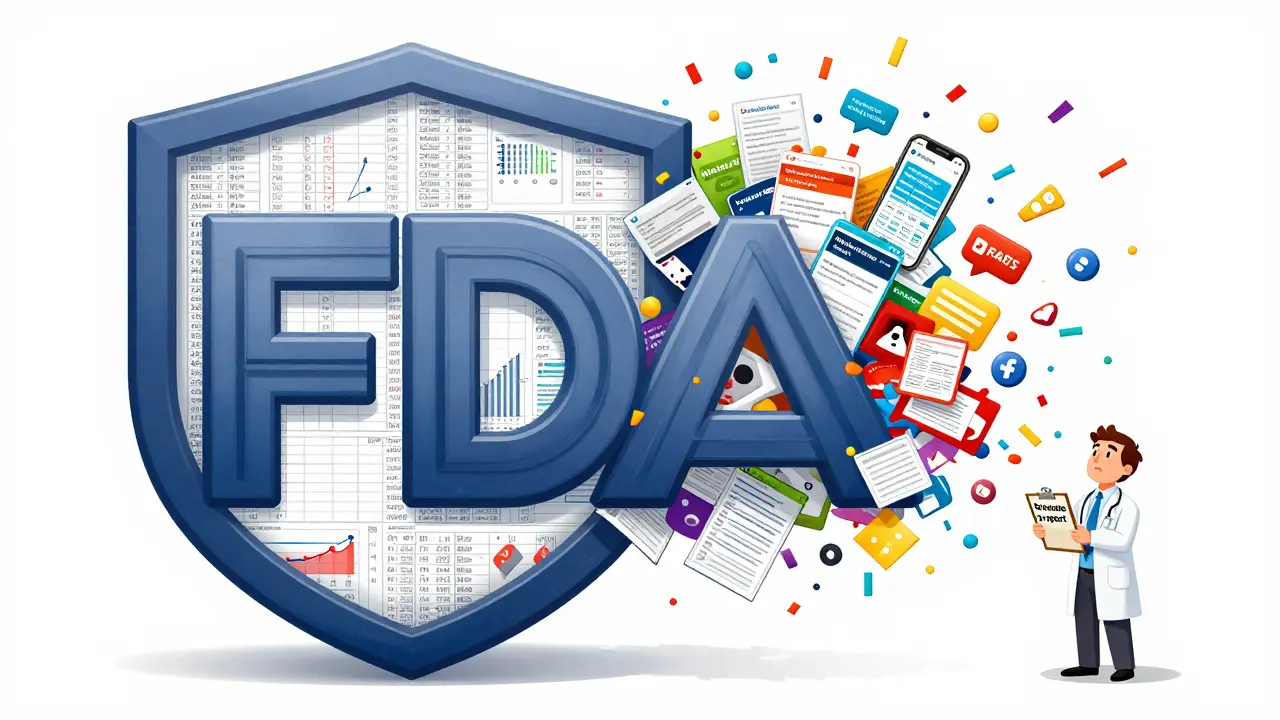
How the FDA Uses Both Types of Data Today
The FDA doesn’t rely on just one. Since the 21st Century Cures Act in 2016, the agency has been required to use real-world evidence in regulatory decisions. By 2022, 67% of new drug approvals included real-world data in their post-marketing safety plans. That’s up from just 29% in 2017. Here’s how it works: Clinical trials prove a drug works and catch the most common serious side effects. Once approved, the FDA watches what happens in the wild. The Sentinel Initiative monitors 300 million patient records in near real-time. It uses 17 different analytical methods to spot unusual patterns-like a spike in liver damage reports after a new diabetes drug hits the market. Sometimes, real-world data triggers changes. In 2021, the FDA updated the label for a popular antidepressant after patient reports on social media and digital health apps showed higher-than-expected rates of agitation and insomnia. That wouldn’t have happened without the extra eyes of real users.What Patients and Doctors Are Seeing
Patients are noticing the gap too. A 2022 survey by the National Patient Advocate Foundation found 63% of people experienced side effects not listed on their medication’s FDA-approved label. Of those, 41% said the side effects were moderate to severe and affected their daily life. Doctors are frustrated. Many say the side effect profiles in prescribing guides feel outdated. One oncologist in Boston told me, “I’ve seen three patients with severe joint pain from a drug that only lists ‘mild fatigue’ as a possible side effect. I had to look up case reports online to confirm it was even possible.” Meanwhile, digital tools are helping. The MyTherapy app, used by over 1.2 million people, found a 27% higher rate of fatigue with immunotherapy drugs than what trials reported. Why? Because patients tracked symptoms daily, not just during clinic visits. They caught fatigue that peaked at night, after work, or during family time-moments trials never asked about.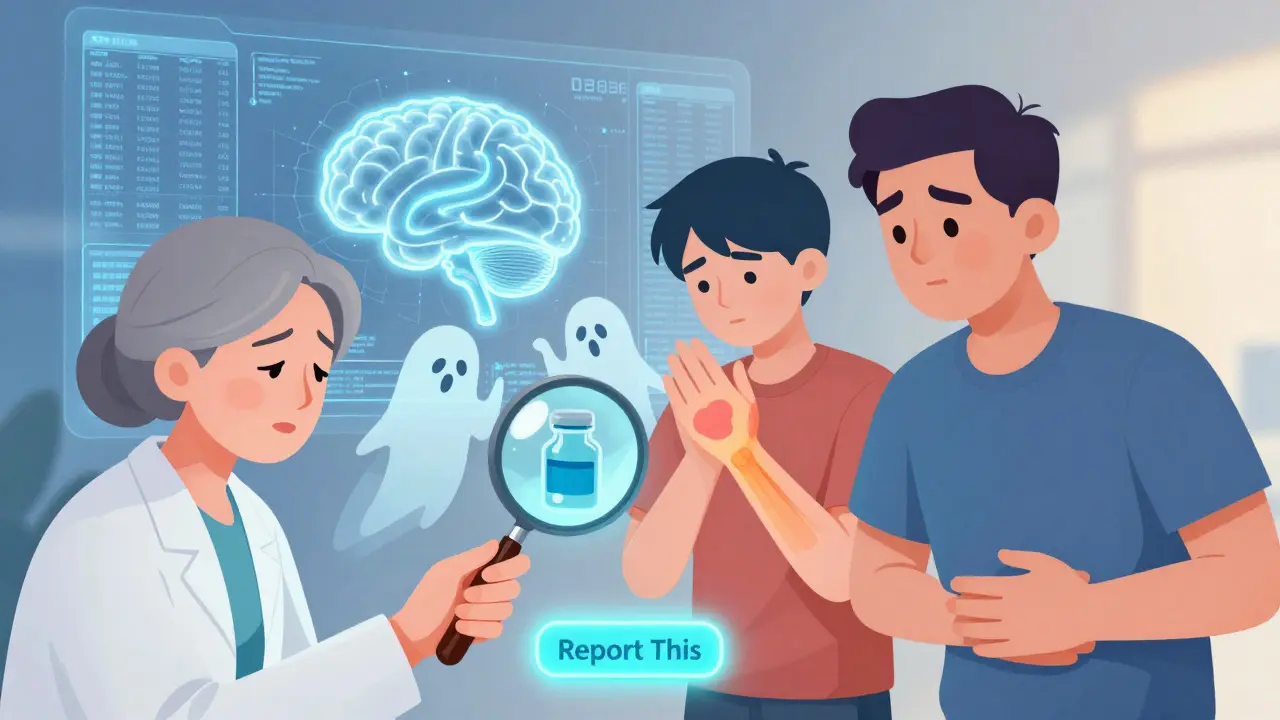
The Future: Blending Both Worlds
The future isn’t about choosing one over the other. It’s about combining them. Top pharmaceutical companies are already doing this. In 2023, Deloitte found 73% of major drugmakers now collect real-world data during late-stage clinical trials. They’re asking participants to use apps to log symptoms between visits. They’re linking trial data to insurance claims and EHRs. AI is speeding things up. Google Health’s 2023 study analyzed 216 million clinical notes and found 23% more drug-side effect links than traditional methods. That’s not replacing trials-it’s making them smarter. The FDA’s 2023 update now requires every new drug application to include a plan for real-world safety monitoring. That’s a big shift. It means companies can’t just say, “We tested it on 400 people and called it good.” They have to promise they’ll keep watching.What This Means for You
If you’re taking a new medication, don’t assume the label tells you everything. Side effects listed in trials are the most common ones. The rare, delayed, or context-specific ones? They show up later. Talk to your pharmacist. Ask if any side effects have been reported by other patients that aren’t on the label. Use a symptom tracker app-even a simple one. Note when symptoms happen, how bad they are, and what you were doing. That data could help others down the line. And if you experience something unusual, report it. Even if it seems minor. The FDA’s FAERS system only works if people speak up. One report might not change anything. But 100? That’s a signal. Clinical trials give us the foundation. Real-world data shows us what happens when the foundation meets real life. Neither is perfect. Together, they’re the best tool we have to keep people safe.Why are side effects in clinical trials different from real life?
Clinical trials use carefully selected participants, strict schedules, and standardized reporting to control variables. Real life includes people of all ages, with other health conditions, taking multiple drugs, and reporting symptoms inconsistently. Trials catch common side effects; real-world data catches rare, long-term, or context-specific ones that trials miss.
Can real-world data replace clinical trials?
No. Clinical trials are still the gold standard for proving a drug works and identifying the most common serious side effects under controlled conditions. Real-world data can’t prove cause and effect the same way. But it can show what happens after approval-over time, in diverse populations, and with long-term use. They work best together.
Why are so few side effects reported to the FDA?
Doctors are overwhelmed. Reporting a side effect to FAERS takes about 22 minutes on average, and most don’t have time. Patients often don’t know how or where to report. Plus, many side effects are mild or blamed on other causes. Experts estimate only 2-5% of actual adverse events are ever reported.
How does the FDA detect real-world side effect signals?
The FDA uses the Sentinel Initiative, which analyzes data from 300 million patient records across hospitals, insurers, and pharmacies. It looks for unusual patterns-like a sudden spike in kidney failure reports after a new drug launches. It uses 17 different statistical methods to rule out random noise. Validating a signal can take 3-9 months.
What should I do if I experience an unexpected side effect?
Talk to your doctor first. Then, consider reporting it to the FDA through MedWatch, their online reporting system. Even if you’re not sure it’s related, your report adds to the bigger picture. You can also use apps like MyTherapy to track symptoms daily. That data helps researchers understand real-world patterns.
Ian Cheung
January 10, 2026 AT 09:29Man I took that GLP-1 stuff and thought I was just being dramatic but nope my stomach was doing backflips for weeks and the label just said "mild nausea" like I'm sipping chamomile tea
chandra tan
January 11, 2026 AT 14:34in india we just take what the doctor says and hope for the best. no apps no tracking. if you feel weird you just say "thoda dikkat hai" and move on
Aurora Memo
January 11, 2026 AT 20:26I appreciate how this post acknowledges both sides without vilifying either system. Clinical trials are necessary, but real-world data is where humanity lives. We need both.
McCarthy Halverson
January 12, 2026 AT 23:26Track your symptoms daily even if it's just a note on your phone. That data matters more than you think
Jake Kelly
January 14, 2026 AT 10:24My mom had a reaction to a drug that wasn't listed. She didn't report it because she thought it was just aging. Turns out it was the medication. We wish we'd known sooner.
Ashlee Montgomery
January 14, 2026 AT 15:03It's not just about data collection. It's about who gets heard. The quiet patients the elderly the overwhelmed the non-English speakers. Real-world data should be a megaphone not a filter
Dwayne Dickson
January 15, 2026 AT 13:35It is imperative to acknowledge that the current pharmacovigilance infrastructure remains fundamentally inadequate for the scale and complexity of contemporary polypharmacy regimens. The CTCAE v5.0 framework, while methodologically rigorous, is inherently constrained by its exclusionary sampling protocols and temporally discontinuous data capture mechanisms. Consequently, the epistemic gap between controlled trial outcomes and emergent real-world phenomena is not merely an observational artifact-it is a systemic epistemic failure requiring structural recalibration through integrated longitudinal digital phenotyping and interoperable EHR-based surveillance architectures.
neeraj maor
January 15, 2026 AT 23:04They're hiding the real side effects. Big Pharma doesn't want you to know how many people end up in the ER. That's why they push clinical trials-they control the narrative. The FDA? They're in the pocket. Look at the numbers: 2-5% reported? That's a lie. It's more like 1 in 10. They bury it. You think they want you to know about the brain fog the heart palpitations the suicidal ideation? No. They want you to keep taking it.
Ritwik Bose
January 16, 2026 AT 03:50Thank you for this thoughtful and meticulously researched exposition 🙏 The integration of real-world evidence into regulatory decision-making represents a paradigm shift of profound therapeutic significance. May this trend continue to expand with ethical rigor and scientific integrity 🌍✨
Bradford Beardall
January 16, 2026 AT 17:47So I've been using MyTherapy for six months now. I track everything: sleep, mood, fatigue, nausea, even how hard it is to get out of bed. Last month I noticed a pattern-every time I took the new blood pressure med, my knees locked up at 3am. I reported it. Two weeks later, the app showed 17 other people had the same thing. I didn't know I was part of a signal until I started paying attention. That's power. That's what real-world data looks like when it's not just a number on a spreadsheet. It's people. It's sleepless nights. It's the quiet ones who never go to the doctor but still feel something wrong. We're not noise. We're the system's blind spot-and now we're lighting it up.