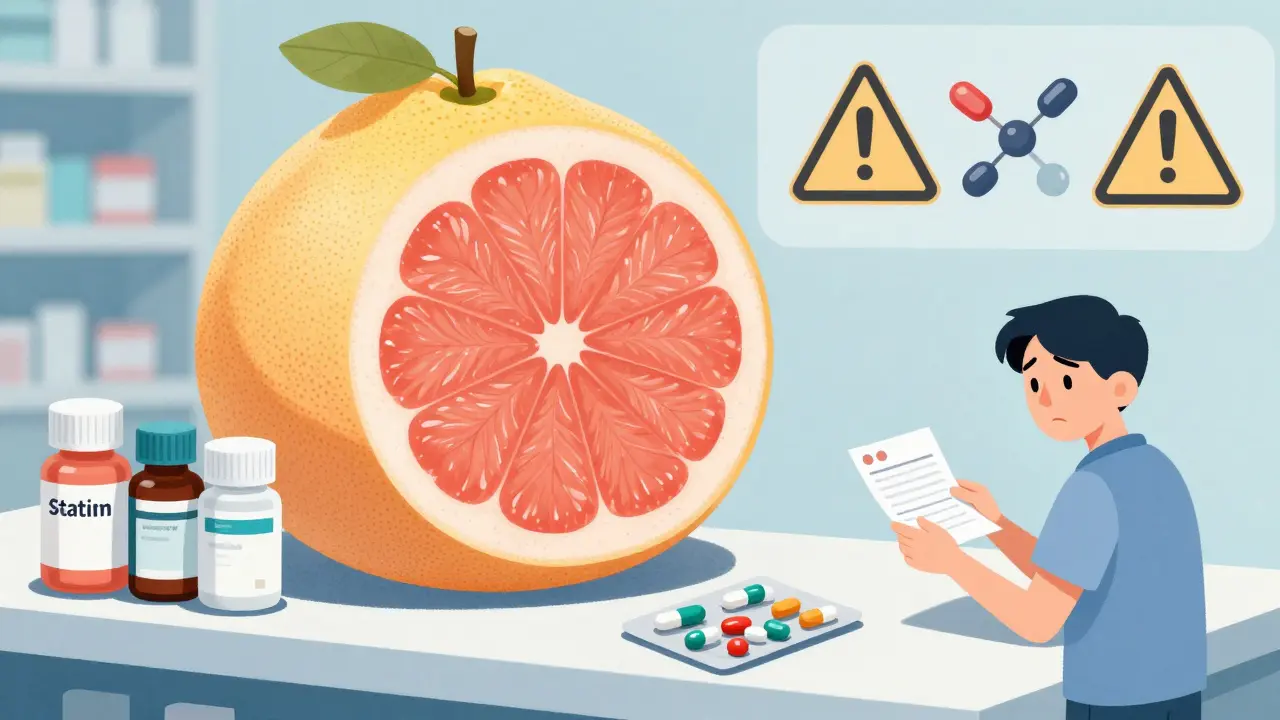
Medication-Citrus Interaction Checker
Check Your Medication Safety
Enter your medication and citrus fruit to see if it's safe to consume together. Includes pomelo and Seville orange risks not covered by standard warnings.
Select medication and citrus fruit to see results
Most people know grapefruit can mess with their meds. But what about the big, pinkish fruit at the Asian grocery that looks like a grapefruit but is way bigger? Or the bitter orange marmalade your grandma swears by? These aren’t just exotic snacks-they’re hidden risks if you’re on certain prescriptions.
What Makes Pomelo and Seville Orange Different?
Pomelo (Citrus maxima) is the giant of the citrus family. It can weigh up to 2 pounds, has thick rind, and flesh that ranges from pale yellow to deep pink. It’s sweet but slightly tart, popular in Southeast Asia and increasingly found in U.S. supermarkets. Seville orange (Citrus aurantium), on the other hand, is too bitter to eat raw. You’ll find it in Spanish marmalades, some cocktails, and traditional remedies. Both are not just cousins to grapefruit-they’re more potent.Here’s the catch: they contain the same chemicals that make grapefruit dangerous with meds-furanocoumarins like bergamottin and 6’,7’-dihydroxybergamottin. These compounds shut down enzymes in your gut that normally break down drugs before they enter your bloodstream. When those enzymes are blocked, your body absorbs way more of the drug than intended. For some medications, that’s the difference between healing and hospitalization.
Studies show pomelo has 20-30% more of these inhibitors than grapefruit. Seville orange peel-used in marmalade-can contain up to 4.0 μM of bergamottin, compared to grapefruit’s 2.0 μM. That’s not a small difference. It means even a spoonful of Seville orange marmalade on toast could be enough to spike your drug levels.
Which Medications Are at Risk?
Not all drugs are affected. The danger is focused on ones that rely on the CYP3A4 enzyme and OATP transporters to be processed. If your med falls into one of these categories, pomelo and Seville orange are off-limits:- Statins (like simvastatin, atorvastatin): These lower cholesterol. Too much in your system can cause rhabdomyolysis-a condition where muscle breaks down, damaging kidneys. A 2018 study found pomelo increased simvastatin levels by 350%, worse than grapefruit’s 300%.
- Calcium channel blockers (like amlodipine, felodipine): Used for high blood pressure. Extra drug can drop your blood pressure dangerously low, causing dizziness, fainting, or even heart issues.
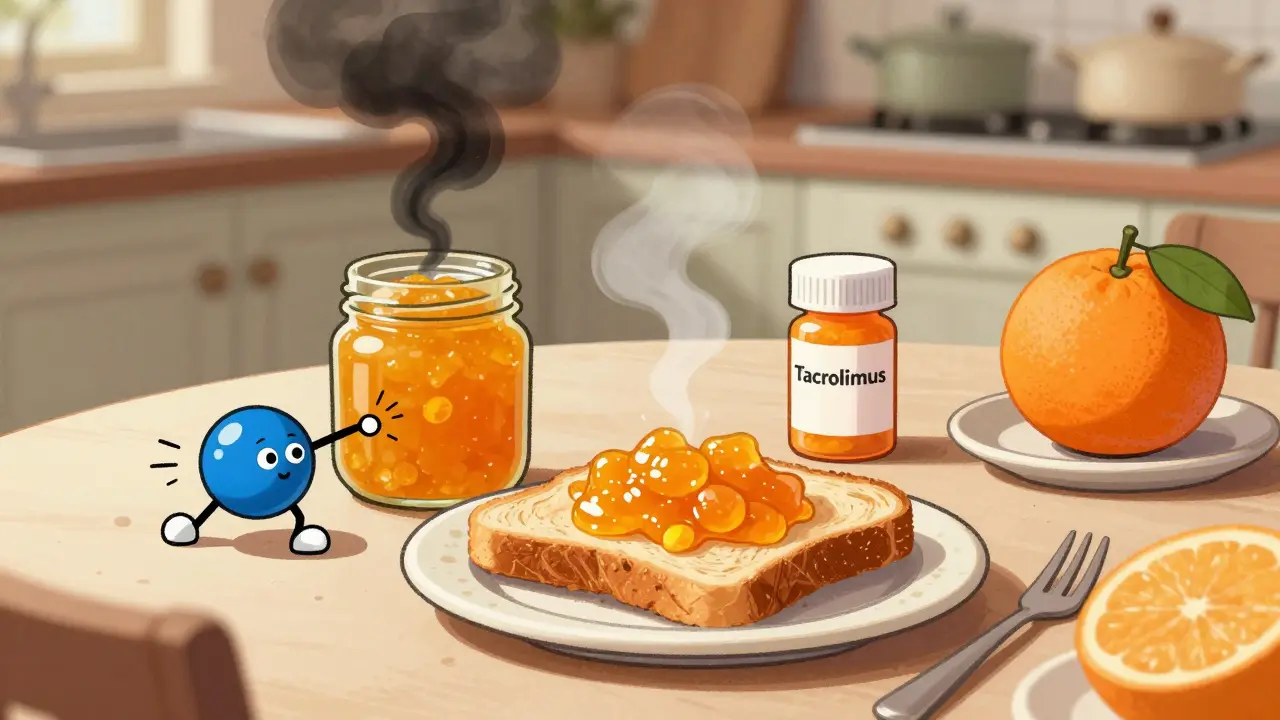
- Immunosuppressants (like tacrolimus, cyclosporine): Critical for transplant patients. Too much can poison your kidneys or liver. One case report showed tacrolimus levels jumped 400% after Seville orange marmalade.
- Benzodiazepines (like midazolam, triazolam): Used for anxiety or sleep. Higher levels mean extreme drowsiness, slowed breathing, or coma.
- Some anti-arrhythmics (like amiodarone): Can trigger dangerous heart rhythms.
Drugs like metformin, ibuprofen, or most antibiotics? No problem. The risk is narrow but deadly. If you’re on any of these, don’t assume grapefruit is the only culprit.
How Long Does the Effect Last?
This is where most people get it wrong. You don’t just need to avoid these fruits the day you take your pill. The enzyme inhibition is irreversible. Once CYP3A4 is blocked, your body has to make new enzymes to replace them. That takes about 72 hours.So if you eat a slice of pomelo on Monday, your system is still vulnerable on Thursday. Even if you take your medication on Friday, the risk remains. That’s why the FDA recommends avoiding these fruits for at least three days before and during treatment with sensitive drugs.
And it’s not just juice. Eating the fruit, drinking tea made from the peel, or even using citrus-flavored supplements can trigger the same reaction. One patient in a 2022 Reddit thread described rhabdomyolysis after eating pomelo daily for two weeks-no juice, just the flesh. No one warned him.
Why Is This So Overlooked?
Grapefruit gets all the attention. But here’s the truth: only 37% of pomelo and Seville orange products carry any warning label. Compare that to 78% for grapefruit. Most people don’t know Seville orange is different from sweet orange. They see “orange marmalade” and assume it’s safe.Pharmacists are better off than most, but still lag. A 2023 survey found only 42% of community pharmacists routinely ask patients about pomelo or Seville orange use. Most still just ask, “Do you eat grapefruit?”
And it’s not just patients. Doctors often don’t know either. A 2021 JAMA Internal Medicine editorial pointed out that many clinicians think these interactions are rare or overblown. But data from the FDA’s Adverse Event Reporting System shows pomelo and Seville orange account for 15% of all citrus-drug interaction cases between 2015 and 2022. That’s not rare. That’s significant.
Real Stories, Real Consequences
A transplant patient in North Carolina ended up in the ER after eating Seville orange marmalade every morning for a month. His tacrolimus levels were off the charts. He nearly lost his new kidney. Another man in Florida, on simvastatin, started eating pomelo because he thought it was “healthier than grapefruit.” Two weeks later, he couldn’t walk. His muscles were breaking down. His creatine kinase levels were 20 times higher than normal. These aren’t outliers. They’re predictable. And they’re preventable.On the flip side, patients who switch to sweet oranges (like navel or Valencia) report zero issues. A 2022 Mayo Clinic survey found 82% of people who made the switch felt confident and safe. Sweet oranges don’t contain furanocoumarins. They’re the safe alternative.
What Should You Do?
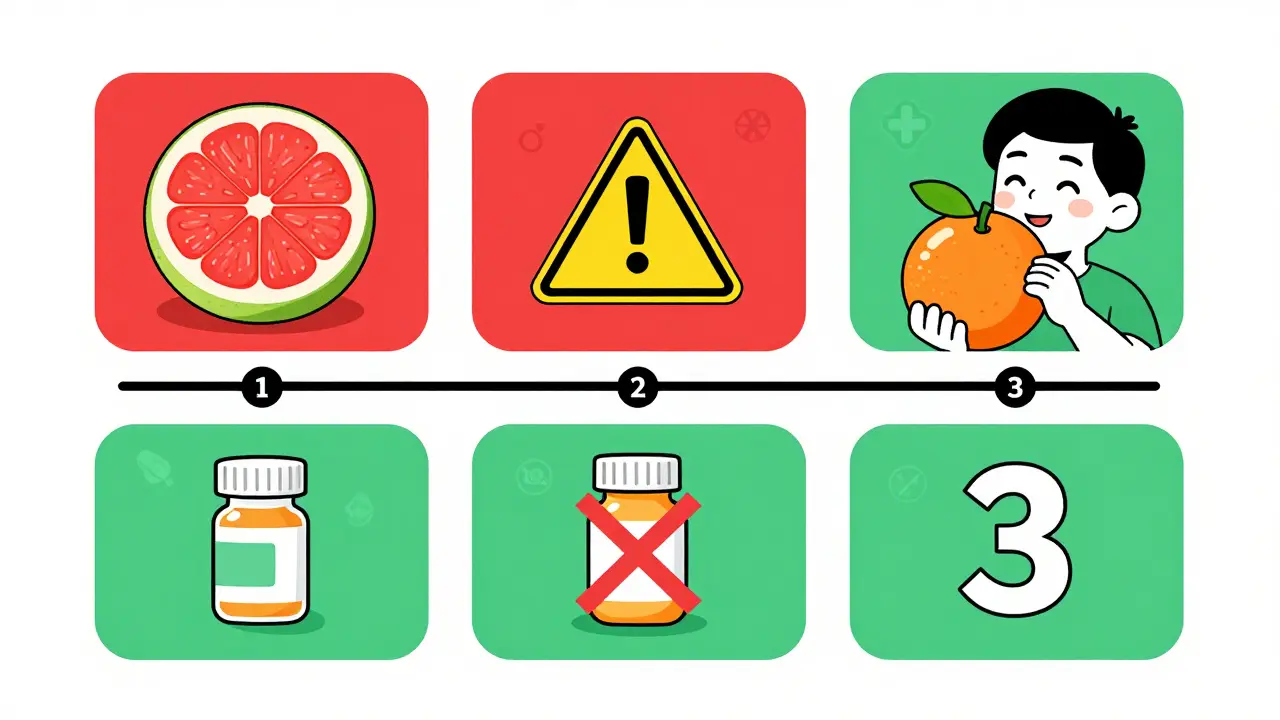
If you’re on medication:- Check your prescription label. If it says “avoid grapefruit,” assume pomelo and Seville orange are also off-limits.
- Ask your pharmacist or doctor. Don’t assume they know. Say: “I’ve heard pomelo and Seville orange can interact with meds too. Should I avoid those?”
- Read labels on marmalades and juices. If it says “Seville orange” or “bitter orange,” put it back. Even “natural flavoring” from these fruits can be risky.
- When in doubt, choose sweet oranges. Navel, Valencia, blood orange-these are safe. They don’t block the enzymes.
- Wait 72 hours. If you accidentally eat one of these fruits, don’t take your medication until three days have passed.
And if you’re a caregiver or family member: watch what’s on the table. A jar of marmalade or a bowl of pomelo might seem harmless. But if someone’s on a statin or transplant drug, it’s a silent threat.
What’s Changing?
The FDA is finally catching up. In 2023, they proposed expanding warning labels to include all furanocoumarin-containing citrus fruits-not just grapefruit. The rule is expected to go into effect by mid-2025. Until then, the burden is on you.Research is also accelerating. The University of Washington just got $2.1 million from the NIH to study pomelo interactions in detail. And electronic health records are slowly starting to flag these risks. But right now, you’re your own best defense.
Bottom Line
Pomelo and Seville orange aren’t just fancy fruits. They’re drug interaction powerhouses-sometimes stronger than grapefruit. If you’re on statins, blood pressure meds, or immunosuppressants, treat them like the hazard they are. Don’t wait for a warning label. Don’t assume “it’s just an orange.” Your life might depend on knowing the difference.Can I eat sweet oranges if I’m on medication?
Yes. Sweet oranges like navel, Valencia, or blood oranges do not contain furanocoumarins and are safe to eat with most medications. They’re the best citrus alternative if you’re avoiding grapefruit, pomelo, or Seville orange.
Is pomelo juice worse than grapefruit juice?
In many cases, yes. Studies show pomelo juice contains higher levels of furanocoumarins-up to 30% more than grapefruit juice. One study found it increased simvastatin levels by 350%, compared to 300% for grapefruit. The risk is similar, but often greater.
Does cooking or baking with Seville orange destroy the interaction risk?
No. Furanocoumarins are heat-stable. Making marmalade, jam, or baking with Seville orange doesn’t break them down. The risk remains even in cooked products. If the fruit is in the recipe, the interaction risk is still there.
I ate pomelo and took my pill the next day. Should I be worried?
Yes. The enzyme inhibition lasts up to 72 hours. Even if you ate pomelo 24 hours before your dose, your body may still be unable to metabolize the drug properly. Wait three full days before taking medications known to interact with citrus fruits.
Are there any citrus fruits that are completely safe?
Sweet oranges (navel, Valencia), tangerines, clementines, and mandarins are safe. Lemons and limes have very low levels of furanocoumarins and are generally considered low risk, but it’s still best to avoid large amounts if you’re on a sensitive medication. Stick to sweet oranges for the safest option.
Melissa Cogswell
February 1, 2026 AT 07:41I’ve been on simvastatin for years and never knew pomelo was worse than grapefruit. I thought I was being safe by switching to oranges-turns out I just needed to avoid the big pink ones at the Asian market. Learned this the hard way after a friend ended up in the ER. Always check labels now.
Also, that stat about 15% of citrus-drug interactions coming from pomelo and Seville orange? Mind blown. Why isn’t this on every prescription bottle?
Blair Kelly
February 3, 2026 AT 07:09Let’s be clear: if your pharmacist doesn’t ask you about Seville orange marmalade, they’re negligent. This isn’t ‘maybe dangerous’-it’s documented, quantified, and lethal. That 400% spike in tacrolimus? That’s not a side effect, it’s medical malpractice waiting to happen. And no, ‘I only had a spoonful’ doesn’t cut it. Furanocoumarins don’t care how much you ate-they care that you ate at all.
Stop treating this like a food blog. This is pharmacology, and people are dying because we’re lazy.
Rohit Kumar
February 3, 2026 AT 08:07In India, we’ve used bitter orange in Ayurveda for centuries-mostly in teas and skin treatments. But we never mixed it with Western meds. There’s a cultural wisdom here: if something is potent, you use it with intention, not casually. Today’s medicine treats everything like a vending machine-pop a pill, eat whatever, no consequences.
This isn’t just about enzymes. It’s about how we’ve lost the respect for substances that interact with our biology. Pomelo isn’t ‘exotic fruit.’ It’s a pharmacological agent. And we treat it like a snack.
Also, the FDA’s delay in labeling? That’s not bureaucracy-it’s capitalism. Grapefruit is a commodity. Seville orange is niche. Profit drives awareness, not safety.
Lily Steele
February 3, 2026 AT 13:46Just wanted to say thank you for this post. My dad’s on cyclosporine after his transplant and we used to put Seville marmalade on his toast every Sunday. We had no idea. Now we only use sweet orange jam and he’s been stable for 8 months.
Also, if you’re on meds and you’re not sure? Just ask. No shame. I used to think pharmacists were too busy to care. Turns out they’re just waiting for you to ask.
And yeah, sweet oranges are your friends. Navel’s my go-to now. Tastes like sunshine without the risk.
Jodi Olson
February 4, 2026 AT 04:58The notion that cooking destroys furanocoumarins is a dangerous myth. Heat stability of these compounds is well documented in peer-reviewed toxicology journals. The 2021 study from the Journal of Agricultural and Food Chemistry confirms thermal degradation is negligible below 180°C, and marmalade processing typically occurs at 100–110°C. Therefore, no, your grandmother’s recipe is not safe.
Furthermore, the FDA’s 2023 proposal is insufficient. It should mandate labeling on all citrus-derived ingredients in processed foods, including flavorings, extracts, and essential oils. Current regulations are reactive, not preventive.
Beth Beltway
February 5, 2026 AT 15:21Of course you didn’t know. You probably think ‘citrus’ means ‘orange’ and ‘grapefruit’ is the only bad one. Newsflash: ignorance isn’t bliss, it’s a death sentence. You think your ‘natural’ pomelo smoothie is healthy? It’s a silent killer for anyone on statins. And no, you don’t get a pass because you ‘only had a little.’
People like you are why hospitals are full. You don’t read labels. You don’t ask questions. You assume because it’s fruit, it’s safe. Fruit doesn’t care about your lifestyle. Enzymes do.
Stop being a liability.
Kelly Weinhold
February 5, 2026 AT 20:46Okay I just read this and I’m crying a little because my aunt almost lost her kidney and we didn’t know why. She was eating Seville orange marmalade every morning like it was normal. She thought ‘it’s just orange.’
But now? We’ve got a whole new breakfast routine. Sweet oranges, blueberries, oatmeal. No more mystery jams.
And honestly? This post saved lives. Not just mine. My cousin’s husband is on a calcium channel blocker and he’s already switched. I’m telling everyone. This needs to be on every pharmacy counter. Like, right now.
Thank you for making this so clear. No jargon. Just truth. That’s rare.
Kimberly Reker
February 6, 2026 AT 01:34Biggest takeaway: it’s not about avoiding citrus. It’s about avoiding the wrong citrus.
My mom used to make homemade marmalade with Seville oranges because it ‘tasted better.’ We didn’t know she was poisoning her own meds. Now she uses blood orange. Tastes just as good. No hospital trips.
Also, if you’re on meds and you’re unsure, Google ‘[your med] + citrus interaction’-you’ll find the FDA and Mayo Clinic pages. Don’t wait for someone to tell you. Be your own advocate.
And yes, sweet oranges are the MVPs of the citrus world. Eat them like they’re gold.
calanha nevin
February 7, 2026 AT 05:46Pharmacokinetic data unequivocally demonstrates that furanocoumarin-mediated CYP3A4 inhibition is irreversible and durationally persistent. The 72-hour washout period is not arbitrary-it reflects the half-life of enzyme regeneration in the enterocytes. This is not a suggestion. It is a physiological imperative.
Additionally, the underreporting of non-grapefruit citrus interactions in clinical databases reflects systemic diagnostic bias. Providers are trained to screen for grapefruit, not its phytochemically analogous counterparts. This is a failure of medical education, not patient negligence.
Until labeling and curriculum are updated, patient autonomy must be reinforced through accessible, non-alarmist education. This post achieves that.
April Allen
February 8, 2026 AT 16:47Here’s the real issue: the entire healthcare system treats drug interactions like a checklist, not a dynamic system. Furanocoumarins don’t just inhibit CYP3A4-they alter OATP1A2 and P-gp transporters too. That means even drugs not traditionally flagged can be affected. The 2022 Lancet paper on pomelo and metformin co-administration showed a 22% increase in plasma concentration despite metformin being ‘safe.’
So no, you can’t assume anything’s safe unless it’s explicitly validated. Sweet oranges are the only citrus fruit with a verified absence of furanocoumarins. Everything else? Assume risk until proven otherwise.
Sheila Garfield
February 8, 2026 AT 21:42I’m from Ireland and we don’t really eat pomelo here, but I’ve seen Seville orange marmalade in the UK and thought it was just fancy. This post made me check my mum’s pantry-turns out she’s been eating it with her blood pressure pills. She’s switching to sweet orange tomorrow. Thank you for making me look.
Also, I think we need more public health campaigns that say ‘this fruit can kill you’ without sounding like a scare tactic. This post? Perfect balance.
Shawn Peck
February 9, 2026 AT 23:11STOP EATING POMELO. THAT’S IT. NO EXCUSES. YOU THINK YOU’RE HEALTHY? YOU’RE JUST A WALKING HEART ATTACK IF YOU’RE ON STATINS. I’VE SEEN IT. MY COUSIN GOT PUT IN A COMA. IT WASN’T DRUGS. IT WAS THE FRUIT. THE FRUIT.
GRAPES? FINE. ORANGES? FINE. POMELO? BAN IT. JUST SAY NO.
Niamh Trihy
February 10, 2026 AT 17:24My sister’s a transplant nurse and she told me this exact thing last year-pomelo is the silent killer nobody talks about. I thought she was being dramatic. Then I read this. Now I’m checking every jar of marmalade in the house.
Also, if you’re on meds and you’ve ever had a weird muscle ache or dizziness after eating citrus? That wasn’t coincidence. It was your body screaming. Listen.