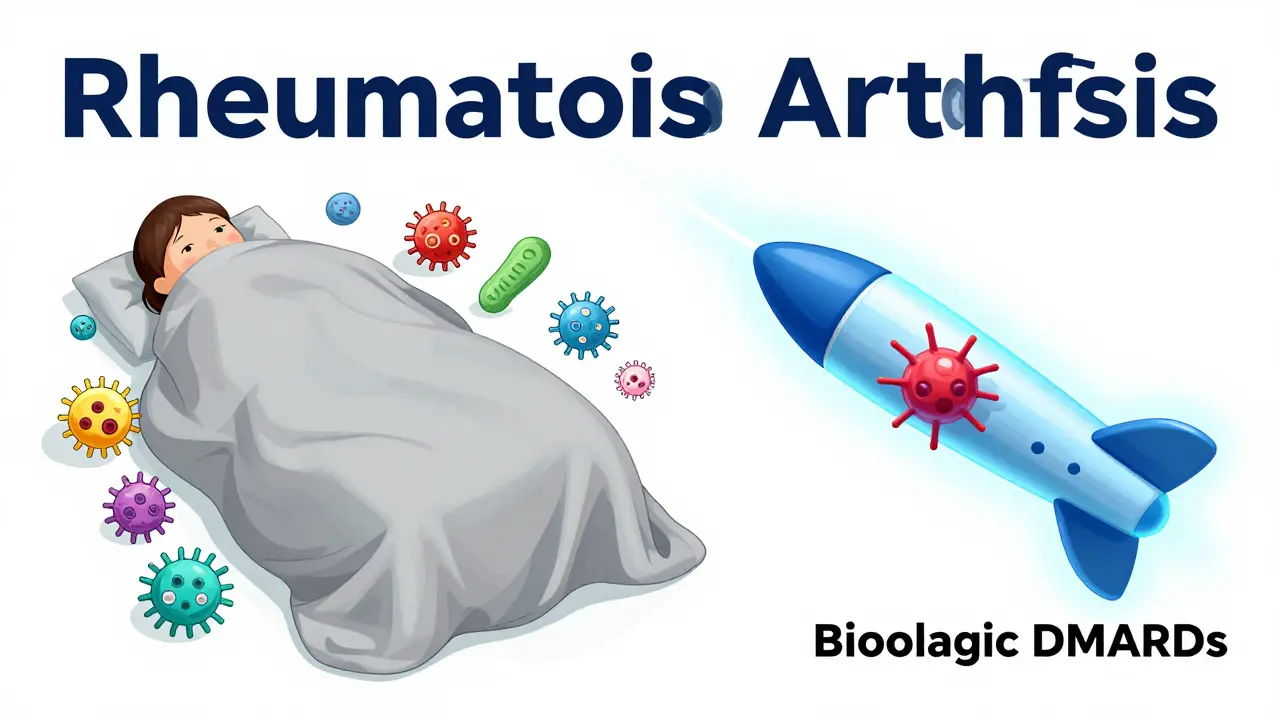
Living with rheumatoid arthritis often feels like a constant battle against your own body. For years, the goal was simply to manage the pain and keep joints from warping. But things have changed. We've moved into an era where Biologic DMARDs make it possible for many people to actually reach disease remission-a state where inflammation vanishes and the disease stops attacking the joints entirely.
If you've tried standard medications like methotrexate and they didn't quite do the trick, you're not alone. About 30% of people with RA find that conventional treatments aren't enough. That's where biologics come in. These aren't your typical pills; they are complex proteins engineered to target the specific parts of your immune system that cause the chaos in your joints. While the idea of "biologics" might sound intimidating, they've transformed RA from a guaranteed path to disability into a manageable condition.
| Class | Common Examples | How it Works | Admin Method |
|---|---|---|---|
| TNF Inhibitors | Adalimumab, Etanercept | Blocks TNF protein | Injection/Infusion |
| IL-6 Inhibitors | Tocilizumab | Blocks IL-6 receptor | Injection/Infusion |
| B-Cell Depletors | Rituximab | Targets CD20 on B-cells | IV Infusion |
| T-Cell Modulators | Abatacept | Prevents T-cell activation | Injection/Infusion |
Understanding Biologic DMARDs
To understand how these work, we first need to look at the central player: Biologic DMARDs is a class of targeted therapies designed to specifically inhibit components of the immune system responsible for inflammation in rheumatoid arthritis . Unlike traditional synthetic DMARDs, which act like a broad blanket suppressing the whole immune system, biologics are like precision missiles. They target specific proteins called cytokines.
The first big breakthrough happened in 1998 when Etanercept (known by the brand Enbrel) was approved. It belongs to the TNF inhibitors group, which blocks Tumor Necrosis Factor, a key signaling protein that tells your body to create inflammation. Since then, the toolkit has expanded to include other targets like Interleukin-6 (IL-6) and B-cells, giving doctors more options when the first drug doesn't work.
The Road to Disease Remission
What does "remission" actually mean? In the world of RA, it's not just about feeling "better." It's about reaching a point where clinical markers of inflammation are near zero and you have no active joint swelling. For most people using conventional meds, the chance of hitting this gold standard is only about 5-15%. However, for those on appropriate biologic therapy, that number jumps to 20-50%.
Doctors often use a "treat-to-target" strategy. This means they don't just give you a dose and hope for the best; they use a metric called DAS28, which is a composite index that measures the number of tender and swollen joints along with blood markers of inflammation . If your score isn't dropping fast enough within 3 to 6 months, they might switch your biologic or add methotrexate to the mix. This aggressive approach is designed to stop joint damage before it becomes permanent on an X-ray.

Choosing the Right Biologic: Not One Size Fits All
You might wonder why there are so many different types of biologics if they all treat the same disease. The truth is, RA is different in every person. Some people have an "inflammatory profile" dominated by B-cells, while others are driven by TNF. If you have low synovial B-cell signatures, a drug like Rituximab (Rituxan) might only have a 12% chance of working, whereas Tocilizumab (Actemra) could have a 50% success rate for that same person.
Then there are the "targeted synthetic's" like JAK Inhibitors. These aren't biologics (they are small molecules you take as a pill), but they act similarly by blocking the Janus Kinase pathway inside the cell. Newer options like upadacitinib have shown they can sometimes outperform traditional TNF inhibitors in head-to-head trials, especially for people who didn't respond to earlier treatments.
The Real-World Trade-offs: Side Effects and Costs
It's not all sunshine and rainbows. The biggest downside to biologics is the risk of infection. Because you're turning off a specific part of your immune system, you're slightly more vulnerable to things like tuberculosis or severe pneumonia. You'll likely need a screening for TB before you even start the first dose.
Then there's the money. Biologics are expensive. In the US, costs can range from $50,000 to $70,000 a year. This is why Biosimilars have become so popular. Think of a biosimilar as a "generic' version of a biologic. They are highly similar in structure and effect but usually cost 15-30% less. While some patients worry about switching, the data shows they are just as effective at keeping the disease in check.
Practical Tips for Starting Biologic Therapy
Starting a biologic is a bit of a learning curve. If you're using a subcutaneous injection (like a pen or syringe), you'll need to learn the right technique to avoid skin reactions. Most people get the hang of it in a couple of weeks after a few sessions with a nurse. A pro tip: rotate your injection sites-thighs, stomach, and upper arms-to reduce the chance of developing hard lumps under the skin.
You also need to keep a close eye on your health. If you develop a fever or a persistent cough, call your rheumatologist immediately. Because these drugs mask inflammation, a typical "red flag" like a high fever might not appear as strongly as it would otherwise, making early detection of infection crucial.
What Happens When the Meds Stop Working?
One of the most frustrating parts of RA is "secondary non-response." This is when a drug works like a charm for two years, and then suddenly, the joint pain comes back. This happens to about 40% of patients. Your body essentially figures out a way to bypass the drug or develops antibodies against it.
When this happens, the strategy is usually to switch the mechanism of action. If a TNF inhibitor stopped working, your doctor might move you to an IL-6 inhibitor or a JAK inhibitor. The key is not to panic-most people can find a second or third biologic that gets them back into remission.
Do I have to take methotrexate with my biologic?
Not necessarily, but it's very common. Using a biologic in combination with methotrexate often works better than using the biologic alone because it prevents your body from creating antibodies against the drug, making the treatment last longer.
How long does it take for a biologic to start working?
TNF inhibitors often provide relief within a few days to a couple of weeks. Other biologics, like those targeting B-cells or T-cells, can take longer-sometimes several weeks or months-before you feel the full effect.
Are biosimilars as safe as the original biologic?
Yes. Biosimilars must undergo rigorous testing to prove they are clinically equivalent to the original product. They provide the same therapeutic benefit and have a similar safety profile, but at a lower cost.
Can I take biologics if I am planning a pregnancy?
It depends on the specific drug. Some biologics are safer than others during pregnancy. You must discuss this with your rheumatologist early on, as some medications require a strict washout period before conceiving.
What is the biggest risk of using these drugs?
The primary risk is an increased susceptibility to serious infections. Because these drugs suppress parts of your immune system, you may be more prone to opportunistic infections or have a harder time fighting off a common cold or flu.