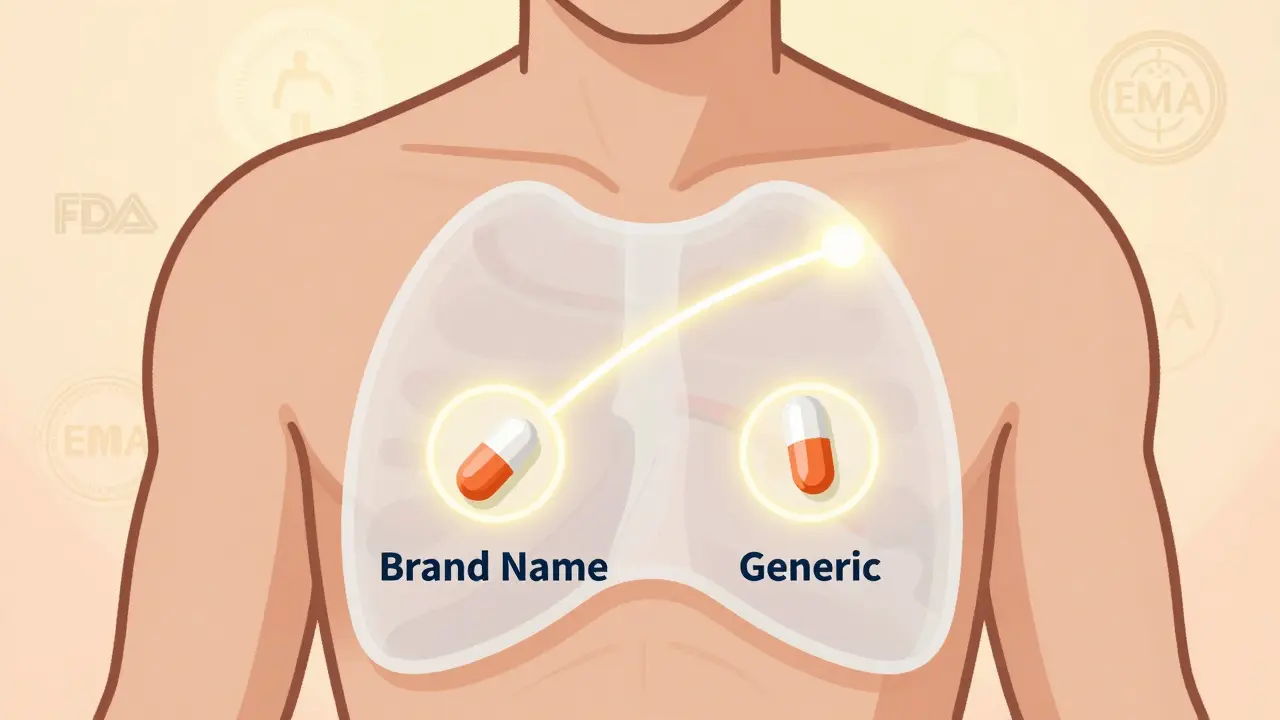
When you pick up a prescription at the pharmacy and see a different name on the pill bottle than what your doctor wrote, it’s natural to wonder: is this really the same thing? That’s where bioequivalence comes in - a quiet but vital science that keeps millions of patients safe every day.
Let’s cut through the noise. Bioequivalence isn’t just a regulatory checkbox. It’s the scientific guarantee that a generic drug performs exactly like its brand-name counterpart. Not "close enough." Not "probably the same." But identical in how your body absorbs and uses it. This isn’t theory. It’s measured, tested, and enforced by global health agencies like the FDA and EMA. And without it, generic drugs wouldn’t be the backbone of modern healthcare.
What Bioequivalence Actually Means
Bioequivalence is defined by one simple standard: if you take two versions of the same drug - say, brand-name Lipitor and its generic atorvastatin - your bloodstream must see the same amount of medicine, at the same speed. This is measured through two key numbers: AUC (how much drug gets absorbed over time) and Cmax (how high the drug spikes in your blood).
The rule? The generic must deliver between 80% and 125% of the brand’s performance. That’s not a random range. It’s based on decades of clinical data showing that within this window, patients experience the same benefits and risks. For most drugs, this works perfectly. But for drugs like warfarin, levothyroxine, or phenytoin - where even a tiny change can cause a blood clot or seizure - regulators tighten the range to 90-111%. These aren’t arbitrary numbers. They’re safety thresholds built from real patient outcomes.
These tests don’t happen in labs with vague assumptions. They’re done in controlled clinical studies, usually with healthy volunteers who take both the brand and generic versions in a crossover design. Blood samples are taken every hour for 24-72 hours. The data is analyzed using strict statistical models. If the 90% confidence interval for the ratio of AUC and Cmax falls within 80-125%, the drug is approved. No exceptions. No shortcuts.
Why This Matters More Than You Think
Imagine switching from your brand-name blood pressure pill to a generic because your insurance requires it. You don’t want to risk your health. But here’s the truth: bioequivalence testing makes that switch safe.
In the U.S., 90% of prescriptions are filled with generics. Yet they cost just 23% of what brand drugs do. In 2020 alone, generics saved the American healthcare system $313 billion. That’s not just money. That’s access. Without bioequivalence, those savings wouldn’t exist. Patients would be forced to pay hundreds more per month - or skip doses entirely.
And it’s not just about cost. It’s about consistency. If you’re on a long-term medication - say, for epilepsy, thyroid disease, or depression - your body adapts to a specific level of the drug. Switching to a product that absorbs too slowly or too quickly can throw your whole treatment off. Bioequivalence testing prevents that. It ensures that every pill, whether from a brand or a generic manufacturer, delivers the same result.
The FDA doesn’t approve generics based on price. They don’t approve them because they look the same. They approve them because the science says they behave the same inside your body. And that’s what protects you.
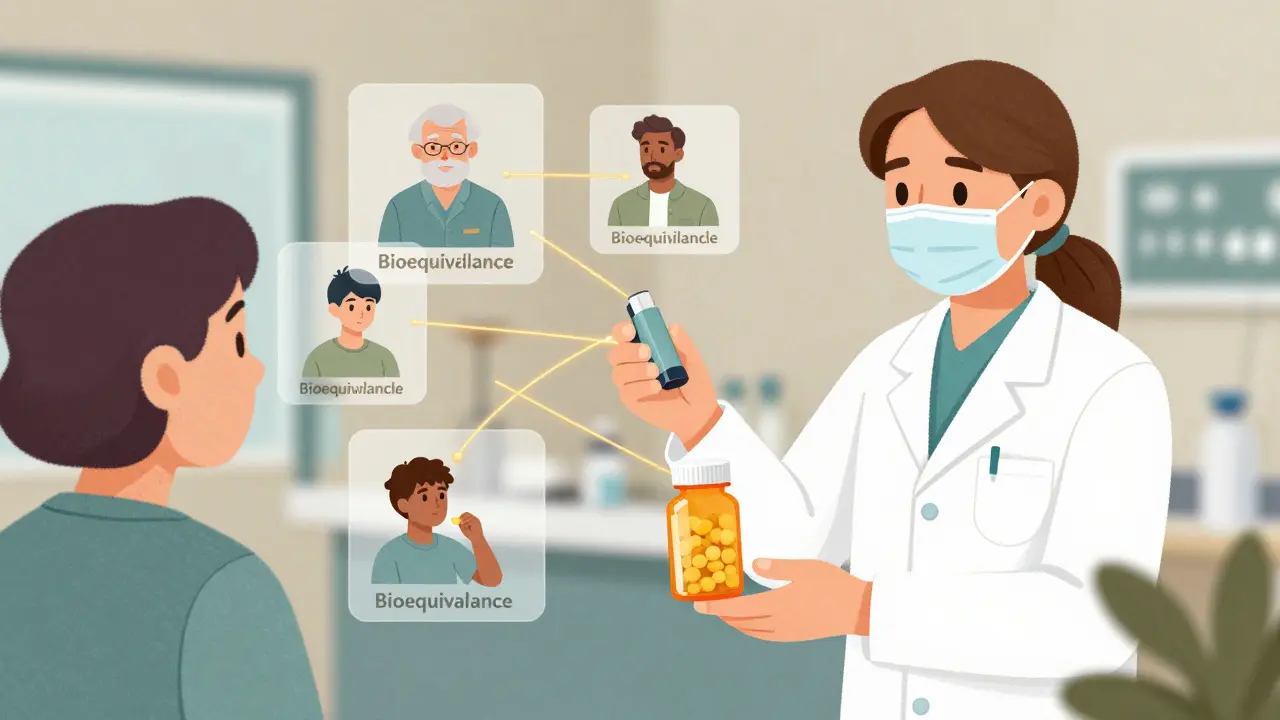
The Hidden Challenges: When Bioequivalence Gets Hard
Not all drugs are created equal. Some are simple. Others? They’re complicated.
Take topical creams. Applying a generic steroid cream to your skin shouldn’t be any different than the brand. But skin absorbs drugs differently than your stomach. A cream might look identical, but if the active ingredient doesn’t penetrate the right layer, it won’t work. That’s why the EMA introduced new in-vitro and in-vivo testing methods in 2023 - because traditional blood tests don’t capture what’s happening on the skin.
The same goes for inhalers, eye drops, and injectables. These drugs don’t enter the bloodstream the same way pills do. Their effectiveness depends on delivery mechanics - particle size, spray pattern, viscosity. That’s why the FDA launched its Complex Generic Drug Products initiative in 2022. It’s a direct response to the fact that bioequivalence for these products can’t be measured with old methods.
And then there’s the problem of highly variable drugs. Some people’s bodies absorb a drug wildly differently from others. For these, regulators use scaled bioequivalence. Instead of a fixed 80-125% range, they widen it to 75-133% - but only if the drug’s variability is high enough and the average difference between brand and generic stays under 10%. This isn’t a loophole. It’s precision. It stops bad products from slipping through while still allowing safe ones to reach patients.
What About Patient Stories? Are Some People Really Having Problems?
You’ve probably seen posts online: "I switched to generic sertraline and felt awful." Or, "My thyroid meds stopped working after I changed brands."
Yes, these stories happen. But here’s what the data says: they’re rare, and rarely caused by bioequivalence failure.
The FDA’s Adverse Event Reporting System (FAERS) shows that only 0.07% of all adverse drug events between 2020 and 2023 involved generic drugs with confirmed bioequivalence. Meanwhile, 2.3% involved brand-name drugs - which suggests that brand-name drugs aren’t immune to side effects either.
So why do people report problems? Often, it’s not the drug. It’s the pill itself. Different fillers, coatings, or manufacturing processes can change how a pill dissolves in your stomach. For someone with a sensitive gut, a different binder might cause bloating. That’s not bioequivalence failure - it’s a side effect of inactive ingredients. And those aren’t tested in bioequivalence studies because they don’t affect how the medicine works.
Pharmacists know this. When patients report issues, they often switch back to the original generic version - not because the new one is unsafe, but because the patient’s body reacted to a different inactive component. It’s like switching from one brand of coffee to another. The caffeine is the same. But if you’re sensitive to the roast, you might notice a difference.
And here’s the kicker: after the FDA tightened bioequivalence standards for levothyroxine in 2012, patient satisfaction went up. On Drugs.com, 58% of users now say the generic works the same as the brand. That’s not coincidence. It’s science working.
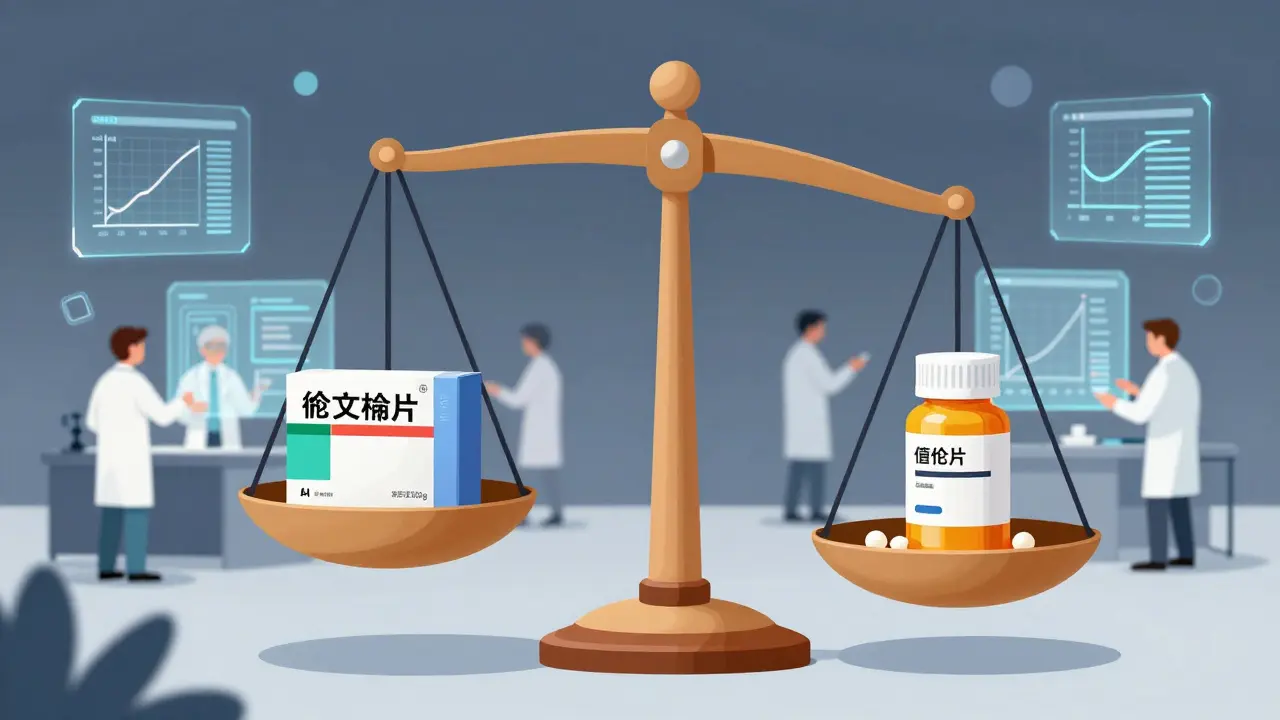
The Bigger Picture: Global Standards and the Future
Not every country does bioequivalence the same way. Japan requires fasting studies even if the brand is meant to be taken with food. Brazil mandates certain medical tests regardless of the study design. These differences make it harder for manufacturers to sell globally - but they also mean regulators are constantly learning.
The International Pharmaceutical Regulators Programme (IPRP) is now working with 16 countries to harmonize rules. Why? Because patients shouldn’t get different quality depending on where they live. And with 134 countries now requiring bioequivalence testing - up from 89 in 2015 - the world is aligning on one truth: safety isn’t optional.
What’s next? Artificial intelligence is starting to predict bioequivalence from dissolution profiles. The FDA is already accepting computer models to replace some clinical studies. This doesn’t mean less testing - it means smarter testing. Faster, cheaper, and just as reliable.
And it’s not just about pills. Biosimilars - the biologic cousins of generics - are now entering the market. They’re more complex, made from living cells, and require a whole different set of tests. But the goal is the same: prove they work just like the original. No shortcuts. No compromises.
What You Can Do
If you’re prescribed a generic drug, you don’t need to worry. The system is built to protect you. But if you notice changes - mood swings, side effects, lack of effectiveness - talk to your pharmacist. They can tell you if the generic changed, and if it’s the same formulation you’ve used before.
Don’t assume a generic is "inferior." It’s not. It’s just cheaper. And it’s been tested harder than most people realize.
Every time you choose a generic, you’re not just saving money. You’re supporting a system that has saved trillions globally. A system that ensures your child’s asthma inhaler, your parent’s blood thinner, and your own antidepressant all work exactly as they should.
That’s not luck. That’s science. And it’s working.
Are generic drugs as safe as brand-name drugs?
Yes. Generic drugs must meet the same strict standards for quality, purity, and strength as brand-name drugs. The only difference is cost. Bioequivalence testing ensures they deliver the same amount of active ingredient at the same rate, meaning they work the same way in your body. The FDA and EMA require this before approval.
Why do some people say generics don’t work for them?
Most often, it’s not the active drug that’s the issue - it’s the inactive ingredients like fillers, dyes, or coatings. These can affect how a pill dissolves or how your stomach reacts. For example, someone with a sensitive gut might feel bloated from a different binder. This doesn’t mean the generic is unsafe or ineffective. It just means your body reacted to something non-medical. Switching back to the original generic version often fixes it.
Do bioequivalence tests always use healthy volunteers?
Usually, yes - because it’s safer and more controlled. But for drugs where stopping treatment could be dangerous - like blood thinners or epilepsy meds - studies are done in patients instead. The goal is the same: measure how the drug enters the bloodstream. The only difference is who’s taking it.
What’s the difference between bioequivalence and therapeutic equivalence?
Bioequivalence means the drug is absorbed the same way in the body. Therapeutic equivalence means it works the same way clinically - same benefits, same side effects. Bioequivalence is the scientific proof used to predict therapeutic equivalence. If two drugs are bioequivalent, regulators assume they’re therapeutically equivalent. For most drugs, this holds true. For narrow therapeutic index drugs, extra checks are done.
Are biosimilars held to the same standard as generics?
No. Biosimilars are not the same as generics. Generics are chemically identical copies of small-molecule drugs. Biosimilars are copies of complex biologic drugs made from living cells. They can’t be exact copies, so regulators use a "totality of evidence" approach - comparing structure, function, immune response, and clinical outcomes. They’re still safe and effective, but the testing is more complex.
Amisha Patel
March 13, 2026 AT 17:23Interesting read. I’ve been on generics my whole life in India and never had an issue. But I do wonder how much of the testing is done on diverse populations. Most studies use Western volunteers-what about our metabolism differences? Just thinking out loud.
Elsa Rodriguez
March 14, 2026 AT 07:31Okay but like… I switched to generic sertraline and became a sobbing mess for three weeks. My therapist said it was ‘probably the filler.’ Yeah right. I’m not dumb. Something’s off and no one wants to admit it.
Serena Petrie
March 15, 2026 AT 15:56Generics work. Stop overthinking it.
Buddy Nataatmadja
March 17, 2026 AT 03:14My uncle in Jakarta takes the same generic blood pressure med I do. Same pill, same dose. He’s fine. I’m fine. Guess science works across borders too.
Stephanie Paluch
March 17, 2026 AT 08:55My mom’s on levothyroxine and she swears the generic made her feel like a zombie. We switched back to the brand for a month, then tried a different generic-same one she used before-and boom, back to normal. Turns out it was the batch, not the drug. 😅
tynece roberts
March 17, 2026 AT 15:35so like i used to take the brand name for my anxiety and then my insurance made me switch and i thought i was gonna die lol. felt weird for like 2 weeks. but then i realized it was just my brain being dramatic. like, the pill is the same. its just the color and the little star on it that made me feel like i was being robbed. now i dont even notice. also i think the new generic tastes like chalk but whatever. 🤷♀️
Rex Regum
March 17, 2026 AT 18:35Oh great. Another corporate shill pretending FDA testing is flawless. Ever heard of the 2018 Ranbaxy scandal? Or the 2020 Indian generic plant that got shut down for falsifying data? This isn’t science-it’s a profit game with a pretty infographic.
Kelsey Vonk
March 19, 2026 AT 12:34I like how you framed this-not as ‘brand vs generic’ but as ‘science vs fear.’ It’s funny how we trust a pill more when it costs more. Like price = purity. But the data doesn’t lie. It’s comforting to know someone’s checking the math so we don’t have to.
Emma Nicolls
March 19, 2026 AT 17:25just wanna say thank you for explaining this so clearly. i always thought generics were just cheap knockoffs. now i get it. theyre like the same song but a different album cover. and honestly? i’d rather save money and not feel guilty. 🙏
Jimmy V
March 20, 2026 AT 21:23Let’s be real: if you’re worried about your generic, you’re probably not reading this. You’re scrolling through Reddit at 3 a.m. Go talk to your pharmacist. They’ve seen 10,000 bottles. They’ll tell you if it’s the pill or your anxiety. And no, your gut isn’t ‘sensitive’-it’s just scared of the new logo.
Richard Harris
March 21, 2026 AT 07:45Good summary. I’ve been on the same generic for 7 years. No issues. But I do wonder if the testing is as strict in lower-income countries. Hope they’re not cutting corners. 🤞