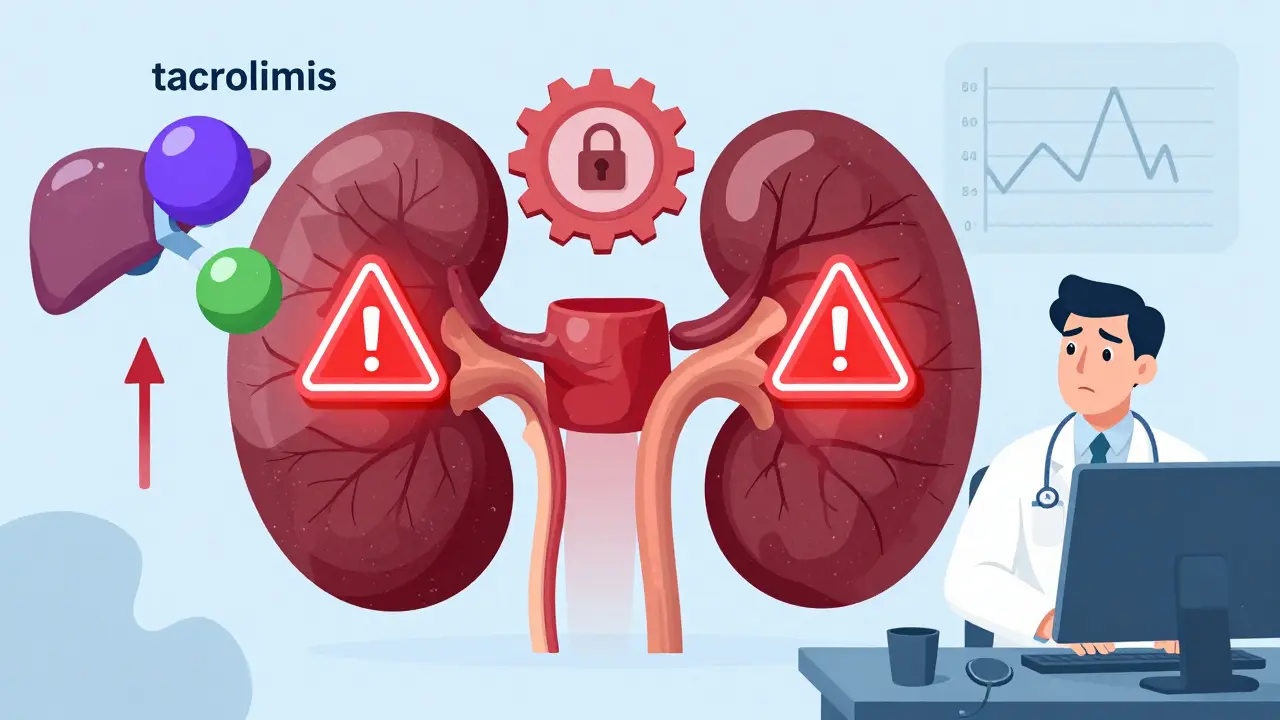
Tacrolimus-Azole Dose Calculator
Adjust Tacrolimus Dose When Adding Azole
When a transplant patient gets a fungal infection, doctors reach for azole antifungals like voriconazole or posaconazole. They work well. But there’s a hidden danger: these drugs can send tacrolimus levels soaring-sometimes by 300% or more-and trigger acute kidney injury. This isn’t rare. It happens weekly in transplant clinics. And it’s preventable-if you know what to look for.
Why Azoles and Tacrolimus Don’t Mix
Tacrolimus is the backbone of immunosuppression after kidney, liver, and lung transplants. It keeps the body from rejecting the new organ. But it’s a narrow-margin drug. Too little? Rejection risk goes up. Too much? Kidneys get damaged. The difference between safe and toxic is often just a few nanograms per milliliter. Azoles-ketoconazole, itraconazole, voriconazole, posaconazole-are antifungals that block a liver enzyme called CYP3A4. That’s the same enzyme that breaks down tacrolimus. When azoles shut down CYP3A4, tacrolimus doesn’t get cleared. It builds up. Fast. A 2023 review in Frontiers in Transplantation found that voriconazole can increase tacrolimus levels by 100-300%. Ketoconazole? Up to 500%. Even posaconazole, often seen as "safer," can push levels up by 150%. That’s not a small bump. That’s a crash course in nephrotoxicity.What Happens When Tacrolimus Spikes
The kidneys don’t handle high tacrolimus well. The drug causes vasoconstriction in the tiny blood vessels inside the kidney, reducing blood flow. That’s the first step toward acute kidney injury. Creatinine rises. Urine output drops. Patients get fatigued, nauseous, confused. One kidney transplant recipient on a patient forum described it this way: "My tacrolimus level jumped from 6.5 to 18.2 overnight after starting voriconazole. My creatinine doubled in 48 hours. I ended up in the hospital with acute kidney injury. I didn’t know antifungals could do that." This isn’t an outlier. A 2022 survey of 127 transplant pharmacists found that 76% saw at least one unplanned hospital admission per month due to this interaction. In some centers, azole-tacrolimus interactions account for 15-20% of all tacrolimus-related kidney damage.Not All Azoles Are Equal
The risk isn’t the same across all azoles. Here’s how they stack up:| Azole | CYP3A4 Inhibition Strength | Typical Tacrolimus Level Increase | Recommended Tacrolimus Dose Reduction |
|---|---|---|---|
| Ketoconazole | Strongest | 300-500% | 75% |
| Voriconazole | Strong | 100-300% | 50-75% |
| Itraconazole | Strong | 150-250% | 50-75% |
| Posaconazole | Moderate | 100-150% | 25-50% |
| Isavuconazole | Weak | 30-50% | 0-25% |
Isavuconazole is the outlier. It’s newer, and it doesn’t slam CYP3A4 the way the others do. Studies show it raises tacrolimus levels by only 30-50%. That’s why some transplant centers are switching to it-especially for long-term prophylaxis. But insurance often blocks it because it’s more expensive. So clinicians are stuck choosing between safety and cost.
What Happens If You Don’t Adjust the Dose
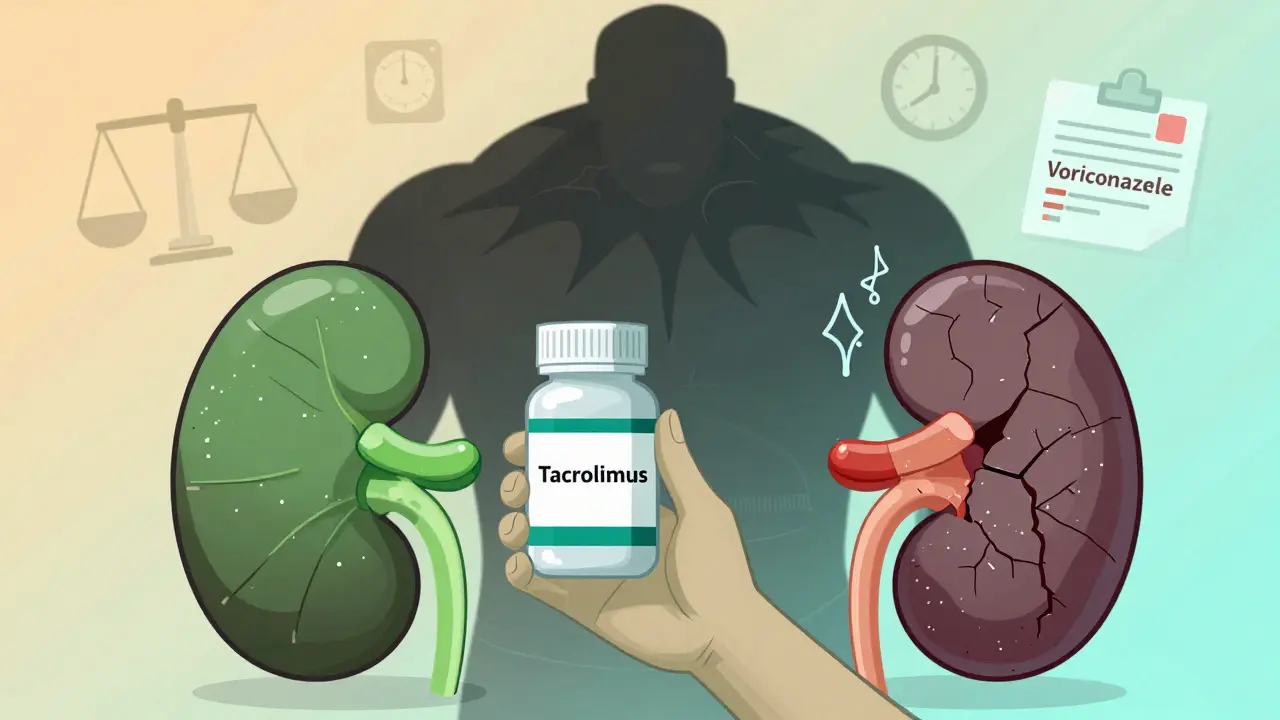
Let’s say a liver transplant patient is on 3 mg of tacrolimus twice daily. Their levels are stable at 8 ng/mL. Then they get pneumonia with fungal involvement. The doctor starts voriconazole. No dose change to tacrolimus. Within 72 hours, levels hit 24 ng/mL. Creatinine jumps from 1.2 to 2.8. The patient develops high blood pressure, swelling in the legs, and confusion. That’s not just "elevated levels." That’s acute nephrotoxicity. And it’s reversible-if caught early. But in 35% of severe cases, according to data from the University of Pittsburgh Medical Center, the interaction goes unnoticed until the patient is already in kidney failure. Why? Because many clinics still rely on outdated protocols. Or the patient isn’t monitored closely enough.How to Manage the Interaction Safely
There’s a clear, evidence-based path forward:- Reduce tacrolimus dose before starting the azole. For voriconazole or ketoconazole, cut the dose by 50-75%. For posaconazole, reduce by 25-50%. For isavuconazole, reduce by 0-25%.
- Check tacrolimus levels daily for the first 3-5 days. Don’t wait for a scheduled check. Levels can spike fast.
- Switch to isavuconazole if possible. Especially for patients on long-term antifungal therapy. It’s safer, and the cost difference narrows over time when you factor in avoided hospitalizations.
- Use C/D ratios (concentration per dose), not just trough levels. A 2023 study showed this approach reduces nephrotoxicity by 22% compared to standard monitoring.
- Know your patient’s CYP3A5 status. About half of people of African descent are "expressers"-they break down tacrolimus faster. That means they might need higher doses to begin with, and the interaction might be less dramatic. But this testing isn’t routine yet.
Centers that implemented these protocols saw a 60% drop in toxicity events since 2020. That’s not magic. That’s systematic care.
Alternatives to Azoles
If the risk is too high, what else can you use?- Echinocandins (caspofungin, micafungin): No CYP3A4 inhibition. Safe with tacrolimus. But they’re IV-only and don’t cover all fungi.
- Lipid-formulation amphotericin B: Also safe for CYP3A4, but it’s nephrotoxic on its own. So you’re trading one kidney risk for another.
- Fluconazole: Weak CYP3A4 inhibitor. Only works against Candida. Useless for aspergillosis or other molds.
So the trade-off is real. Azoles give you broad coverage and oral dosing-critical for outpatient care. But they come with a price tag in kidney function. Sometimes, the best choice isn’t the strongest antifungal. It’s the one that doesn’t wreck your transplant.
The Bigger Picture
Transplant survival is better than ever. In the U.S., 97% of kidney transplant patients are alive one year after surgery. That means more people are living long-term on tacrolimus. And that means more people are getting fungal infections-especially lung transplant recipients, where 85% get azole prophylaxis. This interaction isn’t going away. In fact, it’s growing. With 42,857 transplants performed in 2022 alone, and antifungal use rising, the number of patients at risk is climbing. New tools are helping. The FDA approved a new extended-release tacrolimus formulation in 2023 that smooths out peak levels-making toxicity less likely. And by 2024, the American Society of Transplantation will update guidelines to include CYP3A5 genotyping in decision-making. But the most powerful tool remains: awareness. If you’re managing a transplant patient, you need to ask: "Are they on an azole?" before you even think about a new medication.What Patients Should Know
If you’re on tacrolimus and your doctor prescribes an antifungal:- Ask: "Will this raise my tacrolimus level?"
- Ask: "Will my dose need to be lowered?"
- Ask: "How often will my blood be checked?"
- Watch for swelling, fatigue, less urine, or confusion. Report it immediately.
This isn’t about being paranoid. It’s about being informed. The interaction is well-documented. The solutions exist. You just need to speak up.
Can azoles cause permanent kidney damage when used with tacrolimus?
Yes, if the interaction is not caught early. Repeated or severe spikes in tacrolimus levels can lead to chronic kidney injury, scarring of the kidney tissue, and even loss of transplant function. The damage is often reversible if levels are lowered quickly, but delays can result in permanent loss of kidney function.
Is it safe to use fluconazole instead of voriconazole with tacrolimus?
Fluconazole is a weaker CYP3A4 inhibitor than voriconazole, so it’s safer-but only if the infection is caused by Candida. It won’t work for aspergillosis or other molds. If you need broad coverage, fluconazole isn’t enough. The trade-off is safety vs. effectiveness.
Why do some transplant centers still have toxicity cases despite knowing about this interaction?
Three main reasons: inconsistent monitoring, delayed recognition, and lack of standardized protocols. In 2022, a survey found that 25-30% of transplant centers still had at least one severe case annually. Many still rely on paper charts or don’t have electronic alerts in their systems. It’s not ignorance-it’s system failure.
Does the timing of azole administration matter?
Yes. Starting the azole while tacrolimus levels are already high increases risk. The safest approach is to reduce tacrolimus before starting the azole-not after. Waiting until levels spike means you’re already in crisis mode. Proactive adjustment saves kidneys.
Are there any new drugs that avoid this interaction entirely?
Yes. Belatacept is a newer immunosuppressant that doesn’t rely on CYP3A4 metabolism. It’s approved for kidney transplants and avoids azole interactions entirely. But it’s not used as first-line because it carries a higher risk of early rejection and requires IV infusions. It’s a good option for patients with repeated drug interactions.
Raj Kumar
December 16, 2025 AT 09:36Man, this is why I always double-check med interactions before prescribing. I work in a small clinic in Mumbai and we see this all the time - azoles on tacrolimus patients without adjusting doses. One guy ended up in dialysis because they didn’t catch it. We now have a checklist on our EHR. Simple fix, huge impact.
Also, isavuconazole is a game-changer if insurance lets you use it. Worth the extra cost when you factor in avoided hospital stays.
Christina Bischof
December 16, 2025 AT 16:29So basically if you’re on a transplant med and get a fungal infection, your doctor might accidentally poison your kidneys unless they’re super on top of it?
Yikes. I’m glad I asked questions when I got my fluconazole script last year. My pharmacist caught it before the doc even did.
Nupur Vimal
December 17, 2025 AT 17:04Everyone’s acting like this is new news but this has been textbook for decades. CYP3A4 inhibition isn’t rocket science. If you’re a clinician and you don’t know this by now you shouldn’t be prescribing anything. I’ve seen residents get this wrong and patients pay the price. Stop acting surprised. This is basic pharmacology.
Also fluconazole doesn’t work for aspergillus so stop pretending it’s a safe alternative. You’re just delaying the inevitable with weak drugs.
Cassie Henriques
December 19, 2025 AT 14:12Isavuconazole is literally the MVP here 🙌 I pushed for it at my hospital last year and got so much pushback because of cost. But we’ve had zero toxicity cases since switching. My patients are thriving. We’re even saving money long-term. Insurance needs to wake up.
Also CYP3A5 genotyping? YES PLEASE. My African American patient had way higher tacrolimus clearance than expected - we adjusted and boom, stable levels. Why isn’t this routine yet??
Michelle M
December 21, 2025 AT 05:26It’s funny how medicine has all the answers but still struggles to implement them. We know how to prevent this. We have the tools. We have the data. But systems are broken. People are tired. Protocols are buried in PDFs no one reads.
Maybe the real problem isn’t the drug interaction - it’s that we’ve normalized burnout. We expect clinicians to remember every possible interaction while drowning in charts, alerts, and paperwork.
What if we stopped blaming individuals and fixed the system instead?
One nurse at my hospital started printing laminated interaction cards and hanging them by the med carts. Guess what? Toxicity dropped 70%. Sometimes the simplest things save lives.
Lisa Davies
December 21, 2025 AT 20:10As a transplant nurse, I see this every week 😔
Patients come in confused, scared, and overwhelmed. They don’t know what azoles are. They just know they’re on a million pills already.
We started handing out little color-coded cards: RED = DANGER (voriconazole/ketoconazole), YELLOW = CAUTION (posaconazole), GREEN = SAFE (isavuconazole).
Parents now bring them to appointments. One mom showed me hers with a highlighter on ‘ask about dose change’ - I cried.
Education isn’t fancy. It’s just clear, simple, and repeated. 💙
Jake Sinatra
December 23, 2025 AT 08:31This is a textbook case of clinical negligence masked as innovation. The interaction between azoles and tacrolimus has been documented since the late 1990s. The fact that 25-30% of transplant centers still experience preventable nephrotoxicity annually is not an accident - it is institutional failure.
Electronic health record systems must implement mandatory alerts triggered by concurrent azole and tacrolimus prescriptions. No exceptions. No waivers. No excuses.
Furthermore, isavuconazole should be the first-line agent for all transplant patients requiring prolonged antifungal therapy. Cost is not a valid argument when patient safety and long-term graft survival are at stake.
Let me be clear: every case of avoidable acute kidney injury in this context is a preventable medical error.
RONALD Randolph
December 25, 2025 AT 07:58What’s wrong with America? We have the science, the guidelines, the data - and yet we let insurance companies decide who lives and who gets kidney failure?!
Isavuconazole is cheaper in the long run - but you’d rather pay $50K for a hospital stay than $300 for a pill?
And don’t get me started on the ‘CYP3A5 genotyping isn’t routine’ nonsense. We test for blood type before surgery - why not test for metabolism? This isn’t science - it’s bureaucratic incompetence.
Fix the system. Or stop pretending you care about transplant patients.
Benjamin Glover
December 25, 2025 AT 17:53It’s rather elementary, really. The CYP3A4 interaction is well-established. The only surprise here is the persistence of suboptimal practice in a field that prides itself on evidence-based medicine.
That said, the American healthcare system’s reluctance to adopt cost-effective alternatives - despite overwhelming data - speaks volumes about its structural dysfunction.
Meanwhile, in the UK, we’ve had isavuconazole on formulary since 2021. No drama. No crises. Just rational prescribing.
Perhaps the real issue isn’t pharmacology - but cultural inertia.