
For millions of people, asthma isn’t just a cough or a wheeze-it’s a constant balancing act. One missed dose, a walk through pollen-heavy park, or a cold draft can turn a quiet day into a struggle for breath. The good news? Asthma can be controlled. Not just managed, but truly controlled. And the latest guidelines from 2025 make it clearer than ever how to do it.
It’s Not About Using an Inhaler-It’s About Using the Right One
For years, many people with asthma were told to reach for a blue inhaler-usually salbutamol (albuterol)-whenever they felt tightness. That blue inhaler is a short-acting beta-agonist (SABA), and it works fast. But relying on it alone? That’s like putting a bandage on a leaky pipe. It stops the drip for now, but the pipe keeps breaking. The 2025 VA/DOD and GINA guidelines have made one thing crystal clear: no one should be on SABA-only treatment anymore. Not even someone with mild, occasional symptoms. Studies show SABA-only use increases the risk of severe attacks and even death. The shift isn’t subtle-it’s a full reset in how we treat asthma. Now, every adult and adolescent with asthma should be on an inhaled corticosteroid (ICS). That’s the red or brown inhaler. It doesn’t give instant relief, but it reduces inflammation in your airways over time. For most people, the best option is a combination inhaler: ICS plus a fast-acting LABA like formoterol. This single device works as both your daily controller and your rescue inhaler. Need relief? Use it. Need to prevent flare-ups? Use it. No need to carry two inhalers. No confusion. No delay. Dosing matters. Low-dose ICS is 50-250 mcg twice daily. Medium is 251-500 mcg. High is over 500 mcg. But don’t count puffs alone-some inhalers deliver 100 mcg per puff, others 200. Always check the label. A 200 mcg inhaler means you take one puff instead of two. Fewer puffs, better adherence.What Sets Off Your Asthma? Know Your Triggers
If you’ve ever had an asthma attack after walking past a smoker, cleaning with bleach, or waking up gasping in the middle of the night, you’ve met a trigger. Triggers aren’t the same for everyone. But they’re predictable-and avoidable. The most common ones? Dust mites, pet dander, mold, pollen, cigarette smoke, air pollution, and cold air. But don’t stop there. Things like stress, strong perfumes, and even certain foods can spark reactions. And don’t forget the silent ones: acid reflux (GERD) and obesity. Both worsen asthma by increasing inflammation and pressure on the lungs. The 2025 guidelines recommend a simple step: get tested if you have persistent asthma. Skin prick tests or blood tests can show exactly what you’re allergic to. If you’re allergic to dust mites, use allergen-proof mattress covers. If pets trigger you, keep them out of the bedroom. If pollution spikes in your city, check local air quality apps and stay indoors on bad days. And smoking? Even secondhand smoke is a major red flag. If you smoke, quitting is the single most effective thing you can do-not just for asthma, but for your lungs, heart, and lifespan. If you live with a smoker, ask them to smoke outside. No exceptions.Long-Term Management Isn’t Just Medication-It’s a Plan
Asthma control isn’t about taking pills and hoping for the best. It’s about having a written plan. Every person with asthma should have an asthma action plan. It’s not a fancy document. It’s usually one page. It tells you:- Which medicines to take every day
- What to do when symptoms start getting worse
- When to increase your medicine
- When to call your doctor or go to the ER
Stepping Down: When You Can Reduce Your Medication
A common myth is that if you feel fine, you can stop your inhaler. That’s dangerous. But here’s the flip side: if your asthma has been stable for three months straight, you can safely reduce your dose. The 2025 guidelines say to lower your ICS by 25-50%-not cut it out. Keep your combination inhaler. You might go from two puffs twice daily to one puff twice daily. Your doctor will monitor you closely. If symptoms return, you step back up. If they stay away, you might eventually stop the LABA part-but only if your ICS is still working. Never stop your ICS cold turkey. Even if you feel great, the inflammation is still there. Stopping can lead to a sudden, scary flare-up.Inhaler Technique: The Hidden Problem
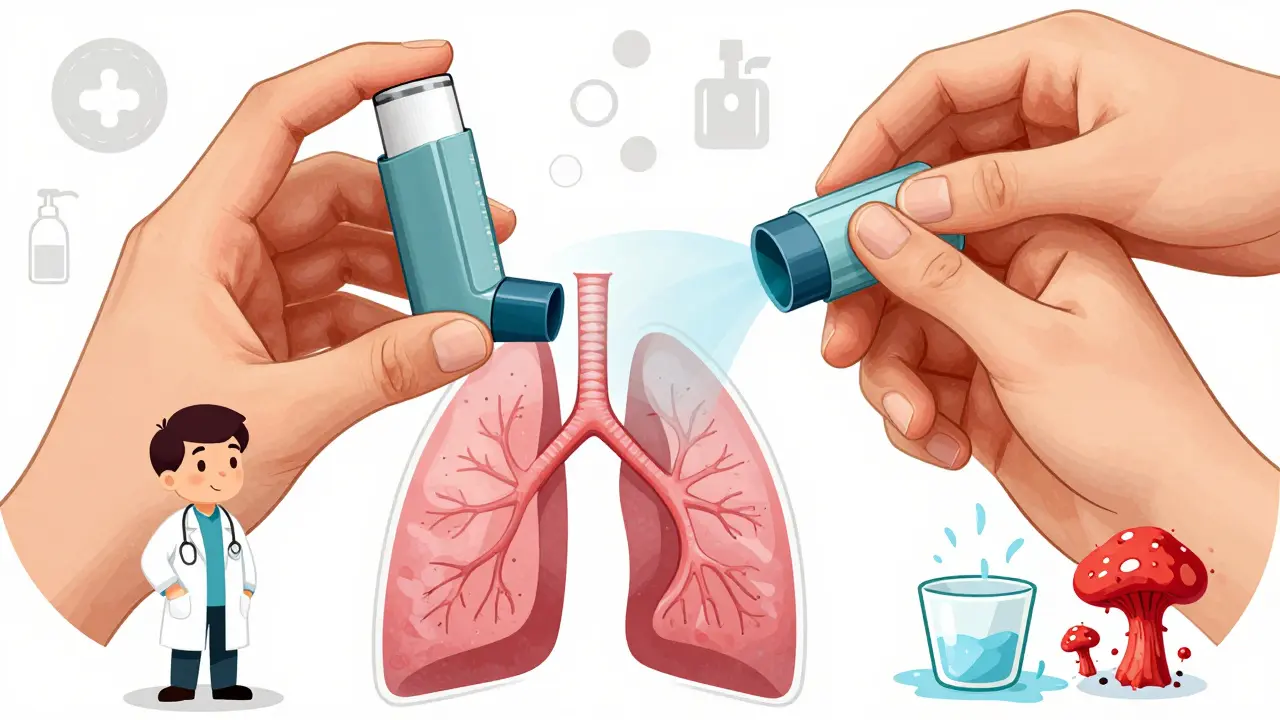
You might be taking your medicine exactly as prescribed-and still struggling. Why? Technique. Up to 90% of people use their inhalers incorrectly. Metered-dose inhalers (MDIs) need a shake before use. Hold it upright. Breathe out fully. Seal your lips around the mouthpiece. Press the canister and breathe in slowly and deeply over 3-5 seconds. Hold your breath for 10 seconds. Wait 30 seconds before the next puff. Dry powder inhalers (DPIs) are different. No shaking. Breathe out fully. Put the mouthpiece in your mouth. Breathe in fast and hard. Don’t breathe out into it. The powder needs a strong puff to reach your lungs. Many people forget to rinse their mouth after using ICS. That’s a mistake. It can cause thrush-a fungal infection in the mouth. Rinse with water and spit it out. Don’t swallow. Ask your pharmacist or nurse to watch you use your inhaler. Do it every time you get a new prescription. It takes two minutes. It could save your life.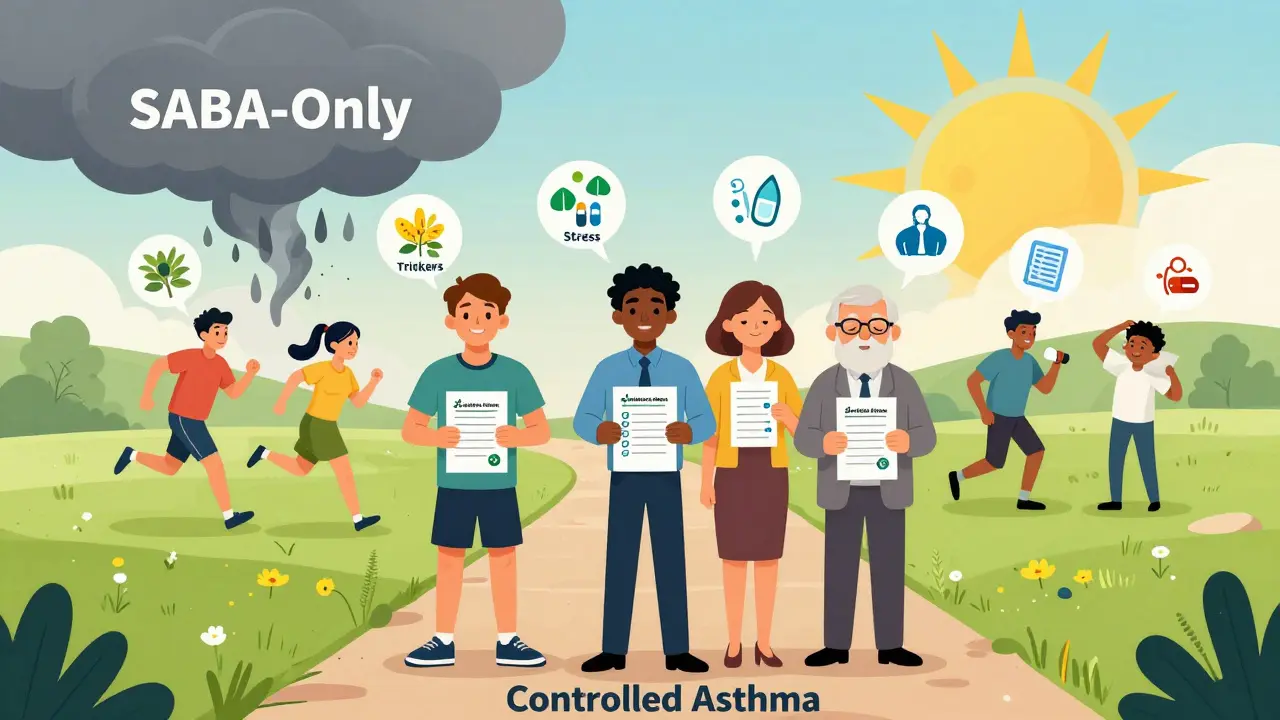
What About New Tech? Apps, Wearables, Smart Inhalers?
You’ve seen the ads: smart inhalers that track your use, apps that remind you, wearables that predict attacks. Sounds great, right? The truth? There’s no strong evidence yet that these tools improve asthma control. The 2025 guidelines say they neither support nor oppose them. They’re not part of standard care. If you find one helpful, use it. But don’t assume it replaces your action plan or your doctor’s advice. The real tech that works? A simple paper action plan. A calendar. A notebook where you write down when you felt bad and what you were doing. That’s the data your doctor needs.What’s Next? The Future of Asthma Care
For people with severe asthma that doesn’t respond to standard treatment, new options are emerging. Blood tests can now measure eosinophils-white blood cells linked to inflammation. If your count is above 300 cells/μL, or your exhaled nitric oxide (FeNO) is over 50 ppb, you might be a candidate for biologic injections. These target specific parts of the immune system and can cut attacks by 50% or more. But these aren’t for everyone. They’re expensive. They require regular clinic visits. And they’re only for those who truly need them. The bigger trend? Moving toward SABA-free asthma care. The North East and North Cumbria guidelines call it a “paradigm shift.” The goal? No one should ever be prescribed a blue inhaler alone again. That’s the standard now.Final Thought: Control Is Possible
Asthma control doesn’t mean being symptom-free 24/7. It means knowing your limits. Knowing your triggers. Knowing your plan. It means you can run, laugh, sleep through the night, and not live in fear of the next attack. It’s not about being perfect. It’s about being consistent. Take your medicine. Check your technique. Avoid your triggers. Track your symptoms. Talk to your doctor. You’ve got this. And you’re not alone.Can I stop my inhaler if I feel fine?
No. Even if you feel fine, the inflammation in your airways is still there. Stopping your inhaled corticosteroid (ICS) can lead to a sudden, dangerous flare-up. Instead, if your asthma has been stable for three months, ask your doctor about safely reducing your dose by 25-50%. Never stop without medical advice.
Is a blue inhaler enough for asthma?
No. Blue inhalers (SABAs like salbutamol) only relieve symptoms temporarily. Using them alone increases the risk of severe attacks and death. Since 2024, global guidelines recommend all asthma patients use an ICS-containing inhaler daily-even if symptoms are mild. The new standard is a combination inhaler that works as both controller and reliever.
How do I know if my inhaler technique is wrong?
Common mistakes include not shaking a metered-dose inhaler, breathing in too slowly, not holding your breath after inhaling, or forgetting to rinse your mouth. If you’re still having symptoms despite taking your medicine, or if you get thrush in your mouth, your technique may be off. Ask your pharmacist or nurse to watch you use it. A two-minute check can make all the difference.
What triggers should I avoid?
Common asthma triggers include dust mites, pet dander, mold, pollen, cigarette smoke, air pollution, cold air, strong perfumes, stress, and acid reflux. If you notice symptoms after certain activities or environments, write them down. Get tested for allergies if you have persistent asthma. Simple steps like using allergen-proof bedding, keeping pets out of the bedroom, and avoiding smoking can significantly reduce flare-ups.
Do I need a smart inhaler or asthma app?
Smart inhalers and apps can remind you to take your medicine, but there’s no strong evidence they improve asthma control more than traditional methods. The 2025 guidelines don’t recommend them as standard care. A simple written asthma action plan, a symptom diary, and regular check-ins with your doctor are more reliable and proven.
Can asthma be cured?
No, asthma cannot be cured. But it can be controlled. With the right medication, trigger avoidance, and a personalized action plan, most people live full, active lives without daily symptoms. The goal isn’t to eliminate asthma-it’s to make it a minor part of your life, not the center of it.
pradnya paramita
February 5, 2026 AT 02:14Per the 2025 GINA/VA-DOD update, the paradigm shift away from SABA monotherapy is evidence-based and non-negotiable. SABA overuse correlates with increased mortality due to unaddressed eosinophilic inflammation. The ICS-formoterol combination as both maintenance and reliever therapy (MART) reduces exacerbations by 30-50% in real-world cohorts. Dosing precision matters-200 mcg fluticasone propionate per puff vs. 100 mcg budesonide alters adherence dynamics. Always confirm actuator calibration and spacer use in MDI patients. Rinsing post-ICS is non-optional to mitigate oropharyngeal candidiasis risk.
For trigger mitigation, FeNO >50 ppb and sputum eosinophils >3% are biomarkers indicating type 2 inflammation. These patients are ideal candidates for biologics like mepolizumab or dupilumab. Don’t dismiss GERD as a comorbidity-proton pump inhibitors can improve asthma control independently of respiratory meds.
Smart inhalers? Data shows no significant improvement in ACT scores over structured education and paper logs. The placebo effect of tech is real, but clinical outcomes aren’t. Stick to the action plan. Track symptoms. Reassess every 3 months.
And yes-stopping ICS cold turkey is a recipe for near-fatal rebound. Even ‘well-controlled’ patients have subclinical inflammation. Step-down requires titration, not termination.
caroline hernandez
February 5, 2026 AT 02:26Let me just say-this is the most clear-headed asthma guide I’ve seen in years. I’ve been a respiratory nurse for 14 years, and I still see patients on blue inhalers only. It’s terrifying. The MART approach is game-changing, especially for teens who forget to take ‘daily’ meds. One device, two purposes? Genius.
Also, the rinse-after-ICS tip? So many patients don’t know this. I’ve seen thrush so bad it looked like cottage cheese in their mouths. Two minutes with a pharmacist can prevent that. And yes, technique matters more than dose sometimes. I had a patient who was using her inhaler like a spray deodorant-no coordination, no breath hold. After one demo with a spacer? She went from 3 ER visits a year to zero.
Don’t get sucked into the smart inhaler hype. My patients who use them are just as likely to miss doses. But those with printed action plans? They’re the ones who show up to appointments with notes, logs, and questions. That’s real engagement.
You’ve got this. Seriously. You’re not alone.
Jhoantan Moreira
February 6, 2026 AT 03:40Wow. This is actually the first time I’ve read something about asthma that didn’t feel like a textbook. 😊
My cousin’s been on SABA-only for 8 years. I’m sending her this right now. She thinks the blue inhaler is ‘the cure’-like a magic wand. But now I get it: it’s just a bandage. The red one is the real healer.
Also, the part about GERD? That hit home. I had unexplained asthma flares for years-turned out it was acid reflux. Once I stopped eating pizza before bed and started sleeping propped up? No more night wheezing. 🤯
And yes, I rinse my mouth every time. My dentist noticed. She said, ‘You’re the only asthma patient who doesn’t have thrush.’ 😄
Thanks for writing this. Really. It matters.
Meenal Khurana
February 6, 2026 AT 04:23Stop SABA-only. Use ICS-formoterol. Rinse mouth. Avoid triggers. Action plan. That’s it.
Keith Harris
February 7, 2026 AT 08:19Oh, so now the medical-industrial complex wants us to buy *combination* inhalers because they’re more profitable? 😏
Let me guess-you’re also gonna tell me that ‘asthma control’ means lifelong dependency on corticosteroids? That’s not control, that’s chemical surrender. I’ve seen people on high-dose ICS who still wheeze like bellows. And don’t get me started on ‘biologics’-$30k/year for a shot? That’s not medicine, that’s corporate extortion.
And don’t even mention ‘technique.’ Most of these inhalers are designed by engineers who’ve never had asthma. Try using a DPI with arthritic hands. Good luck.
Meanwhile, people in the 1980s didn’t have all this ‘guideline’ nonsense and lived just fine. Maybe the real problem isn’t asthma-it’s the system that turned it into a cash cow.
And yes, I’ve been off meds for 12 years. Breathing fine. Natural remedies. No ‘action plan.’ Just common sense and willpower. 🤷♂️
Nathan King
February 8, 2026 AT 06:55While the 2025 guidelines represent a significant evolution in clinical consensus, one must remain cognizant of the limitations of population-level recommendations when applied to individual phenotypes. The conflation of ‘control’ with ‘medication adherence’ risks pathologizing normal physiological variability. Moreover, the emphasis on combination ICS/LABA inhalers as universal therapy overlooks the heterogeneity of asthma endotypes-particularly in non-type-2 phenotypes where eosinophilic biomarkers are absent.
Furthermore, the assertion that 90% of patients exhibit improper inhaler technique is statistically suspect without reference to validated observational protocols. The assumption that technique is the primary determinant of therapeutic failure ignores socioeconomic barriers-such as lack of access to pharmacists, cognitive load, and health literacy disparities.
While the MART regimen is empirically sound in randomized trials, its scalability in resource-limited settings remains unaddressed. The dismissal of digital tools as ‘unproven’ is equally reductive; longitudinal data from wearable sensors may yet reveal predictive patterns unattainable through patient self-report.
Control, after all, is not merely pharmacological. It is epistemological. One must interrogate the epistemic authority of guidelines before internalizing them as dogma.
Harriot Rockey
February 8, 2026 AT 07:07This is so beautifully written. 🙌 I’ve been helping my nephew manage his asthma since he was 8, and this? This is exactly what families need.
I love how you emphasized that control doesn’t mean perfection. He still gets coughy sometimes-but now he knows *why*, and what to do. We track his ACT scores together every month. He even draws little stars when he doesn’t need his inhaler for a whole week. 🌟
And the part about rinsing after the inhaler? I had no idea. Now I keep a little water bottle next to his meds. Small things, big impact.
Also, I’m so glad you mentioned GERD. My sister didn’t realize her acid reflux was making his asthma worse. Once she cut out soda and late-night snacks? His nighttime cough vanished.
You’re right-we’re not alone. And we’re doing better than we think.
rahulkumar maurya
February 8, 2026 AT 07:17Let’s be honest-most of you are just parroting GINA guidelines like trained parrots. The real issue? Asthma is being overmedicalized. You’re treating a *symptom* as a *disease*. In traditional systems-Ayurveda, TCM, even ancient Greek medicine-asthma was viewed as a systemic imbalance, not a lung defect. You prescribe corticosteroids like they’re vitamins, but you ignore diet, gut microbiome, chronic stress, and environmental toxins.
And don’t get me started on ‘combination inhalers.’ That’s Big Pharma’s masterpiece: one device, two drugs, triple the profit. Meanwhile, the real culprits-industrial air pollution, ultra-processed food, glyphosate residues-are never mentioned.
And you want me to believe that a 50 mcg puff of fluticasone is safer than a natural anti-inflammatory like turmeric? Please. I’ve seen patients reverse their asthma with plant-based diets and breathwork. No inhalers. No ‘action plans.’ Just discipline.
Guidelines are not gospel. They’re corporate-sponsored consensus. And you’re all drinking the Kool-Aid.