Antihistamine Cross-Reactivity Checker
Which antihistamine did you react to?
Select the antihistamine that caused worsening symptoms for you.
Important Notes
- Not all reactions are cross-reactive - reactions can vary based on individual immune response
- Chemical structure matters - Cross-reactions often occur between similar chemical classes (e.g., piperazine vs piperidine)
- Underlying conditions - Many reactions are linked to immune system dysfunction
Results
Select an antihistamine to see potential cross-reactions.
Important Safety Note
Do NOT switch to another antihistamine without medical supervision. Your reaction could be cross-reactive.
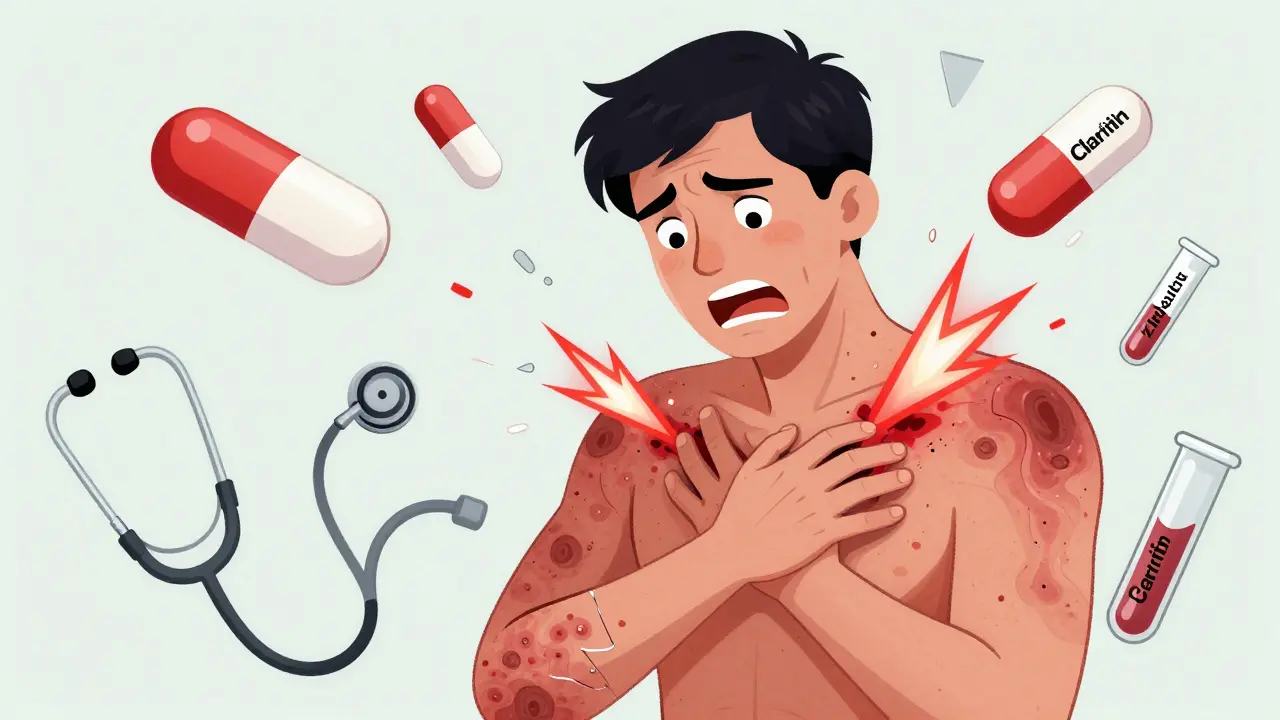
It’s ironic, isn’t it? You take an antihistamine to stop your itchy skin, runny nose, or hives - and instead, your body reacts worse. You break out in more hives. Your eyes swell. Your skin burns. You’re not getting better. You’re getting antihistamine allergy - a rare but real condition where the medicine meant to calm your immune system ends up triggering it.
How Can an Antihistamine Cause an Allergy?
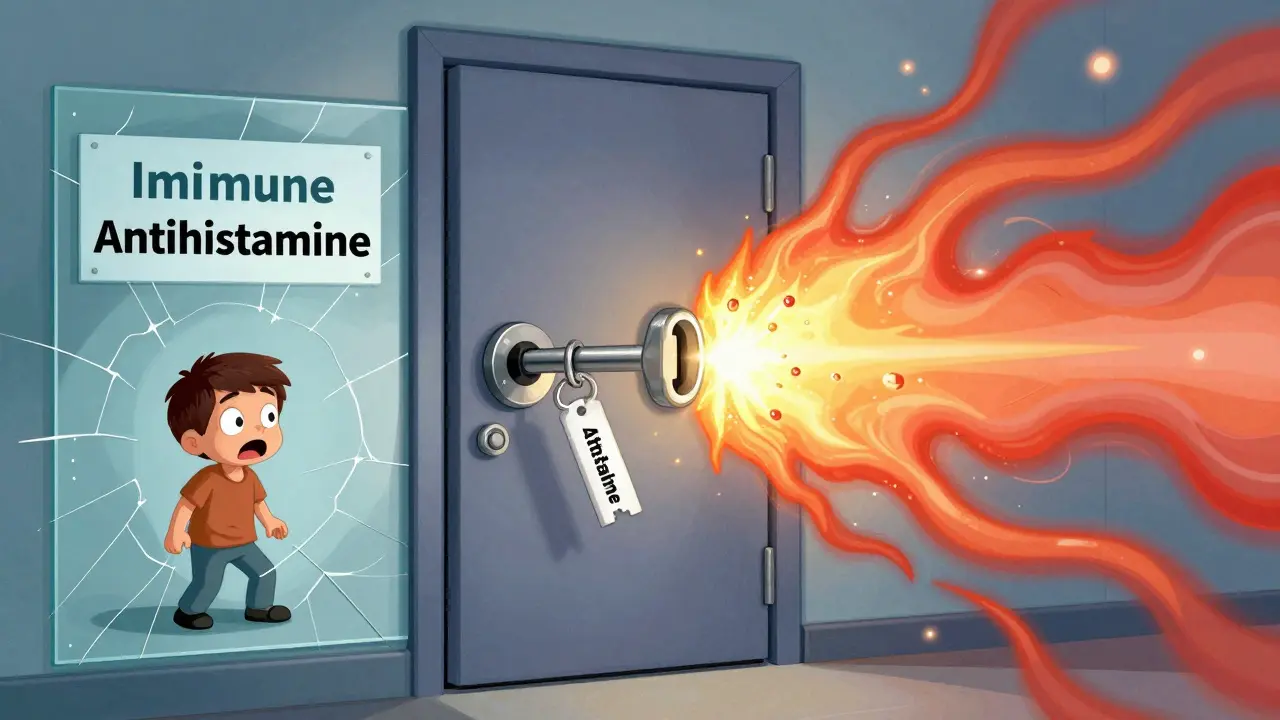
Antihistamines work by blocking histamine, the chemical your body releases during an allergic reaction. First-generation ones like diphenhydramine (Benadryl) and second-generation ones like cetirizine (Zyrtec) or loratadine (Claritin) were designed to fit neatly into the H1 receptor - the main switch that turns on allergy symptoms. They’re supposed to lock that switch in the ‘off’ position.
But in some people, that’s not what happens. Instead of turning off the receptor, the antihistamine accidentally turns it on. Think of it like a key that fits the lock but twists it the wrong way. This paradoxical effect has been documented in patients with chronic urticaria who develop worsening hives after taking even a single dose of an antihistamine they’ve used before without issue.
Recent structural studies using cryo-electron microscopy show why. The H1 receptor has a deep pocket where antihistamines bind. Normally, the drug pushes a key part of the receptor (called W428) into a resting shape. But in hypersensitive individuals, the drug’s shape - especially if it closely mimics histamine - may hold the receptor in its active state. That means histamine isn’t even needed. The drug alone is enough to trigger a reaction.
Which Antihistamines Are Most Likely to Cause This?
You might assume it’s only older, sedating antihistamines. But that’s not true. Cases have been reported with both first- and second-generation drugs.
- First-generation: Diphenhydramine, pheniramine, hydroxyzine - these cross the blood-brain barrier and can cause drowsiness. But they’ve also triggered immediate hypersensitivity reactions, including anaphylaxis-like symptoms in rare cases.
- Second-generation: Cetirizine, loratadine, fexofenadine, desloratadine, ebastine, mizolastine - these are marketed as non-sedating, but they’ve been linked to worsening hives. One patient developed severe urticaria after taking levocetirizine, even though she’d used cetirizine for years without problems.
Even more confusing: reactions don’t follow chemical families. One person might react to piperidine-based drugs (like fexofenadine) but tolerate piperazine-based ones (like cetirizine). Another might react to both. There’s no clean pattern. A skin test might say ‘negative’ - but an oral challenge five hours later could trigger a full-blown flare.
Why Skin Tests Often Miss the Problem
Doctors often rely on skin prick tests to check for allergies. But with antihistamine hypersensitivity, those tests can be misleading. In one documented case, a patient had negative skin tests to ketotifen - yet developed a severe skin eruption after taking it orally. The reaction didn’t show up until 120 minutes later.
That’s because skin tests detect IgE-mediated allergies - the classic type that causes sneezing or hives right away. But antihistamine reactions can be non-IgE, meaning they involve other immune pathways. The body may be reacting to the drug’s shape, its metabolites, or even a combination with an underlying infection.
So if your hives get worse after taking an antihistamine - even if your skin test was negative - don’t dismiss it. An oral challenge, done carefully under medical supervision, is still the gold standard for diagnosis.
What Triggers the Reaction - Beyond the Drug
It’s not always just the antihistamine. In one well-documented case, a woman developed chronic hives after taking multiple antihistamines. Her symptoms vanished only after two things changed: she stopped all antihistamines, and she treated a hidden chronic infection.
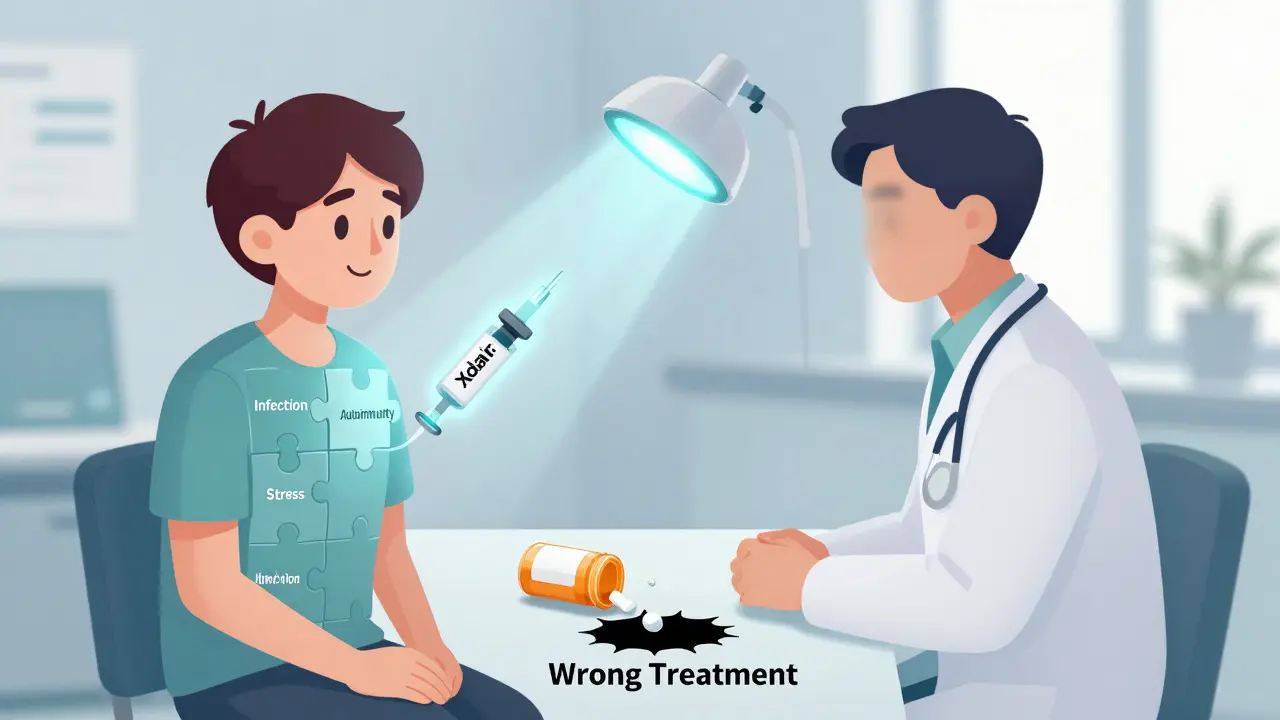
Researchers believe the immune system in these patients is already on edge. An underlying infection, autoimmune condition, or even stress can lower the threshold for a reaction. The antihistamine doesn’t cause the problem alone - it’s the final trigger in a system already primed to overreact.
This explains why some people react to multiple drugs across different classes. It’s not just about the antihistamine - it’s about the body’s overall sensitivity. This is sometimes called Multiple Drug Hypersensitivity Syndrome, and it’s more common than you’d think in people with chronic inflammatory conditions.
What to Do If You Think You’re Reacting
If you’ve noticed your hives, itching, or swelling getting worse after taking an antihistamine, here’s what to do:
- Stop taking the drug immediately. Don’t switch to another antihistamine hoping it’ll be better - you might trigger the same reaction.
- See an allergist or immunologist. General practitioners often don’t recognize this condition. You need someone who’s seen it before.
- Ask about oral provocative testing. This involves taking tiny, controlled doses under supervision to see if a reaction occurs. It’s risky, but it’s the only way to confirm the diagnosis.
- Check for hidden triggers. Have you had a recent infection? Are you under unusual stress? Is there an autoimmune condition you haven’t been tested for?
Don’t keep taking antihistamines hoping they’ll ‘work eventually.’ They won’t. They’ll make it worse.
What Are Your Alternatives?
If you can’t use antihistamines, you still have options. The key is to treat the root cause, not just the symptom.
- Omalizumab (Xolair): This injectable biologic is FDA-approved for chronic spontaneous urticaria that doesn’t respond to antihistamines. It targets IgE directly and has helped many patients who can’t tolerate standard treatments.
- Cyclosporine: An immune suppressant sometimes used off-label for severe, treatment-resistant hives. Requires monitoring but can be life-changing.
- Leukotriene inhibitors: Drugs like montelukast (Singulair) block a different inflammatory pathway. They’re not as fast as antihistamines, but they work for some people who react to H1 blockers.
- Light therapy (UVB): For chronic hives, narrowband UVB phototherapy has shown promise in reducing flare frequency.
- Addressing infections: If you have a lingering sinus infection, H. pylori, or even dental abscess, treating it can eliminate the trigger entirely.
Some patients have even found relief with dietary changes - reducing histamine-rich foods like aged cheese, fermented foods, or alcohol. It’s not a cure, but it can reduce the overall load on an overactive system.
The Future: Better Drugs on the Horizon
Scientists are now designing antihistamines based on the exact 3D structure of the H1 receptor. A 2024 study using cryo-EM revealed not just one binding site, but a second one that could be targeted to avoid the paradoxical effect.
This means the next generation of antihistamines might be engineered to avoid fitting into the ‘wrong’ shape - reducing the chance of triggering a reaction. These new drugs could be safer for people with receptor polymorphisms - the tiny genetic differences that make some of us react badly to standard meds.
Until then, we’re stuck with what we have. And that means being extra careful.
Bottom Line: Trust Your Body
If you’ve been told your hives are ‘just chronic urticaria’ and you’re on antihistamine after antihistamine - and nothing’s helping - it might not be the disease. It might be the treatment.
Antihistamine hypersensitivity is rare. But it’s real. And it’s often missed. Don’t let a negative skin test or a doctor’s assumption that ‘all antihistamines are safe’ keep you stuck in a cycle of worsening symptoms.
Your body is trying to tell you something. Listen to it. Stop the drugs. Get the right specialist. Find the real trigger. And don’t settle for a treatment that makes you feel worse.
Can you be allergic to all antihistamines?
Yes, but it’s rare. Some people react to multiple antihistamines across different chemical classes - piperidines and piperazines alike. This is usually linked to underlying immune system dysfunction, not the drugs themselves. If you’ve reacted to more than one type, it’s likely you have a broader hypersensitivity syndrome, not isolated allergies to each drug.
Is it safe to try a different antihistamine if one made me break out?
No. Switching to another antihistamine without testing could make your symptoms worse. Even if the new drug is from a different class, cross-reactivity can still happen. Always consult an allergist before trying another one. Oral challenge testing under supervision is the only safe way to determine what, if anything, you can tolerate.
Why do some people react to antihistamines and others don’t?
It comes down to genetics and immune status. Some people have tiny variations in their H1 receptor (called polymorphisms) that change how drugs bind. When combined with chronic inflammation - from infection, stress, or autoimmunity - these variations can flip the drug’s effect from blocker to activator. It’s not random. It’s biology, but we’re still learning the full picture.
Can antihistamine allergies be outgrown?
There’s no evidence you can ‘outgrow’ this type of reaction. But some patients find their sensitivity improves after treating an underlying trigger - like a chronic infection or autoimmune condition. Once the immune system calms down, reactions may lessen or disappear. It’s not about time - it’s about fixing the root cause.
Are second-generation antihistamines safer for people with allergies?
Not necessarily. While second-generation antihistamines don’t cause drowsiness and are less likely to interact with other drugs, they’re just as capable of triggering paradoxical reactions. In fact, many documented cases involve cetirizine, loratadine, or fexofenadine. The real difference is that they don’t cross the blood-brain barrier - but that doesn’t protect you from skin or systemic reactions.
Aditya Kumar
December 15, 2025 AT 21:48Been there. Took Zyrtec for months, hives got worse. Stopped it cold. Didn’t even try another one. Took 3 weeks to calm down, but now I’m fine. No more meds. Just avoid triggers.
Dan Padgett
December 16, 2025 AT 09:59It’s wild how the body turns medicine into a mirror-reflecting not just what’s broken, but how deeply the system’s been strained. This isn’t just allergy. It’s a cry from a nervous system that’s been whispered to for too long, then finally screamed at. The drug didn’t betray you. The system did. And it’s not broken-it’s begging to be heard.
Cassandra Collins
December 18, 2025 AT 02:35THE PHARMA COMPANIES KNOW THIS. THEY’RE HIDING IT. WHY? BECAUSE IF PEOPLE KNEW ANTIBIOTICS AND ANTIANXIETY DRUGS DO THE SAME THING, NO ONE WOULD TAKE THEM. THEY’RE MAKING BILLIONS OFF OUR SUFFERING. I SAW A DOC WHO GOT FIRED FOR TELLING PATIENTS THIS. THEY’RE COVERING IT UP.
Tiffany Machelski
December 19, 2025 AT 19:09I had a reaction to loratadine after years of using it. My skin turned red and hot like I’d been scalded. I thought I was dying. Ended up going to an immunologist and they did an oral challenge. Turns out I’m one of those weirdos who reacts to piperidine-based drugs. I didn’t know that was even a thing. Thanks for writing this.
James Rayner
December 20, 2025 AT 13:26It’s like the body’s H1 receptors are like old door locks… some keys fit, but if the metal’s warped or the spring’s worn, the key turns the lock open instead of shut. And we’re just now learning that the lock’s design has tiny flaws that only show up under stress. We used to think the key was the problem. Turns out, it’s the lock… and the stress that made it brittle.
Also… 🤯
Andrew Sychev
December 20, 2025 AT 15:12Of course this happens. You think Big Pharma gives a damn if you get worse? They want you hooked. They want you to keep buying more pills. You think they’d admit a drug makes your condition worse? HA. They’ll bury this study in a journal no one reads. Then sell you a new version that costs $500 a month. Welcome to modern medicine.
Kim Hines
December 20, 2025 AT 17:02My mom had this. Took Benadryl for years. Then one day, she broke out in blisters. No fever, no infection. Just… hives everywhere. Doctor said it was stress. We didn’t connect it until she stopped everything and it cleared up in a week. Now she avoids all antihistamines. Even the non-drowsy ones. She says she’d rather be itchy than burned.
Elizabeth Bauman
December 21, 2025 AT 14:06Interesting how this only happens in the West. In India, Nigeria, and other places, people don’t even use these drugs. They use turmeric, neem, and traditional remedies. Maybe we’re overmedicating ourselves into weakness. We think we’re smart because we have pills, but maybe we’re just making our bodies fragile. America’s obsession with quick fixes is killing us slowly.
Dylan Smith
December 22, 2025 AT 06:21I’m curious-has anyone tried combining montelukast with UVB therapy? I’ve been on both and it’s been the only thing that’s even slightly helped. I stopped everything else and just went slow. Took 6 months but my hives are 80% better. I wish more doctors knew about this combo. It’s not sexy but it works
Mike Smith
December 23, 2025 AT 21:28Thank you for sharing this with such clarity and care. This is the kind of information that saves lives. Many patients suffer in silence because they’re told, ‘It’s just chronic urticaria,’ when in reality, the treatment is the trigger. Please continue to educate. You are not alone. There are others who have been through this-and they need to know they’re not crazy. Your voice matters.
Ron Williams
December 23, 2025 AT 22:58As someone who’s lived in three countries and seen how different cultures handle chronic illness, I’ve noticed that places with strong community health networks-like rural India or parts of West Africa-have fewer cases of this. Why? Because they don’t default to pills. They use diet, rest, herbs, and time. Maybe the answer isn’t better drugs… but better systems.
Kitty Price
December 25, 2025 AT 10:11I had a reaction to cetirizine after my mom passed away. I didn’t realize stress could do that. But when I stopped everything and just slept for two weeks? My skin cleared up. Now I only use antihistamines if I’m traveling or near pollen. Otherwise? I breathe. I rest. I cry. And it helps more than any pill ever did. 💙
Colleen Bigelow
December 26, 2025 AT 05:45THIS IS A BIG PHARMA COVER-UP. THEY KNOW ANTIBIOTICS AND ANTIDEPRESSANTS DO THIS TOO. THEY’RE ALL DESIGNED TO MANIPULATE YOUR BRAIN AND IMMUNE SYSTEM. THE FDA IS CORRUPT. THEY LET THIS HAPPEN ON PURPOSE BECAUSE THEY GET PAID BY THE COMPANIES. I’VE SEEN THE DOCUMENTS. PEOPLE ARE DYING. WE NEED A WHISTLEBLOWER. WE NEED A PROTEST.
Randolph Rickman
December 28, 2025 AT 00:16Don’t give up. I was in your shoes. Took every antihistamine. Got worse. Thought I’d never be normal again. Found an allergist who actually listened. Did the oral challenge. Turns out I could tolerate fexofenadine-just not the others. Now I’m symptom-free for 18 months. It’s not easy, but it’s possible. You’re not broken. You just haven’t found your path yet. Keep going.
Souhardya Paul
December 29, 2025 AT 10:22This reminds me of something I read in a paper about receptor polymorphisms in chronic inflammatory conditions. It’s not just about the drug-it’s about how your immune system is already primed. Like a loaded gun. The antihistamine is the finger on the trigger. If you’ve got an underlying infection, stress, or autoimmunity, you’re way more likely to have this reaction. It’s biology, not bad luck. We need more research into immune baseline states before prescribing these drugs.