Imagine prescribing three powerful heart medications that work well on their own, but together trigger a perfect storm of toxicity. This isn't hypothetical; it happens every day in clinics worldwide. The combination of Amiodarone, Digoxin, and Warfarin creates a clinically significant pharmacological triad that demands absolute vigilance. If you manage patients with atrial fibrillation or heart failure, understanding how these drugs collide is non-negotiable. We are talking about a scenario where routine care can rapidly spiral into life-threatening bleeding or severe arrhythmias if you miss the subtle signs.
The Dangerous Trio: Who Are These Drugs?
To manage the risk, you first need to know exactly what you are handling. AmiodaroneClass III antiarrhythmic agent is a powerhouse developed by Sanofi, approved by the FDA back in 1985. It's the go-to drug when other treatments fail to stop erratic heart rhythms like ventricular tachycardia. Then there's Digoxin, a cardiac glycoside derived from the foxglove plant (Digitalis purpurea). Doctors have relied on it since the 1780s for rate control in atrial fibrillation, though its narrow therapeutic window means the line between effective and toxic is thin. Finally, Warfarin, the veteran blood thinner discovered in 1948. Despite newer options emerging, millions still depend on it for stroke prevention because of mechanical heart valves or cost constraints. Together, they form a triad found in roughly half of all anticoagulated atrial fibrillation patients needing rate control.
How the Chemistry Collides
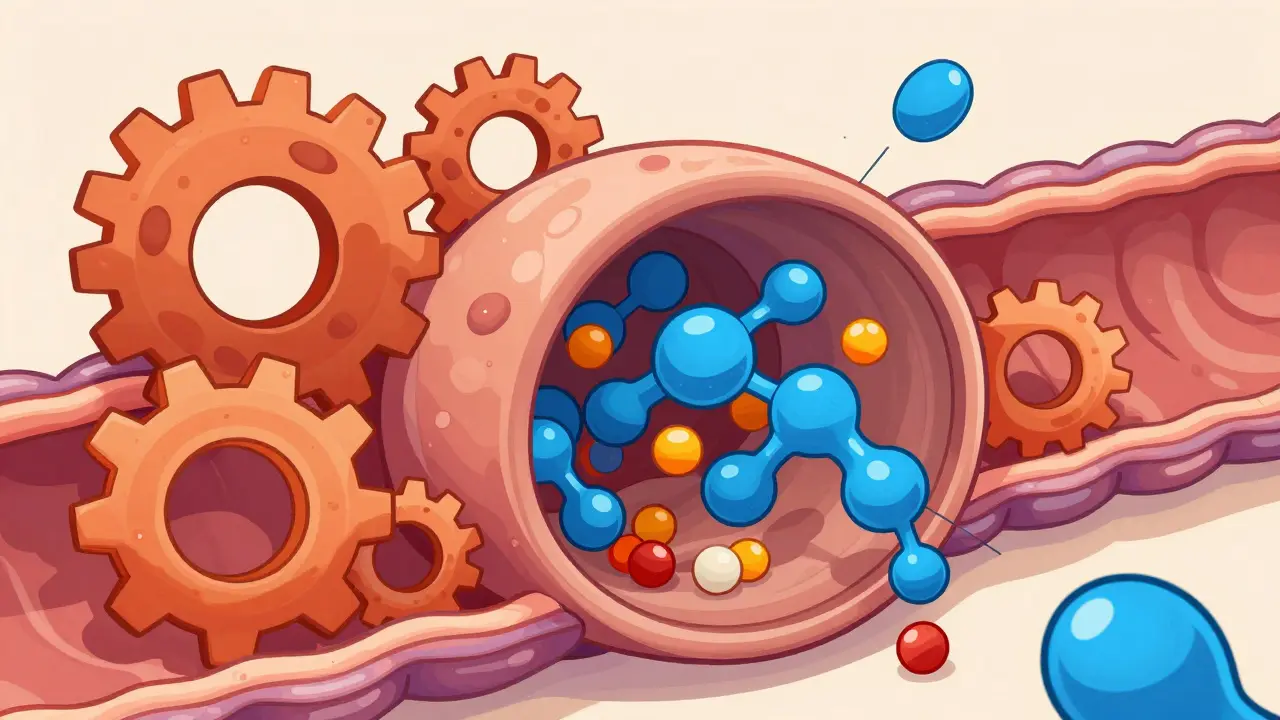
You might wonder why mixing these causes chaos when each treats heart conditions effectively. The problem lies in how the body processes them. Amiodarone doesn't just sit there; it acts as a heavy-handed inhibitor. When introduced to Digoxin, amiodarone blocks a transporter called P-glycoproteinProtein that moves substances out of cells. Think of P-glycoprotein as a security guard kicking digoxin out of kidney cells back into urine for elimination. When amiodarone stops the guard, digoxin gets stuck in the bloodstream. Serum concentrations can jump by 40% to 100% within just one week of starting amiodarone.
This interaction isn't limited to digoxin. Amiodarone and its metabolite also slam the brakes on liver enzymes known as Cytochrome P450Enzymes involved in drug metabolism, specifically CYP2C9 and CYP3A4. These enzymes normally break down Warfarin. Inhibition here slows warfarin clearance by up to 55%, causing your patient's INR to skyrocket. Some research even suggests elevated digoxin levels can displace warfarin from protein binding sites in the blood, leaving more free-floating drug to cause clotting risks-or bleeding risks, depending on which side of the coin you're looking at.
Real-World Consequences and Case Evidence
Numbers on a paper don't capture the severity until you see the patient outcomes. Data from the American Heart Association notes that about 12.1 million Americans live with atrial fibrillation alone, meaning this triad affects a massive population. A landmark study published in Circulation back in 1983 showed that adding amiodarone caused warfarin doses to need cutting by 30-50% almost immediately to stay safe. More recently, a 2021 review in Circulation: Arrhythmia and Electrophysiology highlighted a 28% higher mortality rate in patients taking amiodarone with digoxin compared to those on digoxin alone. That increase often hits hardest in the first 30 days.
We aren't dealing with minor fluctuations either. In documented cases, INR levels have surged from a therapeutic range of 2.0-3.0 straight up to 10 or higher, leading to intracranial hemorrhage. On the flip side, digoxin toxicity presents with classic symptoms like nausea, vomiting, and visual disturbances-often described as yellow halos around lights. While rare, fatal arrhythmias occur in about 15% of toxicity cases. The FDA database reports over 1,800 cases of digoxin toxicity linked to amiodarone co-administration between 2010 and 2022. It represents a preventable tragedy waiting to happen without proper protocols.
| Drug Affected | Primary Mechanism | Serum Level Change | Clinical Risk |
|---|---|---|---|
| Digoxin | P-glycoprotein inhibition | +70% average increase | Tachyarrhythmias, GI upset |
| Warfarin | CYP2C9/CYP3A4 inhibition | INR doubles or triples | Major bleeding, Hemorrhage |
| Thyroid Hormone | Hormonal synthesis disruption | Hypothyroidism common | Metabolic slowdown |
Safe Management Protocols You Must Follow
So, how do you handle a patient who needs this exact combination? You cannot guess, and you certainly shouldn't wait for symptoms to appear before acting. Guidelines from the American College of Cardiology offer a clear roadmap. First, before you even give the first loading dose of amiodarone, reduce the digoxin maintenance dose by 50%. Do not skimp on this cut. Second, prepare to slash the warfarin dose by 30% to 50% immediately. Third, set up aggressive monitoring. Check serum digoxin levels 72 hours after starting amiodarone. For INR, check every 48 to 72 hours during the first two weeks, then weekly until stable.
Remember that amiodarone has a terrifyingly long half-life, ranging from 25 to 100 days. Even after you stop giving the pill, the drug stays in the tissue for months. This means you must keep monitoring INR for four to six weeks after discontinuation. A report from the NHS England Medicines Safety Team confirmed that sticking to these strict adherence protocols reduced adverse events by nearly 80% across hospital trusts. Using electronic health records to flag this interaction helps catch potential slips before they become medical errors.

Navigating the Modern Landscape
The landscape is shifting slightly with new technologies. Direct oral anticoagulants (DOACs) like apixaban or dabigatran are replacing warfarin for most new patients, which naturally lowers the frequency of this specific triad. However, DOACs are not immune; amiodarone interacts with dabigatran via P-glycoprotein too, raising its levels significantly. Genetic factors also play a role now. Recent research shows that variations in the ABCB1 geneGene encoding P-glycoprotein can alter how severe the interaction is. Patients with specific genotypes might see a 92% spike in digoxin levels rather than the standard 70%. While routine genetic testing isn't standard everywhere yet, recognizing individual variability is becoming part of precision medicine in cardiology.
Despite DOAC popularity, amiodarone remains essential for certain high-risk arrhythmias. Mechanical heart valve patients and those with antiphospholipid syndrome cannot switch from warfarin easily. Therefore, this triad remains a cornerstone challenge for cardiologists managing complex cases. With the aging population, polypharmacy is increasing, and the FDA reported over 2,000 serious adverse events related to these combinations in 2022 alone. Awareness and strict protocol adherence are literally lifesaving.
Frequently Asked Questions
Why does Amiodarone increase Digoxin levels so drastically?
Amiodarone inhibits P-glycoprotein transporters in the gut and kidneys. These transporters normally push digoxin out of the body. When blocked, digoxin builds up in the blood, often doubling serum concentrations within a week.
Do I need to adjust Warfarin dosage immediately?
Yes. Reduce the warfarin dose by 30% to 50% before or at the same time you start amiodarone. Wait for the lab results to guide further adjustments, but immediate preemptive reduction is the standard of care.
When should I stop monitoring INR after stopping Amiodarone?
Because of amiodarone's long half-life, you should monitor INR for at least 4 to 6 weeks after completely discontinuing the medication to ensure stability.
Are Direct Oral Anticoagulants (DOACs) safer alternatives?
They avoid the INR monitoring burden, but amiodarone still increases levels of some DOACs like dabigatran through P-glycoprotein inhibition. They are safer for many, but require dosing checks too.
What are the first signs of Digoxin Toxicity?
Look for gastrointestinal distress like nausea and vomiting. Visual changes such as seeing yellow halos are highly specific signs. Irregular heartbeats or palpitations indicate serious progression.
Sabrina Herciu
March 28, 2026 AT 04:50The P-glycoprotein issue is absolutely critical!!! You really cannot ignore the transporter blocking effects. Digoxin stays trapped in the kidneys for too long!!! It is scary how fast levels rise. Patients might feel fine initially!!! But then toxicity hits without warning signs. I always tell residents to monitor closely. We have seen bleeds because of this triad!!! Warfarin interaction is just as dangerous!!! INR spikes are unpredictable during initiation. You must slash the dose preemptively!!! Waiting for lab results is risky business. Half life of amiodarone makes it linger forever!!! Clearance is super slow compared to other agents. Protocols need to be strict and electronic. Software flags save lives daily!!! Never skip the pre-start reduction steps.
Philip Wynkoop
March 30, 2026 AT 03:51Totally agree on the monitoring side :)
gina macabuhay
March 31, 2026 AT 08:37Medical negligence is rampant when clinicians ignore basic pharmacokinetics. They treat patients like guinea pigs in clinical trials without reading labels. It is frankly disgusting how often these interactions cause harm. Someone should actually care about their license instead of billing hours. Safety protocols exist for a reason that people choose to disregard. Patient outcomes suffer when arrogance overrides evidence-based medicine.
Monique Louise Hill
March 31, 2026 AT 11:53This is why we need stricter laws 🛑🚫 Doctors should not be allowed to prescribe blindly 😠💔 Ignorance is not an excuse for harm 🙅♀️ Safety first always 👀🩺
Debra Brigman
March 31, 2026 AT 13:40Medicine becomes a tapestry woven with threads of molecular conflict. The heart beats against a rhythm of chemical warfare. We dance with poison hoping for cure. It is a tragic irony of modern science. Balance remains the ultimate goal of our craft.
Aaron Olney
April 1, 2026 AT 04:42Thier is so much danger thre!!!! I recieve calls form family members who cant understand why thier loved ones got sick!!! It is horrifying stuff!!! Nobody wants thier relative bleeding out!!!
Jordan Marx
April 2, 2026 AT 00:04Consider the ABCB1 polymorphism impact on P-gp efflux clearance rates significantly altering individual susceptibility profiles. Pharmacogenomics dictates dosage adjustments beyond standard empiric reductions observed in population studies. CYP2C9 inhibition kinetics require dynamic modeling for warfarin sensitivity indices. Genetic testing should become routine for high-risk polypharmacy cases. Precision medicine reduces adverse events substantially.
Sophie Hallam
April 3, 2026 AT 16:12It is good to see these interactions highlighted clearly for everyone to read. Many people rely on accurate information to stay safe. Education prevents errors in clinical settings. We all benefit from shared knowledge.