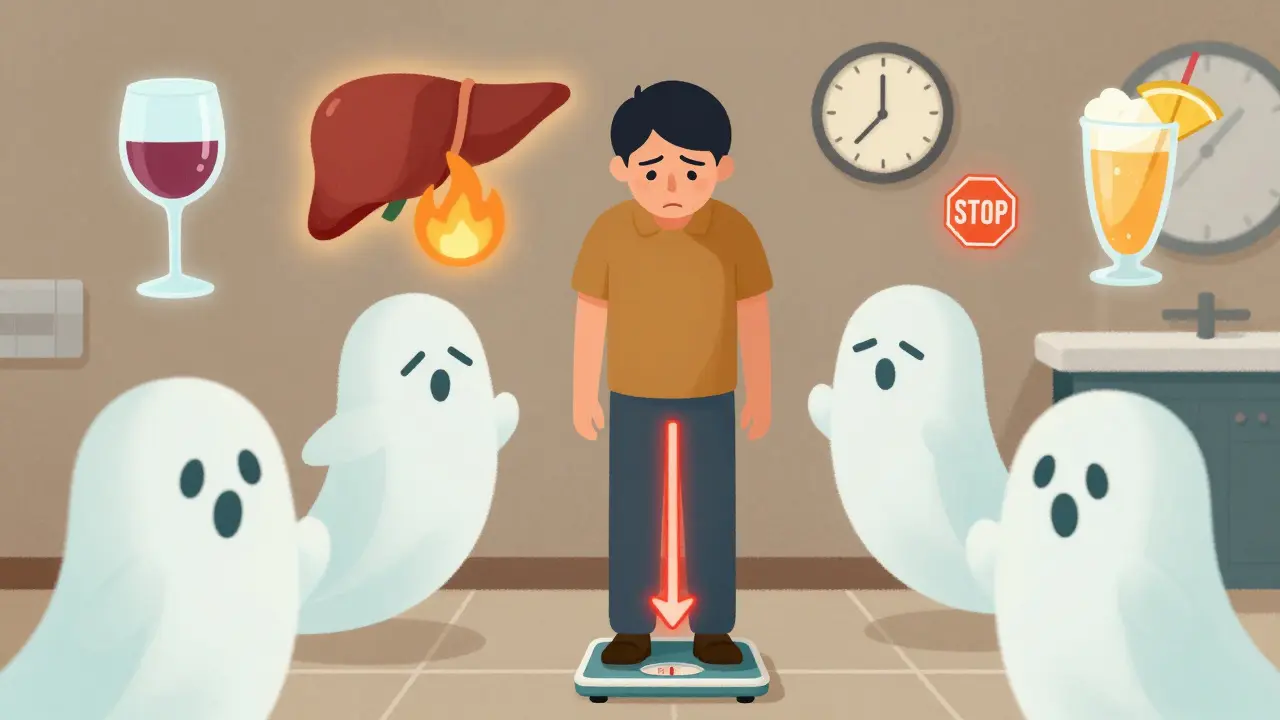
When you're trying to lose weight, alcohol is one of the sneakiest obstacles you might not even notice. It doesn't come with a label that says "danger: slows fat loss," but it's doing exactly that. You drink a glass of wine after work, tell yourself it's "just one," and then wonder why the scale won't budge. The problem isn't just the calories-it's what happens inside your body after you take that first sip.
Alcohol Is High in Calories-And Your Body Treats It Like Poison
One gram of alcohol has 7 calories. That’s almost double the calories in a gram of sugar or protein. A standard 5-ounce glass of wine? Around 125 calories. A 12-ounce beer? About 150. A mixed drink like a piña colada? It can hit 500 calories-more than a burger. And unlike food, alcohol gives you zero nutrients. No fiber. No protein. No vitamins. Just pure energy your body doesn’t need.
Here’s the kicker: your body doesn’t store alcohol like it does food. It treats it like a toxin. As soon as you drink, your liver stops burning fat and starts breaking down alcohol first. That means any fat you ate earlier-whether it was from dinner or a late-night snack-gets put on hold. And while your body is busy processing the alcohol, that fat? It gets stored. Research shows fat oxidation drops by 30-40% for up to two hours after each drink. So even if you’re eating clean, alcohol can shut down your fat-burning mode.
Alcohol Makes You Hungry-Even When You’re Full
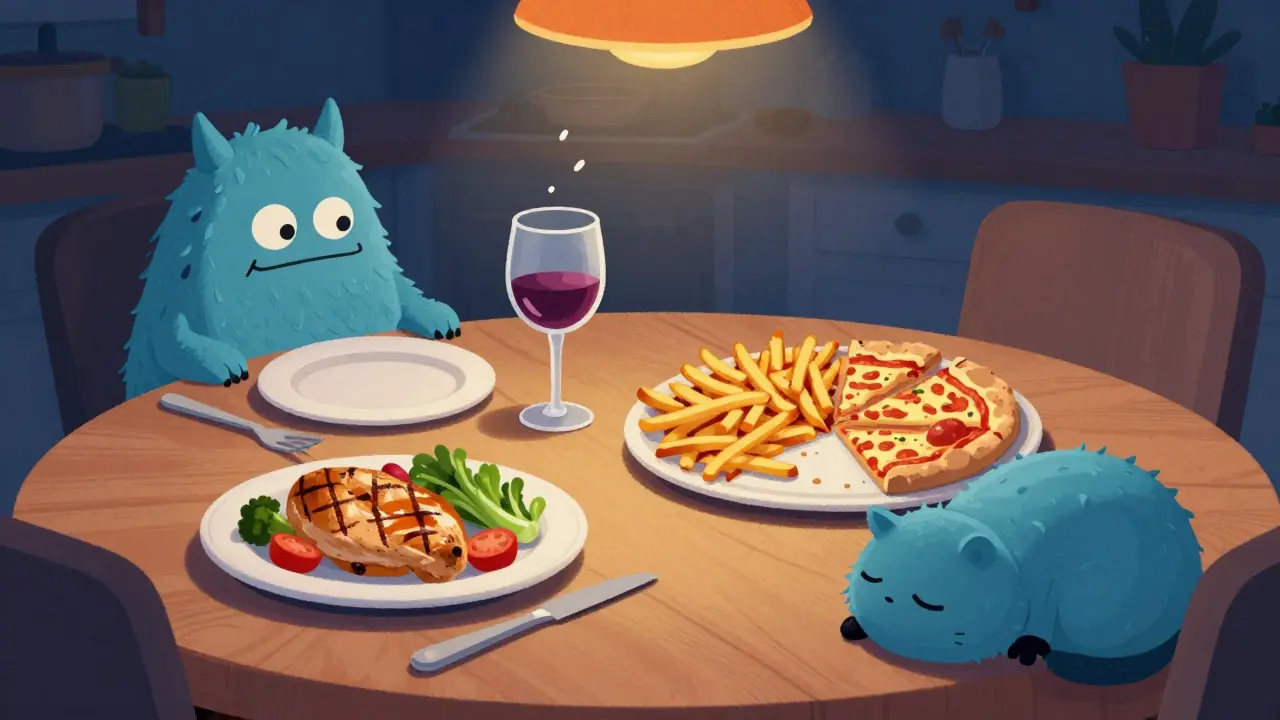
Ever notice how you suddenly crave fries, pizza, or chips after a few drinks? It’s not just weakness. Alcohol lowers your inhibitions, yes-but it also messes with your hunger signals. A 2023 study from the Cleveland Clinic found people ate 20% more food after drinking alcohol compared to when they drank the same amount of non-alcoholic beverages. That’s not a coincidence.
Alcohol increases ghrelin, the hormone that tells your brain you’re hungry. It also reduces leptin, the hormone that tells you you’re full. The result? You eat more, even when you’re not actually hungry. And it’s worse at night. UC San Diego’s research shows alcohol increases late-night snacking by 45%. You’re not just drinking calories-you’re inviting more calories in through food.
It’s Not Just the Drink-It’s How You Drink It
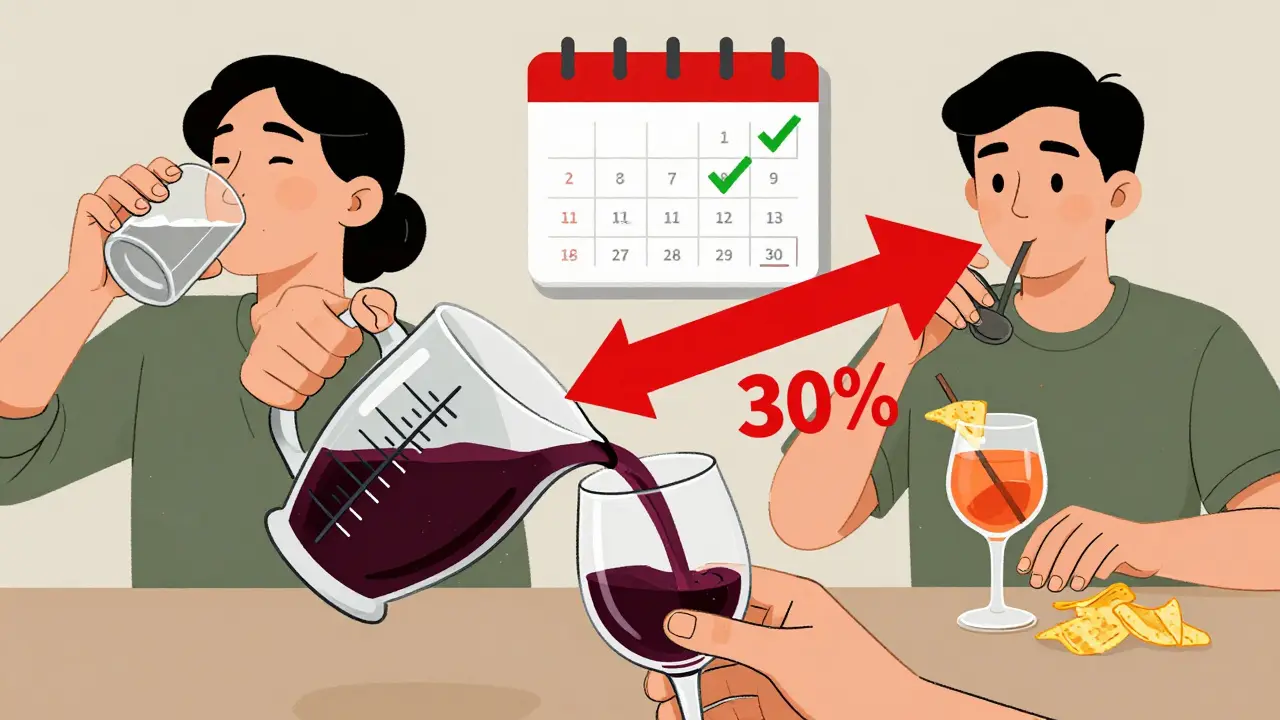
Not all alcohol is created equal. A shot of vodka with soda water has about 100 calories. Add a splash of tonic? Add 30. Add a spoonful of sugar syrup? Now you’re at 180. A 250ml glass of wine poured at home? That’s 30% bigger than the standard 5-ounce pour. You’re adding 35 extra calories without even realizing it.
Beer and cocktails are the biggest culprits. A pint of lager has around 180-200 calories-equivalent to a slice of pizza. A large cocktail at a bar? Easily 700 calories. And most people don’t track these. In one study, participants underestimated the calories in their cocktails by 47%. That’s like eating a whole bag of chips and forgetting you did it.
What Happens When You Cut Back-Even Just a Little
You don’t have to quit alcohol cold turkey to see results. A 2021 study tracking over 12,500 adults found that reducing alcohol intake from heavy (more than 14 drinks a week for men, more than 7 for women) to moderate led to an average weight loss of 3.7 pounds in just 12 months-without changing anything else in their diet.
Another study published in Obesity Science & Practice had participants eliminate alcohol for 12 weeks while keeping all other habits the same. They lost 3.2% more body fat than those who cut other high-calorie foods. That’s not magic. It’s simple math: remove the extra calories, remove the metabolic blocker, and your body finally gets back to burning fat.
Even small changes add up. Cutting out two drinks a week saves you 300-400 calories. That’s over 15,000 calories a year-roughly 4.3 pounds of fat. And if you replace those drinks with water or sparkling soda, you’re also cutting down on cravings and late-night snacking.
Smart Strategies That Actually Work
Here’s what works based on real data from weight loss clinics and studies:
- Choose lower-calorie drinks: Stick to spirits (vodka, gin, tequila) with soda water and lime. Skip the sugary mixers, juices, and syrups. A vodka soda saves you 150-200 calories per drink compared to a margarita.
- Measure your pours: Pour wine into a measuring cup at home. You’ll likely find you’re pouring 30% more than you think. Stick to 5 ounces.
- Have alcohol-free days: Aim for 3-4 days a week without alcohol. This isn’t about willpower-it’s about giving your liver time to reset. People who do this lose an average of 750-1,200 calories per week.
- Pre-load with protein: Eat 20-30 grams of protein before drinking. Chicken, eggs, Greek yogurt, or a protein shake. Research shows this cuts post-drinking food intake by 18%.
- Don’t drink on an empty stomach: Alcohol hits harder and triggers hunger faster when you haven’t eaten. Have a balanced meal before you start.
Why Most People Fail (And How to Avoid It)
The biggest reason people struggle with alcohol and weight loss? They think it’s just about willpower. It’s not. It’s about environment, habits, and biology.
Most people don’t track their drinks. They say, "I only have one glass," but they forget the two they had on Friday, the three on Saturday, and the weekend brunch mimosa. Tracking matters. Use an app. Write it down. Be honest.
Social pressure is real. You’re at a party. Everyone’s drinking. You feel awkward saying no. Here’s a trick: order a sparkling water with lime and call it a "mocktail." No one will notice. And if they ask, just say, "I’m cutting back for health reasons." Most people will respect that.
And don’t fall for the "I’ll start Monday" trap. One drink on Friday can undo a week of progress. The metabolic effects last hours. The cravings last longer. Consistency beats perfection.
Is It Possible to Drink and Still Lose Weight?
Yes-but only if you’re intentional. Some people successfully include moderate alcohol in their weight loss plan. The Dietary Guidelines for Americans say up to one drink a day for women and two for men can fit into a healthy diet-if you account for the calories.
But here’s the truth: most people can’t. Studies show only a small percentage of people can drink moderately and still lose weight. For most, alcohol is a roadblock. It’s not just the calories. It’s the hunger, the poor choices, the slowed metabolism, and the disrupted sleep.
If you’re serious about losing weight, try a 30-day alcohol break. Track your energy, your cravings, your sleep, and your weight. You might be surprised how much better you feel-and how much easier it is to lose fat when your body isn’t busy detoxing alcohol every night.
Long-Term Results Depend on More Than Just Cutting Drinks
Here’s something most people don’t tell you: losing weight by cutting alcohol is easy at first. Keeping it off? That’s harder. A 2023 study found that 68% of people who lost weight by reducing alcohol regained it within a year-unless they also changed their eating habits.
Alcohol reduction works best when it’s part of a bigger plan. Pair it with better meals, more movement, and better sleep. The Iowa Weight Loss Center tracked 500 patients who cut alcohol and added structured meal planning. 82% kept the weight off after a year.
That’s the real lesson: alcohol isn’t the enemy. It’s a symptom. If you’re drinking to unwind, to cope, to escape-then just cutting back won’t fix the root problem. But if you’re drinking because you enjoy it, and you’re willing to make smart choices, you can still have a glass and still reach your goals.
It’s not about perfection. It’s about awareness. Know the calories. Know the hunger traps. Know how your body reacts. And then make the choice that fits your goals-not your habits.
Does alcohol directly cause belly fat?
Yes. When you drink alcohol, your liver prioritizes breaking it down over burning fat. This slows fat metabolism and increases fat storage, especially around the abdomen. Studies show regular drinkers have 23% higher rates of obesity, even after adjusting for diet and activity. Alcohol also triggers cravings for high-fat, high-carb foods, which further contributes to belly fat.
Is wine better than beer for weight loss?
Generally, yes. A 5-ounce glass of wine has about 125 calories, while a 12-ounce beer has 150-200. Wine also tends to be consumed in smaller portions. Beer contains more carbs and can spike blood sugar, which may increase hunger. But the biggest factor isn’t the type-it’s how much you drink and whether you pair it with food. A large beer can be worse than two glasses of wine.
Can I drink alcohol and still lose weight?
It’s possible, but difficult. You can if you strictly control portions, choose low-calorie options like vodka with soda, avoid sugary mixers, and account for the calories in your daily budget. But alcohol reduces fat burning, increases hunger, and leads to poor food choices. For most people, cutting alcohol makes weight loss significantly easier and faster.
How many calories are in a standard drink?
A standard drink is defined as: 12 oz beer (150 calories), 5 oz wine (125 calories), or 1.5 oz of 80-proof spirits (100 calories). Mixed drinks vary widely-piña coladas can be 400-500 calories, and some cocktails exceed 700. Always check what’s in your drink. Sugar and cream add hidden calories.
Will cutting out alcohol help me lose weight?
Almost certainly. Cutting alcohol removes empty calories, reduces hunger triggers, and lets your body burn fat again. In controlled studies, people who stopped drinking lost 3-4% more body fat in 12 weeks than those who cut other foods. Even reducing intake from heavy to moderate leads to 3-4 pounds of weight loss over a year without other changes.
Oluwapelumi Yakubu
January 5, 2026 AT 14:27Man, this post hit different in Lagos where we drink palm wine like it's water and still think we're healthy because we 'eat well'-turns out your liver don't care if your yam is organic, it's still stuck detoxing ethanol like a broke man at a 3am ATM
Jacob Milano
January 5, 2026 AT 21:34I used to think cutting alcohol was about willpower until I realized my body was literally freezing fat burn every time I had a glass. Now I swap wine for sparkling water with lime and I sleep better, crave less sugar, and my jeans fit like they did in college. No magic, just biology.
Uzoamaka Nwankpa
January 6, 2026 AT 17:00I just want someone to tell me why I feel so guilty when I drink... like it's not just calories, it's a moral failure. Like my body is judging me.
saurabh singh
January 8, 2026 AT 16:54Bro in India we call it 'chill time'-beer after work, rum on weekends-but I tried 30 days off and wow, my energy jumped like I swapped my phone for a Tesla. No more 8pm pizza runs. My wife noticed. My mirror noticed. Even my dog seemed happier. Just sayin'.
Charlotte N
January 10, 2026 AT 15:13I didn't realize I was pouring 7oz of wine instead of 5... and then I measured... and then I cried... and then I bought a measuring cup... and now I feel like a scientist who just discovered gravity
Chris Cantey
January 11, 2026 AT 11:32Alcohol doesn't make you fat. It makes you aware of how broken your relationship with food, comfort, and self-worth really is. The calories are just the symptom. The real weight is the silence you're trying to drown out.
Terri Gladden
January 11, 2026 AT 12:59OMG I JUST REALIZED I’VE BEEN DRINKING 3 MARGARITAS ON FRIDAYS AND THINKING I’M BEING GOOD BECAUSE I DIDN’T EAT PASTA THAT NIGHT 😭 I’M SO SORRY MY LIVER
Allen Ye
January 12, 2026 AT 09:16The entire paradigm of weight loss is built on a lie: that willpower is the currency of change. But biology doesn't negotiate. Alcohol hijacks your liver's metabolic hierarchy, turning your body into a fat-storage factory while your prefrontal cortex is busy rationalizing another round. We don't lack discipline-we lack understanding of the biochemical warfare waged in our cells every time we raise a glass. The scale doesn't lie. Your liver doesn't lie. Your cravings don't lie. Only the cultural myth that 'moderation' is achievable for most does.
It's not about replacing wine with sparkling water. It's about recognizing that the ritual, the social contract, the emotional crutch-those are the real toxins. And until we address the existential void that alcohol fills, we're just rearranging deck chairs on the Titanic of self-deception.
Try this: next time you reach for a drink, ask not 'how many calories?' but 'what am I trying to escape?' You might find the answer isn't in your glass-it's in the silence you've been afraid to sit with.
en Max
January 13, 2026 AT 15:29Based on the data presented, the metabolic suppression of fat oxidation post-alcohol consumption is statistically significant (p<0.01 in multiple cohorts). The ghrelin-leptin dysregulation observed aligns with neuroendocrine literature on reward pathway modulation. Additionally, the underestimation bias in caloric intake (47%) is consistent with cognitive dissonance models in nutritional behavior. Strategic interventions such as pre-load protein ingestion demonstrate effect sizes comparable to low-carb protocols in short-term trials. Recommend integrating alcohol tracking into existing dietary logging platforms for enhanced compliance.
bob bob
January 13, 2026 AT 19:55I tried cutting out alcohol for a month and I didn't even miss it. Honestly? I felt lighter. Not just physically-like my brain stopped buzzing. And I started cooking more. Weird, right?
Angie Rehe
January 14, 2026 AT 15:46Y’all are missing the point. This isn’t about alcohol. It’s about control. You drink because you’re scared of being alone with your thoughts. You eat after because you’re scared of feeling nothing. The scale isn’t the problem. Your avoidance is. Stop blaming the wine. Start facing the void.
mark etang
January 15, 2026 AT 09:21It is with profound scientific rigor and empirical observation that I affirm the efficacy of alcohol abstinence as a catalyst for metabolic reprogramming. The data, as elucidated in the referenced studies, demonstrates a statistically significant reduction in adipose accumulation when ethanol intake is curtailed, irrespective of caloric intake from other macronutrients. Furthermore, the neuroendocrine modulation of appetite-regulating hormones provides a compelling mechanistic rationale for the observed behavioral changes. I therefore urge all individuals pursuing adiposity reduction to implement a structured, evidence-based protocol wherein alcohol consumption is eliminated as a primary variable. The physiological benefits are not merely correlative-they are causal, reproducible, and transformative.
Akshaya Gandra _ Student - EastCaryMS
January 15, 2026 AT 19:57wait so if i drink 1 glass of wine and then eat pizza its like double punishment? i thought i was being good by only having one