Starting a new medication can feel overwhelming. You’ve got a prescription in hand, maybe a handful of pills in a bottle, and a doctor’s instructions that felt rushed. You’re not alone. More than 42% of first-time medication users struggle with dosing schedules, and nearly 37% say they don’t fully understand their labels. But here’s the good news: with a few simple steps, you can avoid dangerous mistakes and get the full benefit of your treatment. Medication safety isn’t about memorizing complex rules-it’s about building habits that keep you protected.
Know the Six Rights of Medication Safety
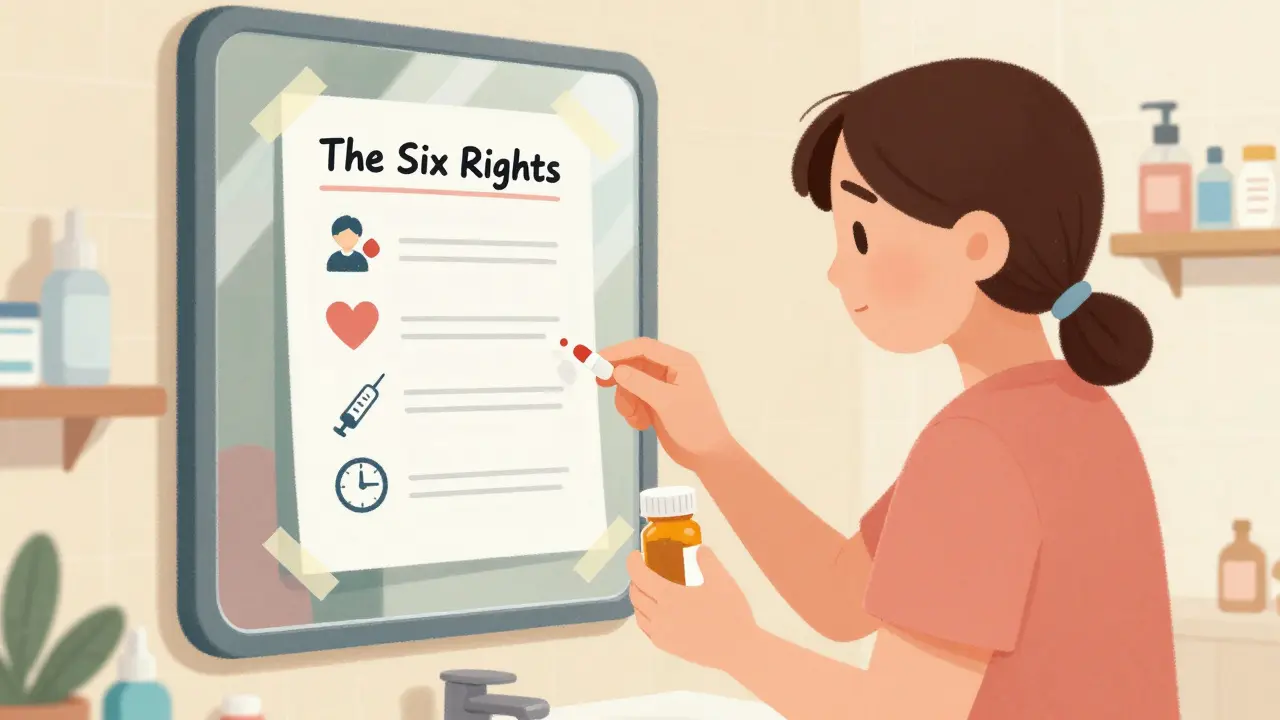
Every time you take a pill, there’s a checklist that saves lives. It’s called the Six Rights, and it’s used by hospitals and pharmacies across the U.S. You don’t need to be a nurse to use it. Just ask yourself these six questions before you swallow anything:- Right patient? Is this medicine really for you? Double-check your name and date of birth on the bottle. If you’re picking it up at the pharmacy, make sure they call you by your full name.
- Right medication? Does the pill look like what your doctor described? Generic versions can change the shape, color, or markings. If it looks different, ask your pharmacist why.
- Right indication? Why are you taking this? Don’t just assume it’s for your headache. Ask: "What condition is this supposed to treat?" If you’re unsure, you might be taking something meant for someone else.
- Right dose? Are you taking the exact amount prescribed? Never guess with teaspoons or tablespoons. Household spoons vary by up to 50% in volume. Use the measuring cup or syringe that came with the medicine.
- Right route? Is it meant to be swallowed, sprayed, applied to skin, or injected? Taking a topical cream orally can be deadly. Always check the instructions.
- Right time? Does it need to be taken with food, on an empty stomach, or at bedtime? Some medicines interact with meals, caffeine, or even sunlight. Timing matters.
Write these down. Tape them to your bathroom mirror. Say them out loud before you take each dose. These six questions cut your risk of error in half.
Keep a Complete Medication List
Most people think they remember everything they’re taking. They don’t. A 2022 study found that patients who kept a full list of their medications had 27% fewer errors. Your list should include:- Every prescription (name, dose, frequency)
- Every over-the-counter pill (ibuprofen, antacids, cold medicine)
- All vitamins and supplements (even fish oil or turmeric)
- Herbal remedies (ginseng, echinacea, etc.)
Update it every time you start, stop, or change a medication. Carry it with you to every doctor’s visit-even for a cold. One in five medication errors happens during hospital discharge, when new drugs are added without checking what you’re already taking. A simple list can prevent dangerous interactions.
Use your phone. There are free apps like Medisafe and MyMeds that let you scan barcodes, set reminders, and share your list with family or your pharmacist. Studies show users of these apps improve adherence by 28%. But even a handwritten list on a piece of paper is better than nothing.
Storage Matters More Than You Think
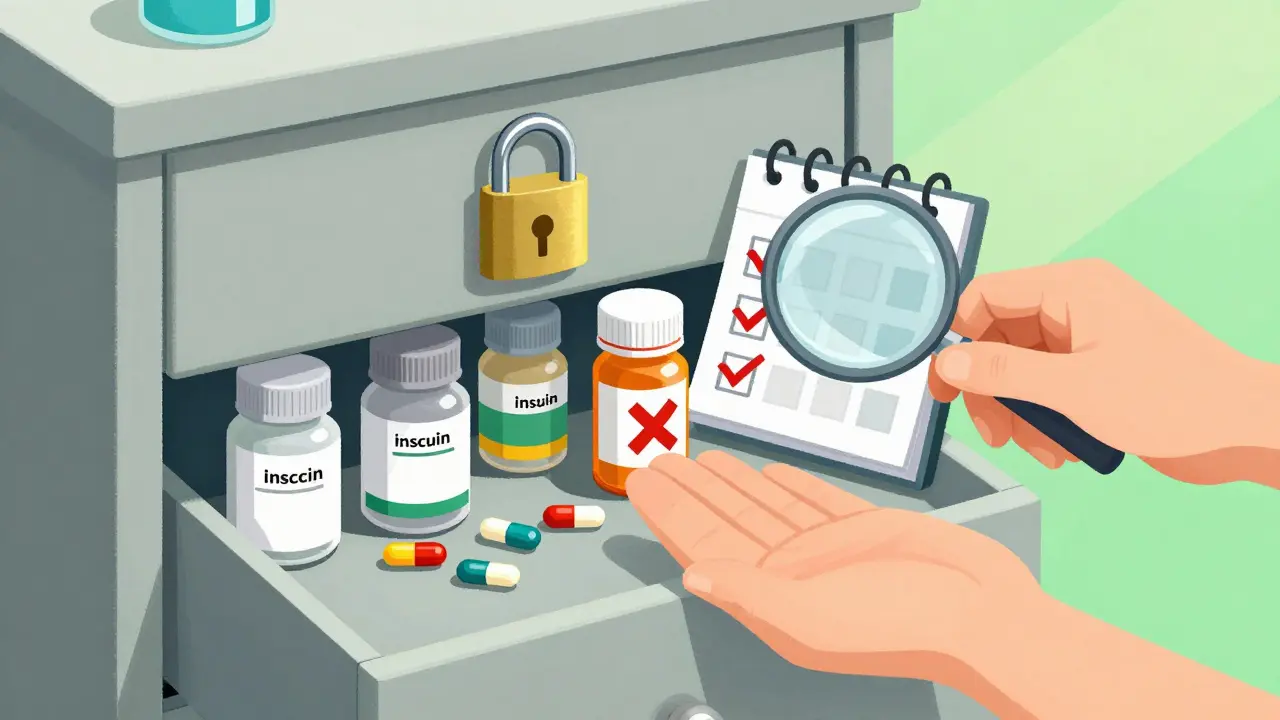
You wouldn’t leave milk out on the counter for days. Why treat medicine differently?- Insulin must be refrigerated until first use (between 36-46°F). After opening, it can stay at room temperature for up to 28 days.
- Most pills should be kept below 86°F (30°C) in a dry place. The bathroom cabinet? Bad idea. Humidity ruins tablets.
- Liquid antibiotics often expire faster. If your doctor gave you a 10-day supply and you only took 5 days’ worth, throw out the rest. Expired meds lose strength-and can become harmful.
- Controlled substances (like opioids or ADHD meds) should be locked away. The FDA reports that 18% of medication errors come from using expired or improperly stored drugs.
Check expiration dates every time you refill. If the date has passed, don’t risk it. A 2023 Merck study found that expired antibiotics were a leading cause of treatment failure and hospital readmissions.
Never Share or Skip Doses
It’s tempting. Your friend has the same pain you do. Your mom says her pill works better. Don’t do it.Sharing medication causes 8% of emergency room visits for adverse drug events. Why? Because drugs are tailored to your body, weight, allergies, and other conditions. A pill that helps your sister might send you into a seizure.
And skipping doses? That’s just as dangerous. The World Health Organization says 50% of treatment failures for chronic illnesses (like high blood pressure or diabetes) happen because patients don’t take their meds as directed. Miss one dose? Don’t double up next time. Call your pharmacist. They’ll tell you what to do-whether to skip it, take it late, or adjust.
Ask Three Questions Every Time You Get a New Prescription
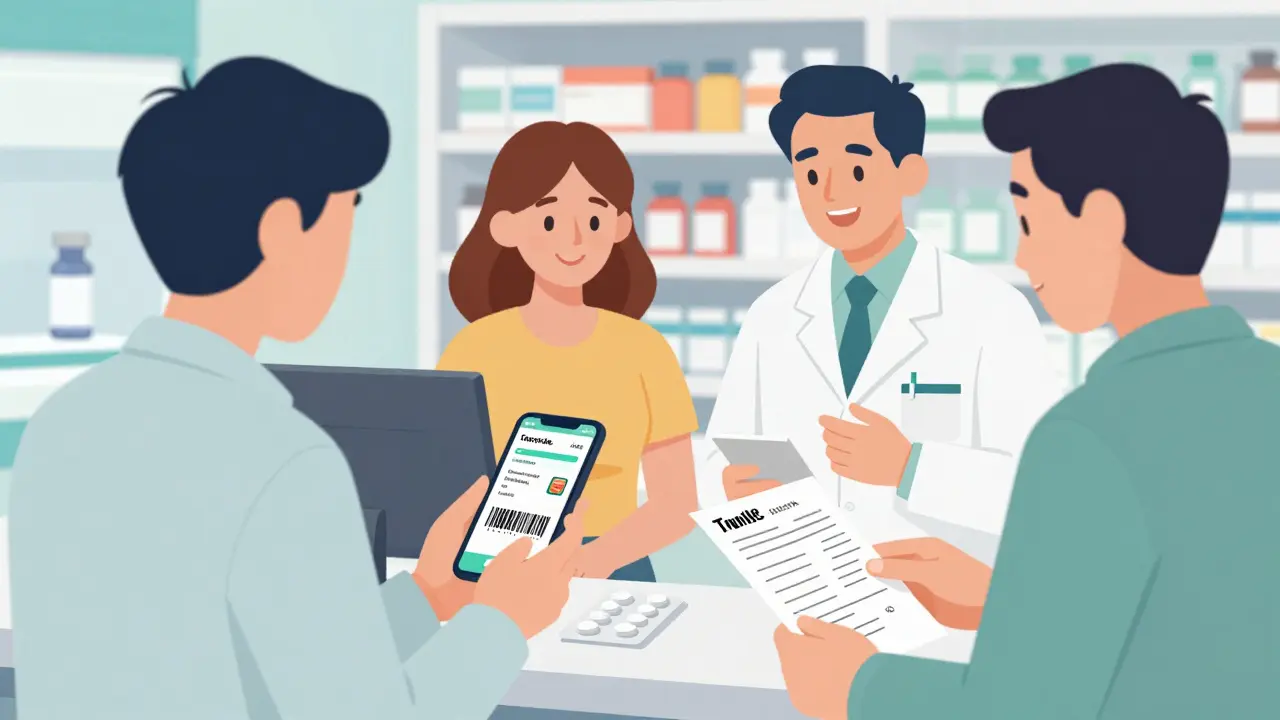
Pharmacists are trained to help you. But they can’t read your mind. If you don’t ask, they assume you know.Before you leave the pharmacy, ask:
- "What should I do if I miss a dose?" Only 22% of patients ask this-but it’s the most common cause of accidental overdose.
- "How should I store this?" Forty percent of medications need special handling. Most people don’t know.
- "What side effects should I watch for?" A 2023 AHRQ study found that only 65% of pharmacy consultations cover this. If you don’t know what’s normal, you might panic-or ignore a real danger.
Bring your current medication list. Ask them to compare it with your new prescription. Many pharmacies now offer free medication reviews. Use them.
Use Tools to Stay on Track
Memory fails. Life gets busy. That’s why tools exist.- Medication charts (paper or digital) that list each drug, dose, time, and special instructions.
- Phone alarms set for morning, noon, and night. Label them: "AM: Blood pressure pill" or "PM: Glucosamine with dinner".
- Blister packs from your pharmacy-these organize pills by day and time. They’re free at many locations.
- Barcode-scanning apps like Medisafe. Scan your pill bottle, and the app tells you what it is, why you take it, and when to take it next.
One patient on Reddit shared how she ended up in the hospital after getting double the dose of levothyroxine. Why? The packaging looked similar to her old pill. A barcode scanner would have caught it.
Watch for Changes-Even Small Ones
If your pill suddenly looks different, don’t assume it’s the same. Ninety percent of prescriptions are filled with generics. They work the same-but they might be a different color, size, or shape.If you notice a change, call your pharmacist. Ask: "Is this the same medicine?" If they say yes, ask them to confirm the active ingredient matches your old one. If they hesitate? Walk out and call your doctor.
Also, watch for side effects. A new headache? Nausea? Dizziness? Don’t brush it off. Write it down. Bring it to your next visit. The FDA issued 78 medication safety alerts in 2023-most were for drug interactions or unexpected side effects.
When in Doubt, Pause
You’re not stupid if you’re unsure. You’re smart if you stop and ask.If a label is blurry, don’t squint. Go to a well-lit room. If the instructions are confusing, don’t guess. Call the pharmacy. If you’re told "take as needed," ask: "What does that mean? How many times a day? What symptoms should I have before taking it?"
And never take unlabeled medication. Ever. A 2022 ISMP report found that 12% of hospital errors came from pills without clear labels. If a friend hands you a pill in a baggie? Say no.
What Happens Next?
Learning to manage medication safely takes time. The average person needs 2-3 weeks to build reliable habits. That’s normal. You’ll make mistakes. That’s okay. What matters is that you learn from them.By following these steps, you’re not just avoiding danger-you’re taking control of your health. Medication safety isn’t about fear. It’s about clarity. And with every pill you take correctly, you’re giving your body the best chance to heal.
What should I do if I accidentally take the wrong dose?
Don’t panic. Call your pharmacist or poison control immediately (1-800-222-1222 in the U.S.). Even if you feel fine, some reactions happen hours later. Have your medication list ready. If you’re dizzy, vomiting, or having trouble breathing, go to the ER. Never wait to see if it "gets better."
Can I crush my pills or open capsules?
Not unless your doctor or pharmacist says it’s okay. Some pills are designed to release slowly. Crushing them can cause too much medicine to enter your body at once. Others have coatings to protect your stomach. If swallowing is hard, ask for a liquid form instead. Many pharmacies can compound medications into easier-to-take forms.
Is it safe to take medicine with alcohol?
Often, no. Alcohol can increase drowsiness, raise blood pressure, or make liver damage worse-especially with painkillers, antidepressants, or antibiotics. Always check the label. If it says "avoid alcohol," it’s not a suggestion. The FDA has issued alerts on over 20 common medications that become dangerous when mixed with alcohol.
How do I know if a medication is expired?
Look for the expiration date on the bottle or box. It’s usually labeled "EXP" or "Expires." If it’s past that date, don’t use it. Liquid medicines, eye drops, and insulin degrade faster than pills. Even if it looks fine, it might not work. Expired antibiotics can fail to treat infections-and lead to antibiotic resistance.
Why do I need to tell my pharmacist about supplements?
Because supplements aren’t harmless. Garlic, ginkgo, and vitamin E can thin your blood-dangerous if you’re on warfarin. St. John’s Wort can make birth control, antidepressants, or heart meds stop working. Pharmacists see these interactions every day. They’re trained to catch them before you get hurt.
Medication safety isn’t complicated. It’s consistent. It’s asking questions. It’s writing things down. It’s checking labels. And it’s never assuming. You’ve got this.
Marie Crick
February 21, 2026 AT 02:02Caleb Sciannella
February 21, 2026 AT 17:36As someone who has spent over two decades in clinical pharmacy and patient education, I must commend the thoroughness of this guide. The Six Rights framework is not merely a mnemonic-it is a foundational pillar of pharmacovigilance that every layperson should internalize. The emphasis on environmental storage conditions, particularly the humidity-induced degradation of tablets in bathroom cabinets, is an insight often overlooked by both patients and even some primary care providers. Moreover, the statistical references to medication error rates are not merely illustrative-they are alarming indictments of our fragmented healthcare communication systems. I would further advocate for the integration of these principles into high school health curricula, as medication literacy should be as fundamental as financial literacy or digital citizenship.
Additionally, the suggestion to carry a physical medication list is prudent, but I would extend it to include not only the drug name and dosage but also the prescribing clinician’s name and contact information. This becomes critical during after-hours emergencies or when transferring care between institutions. The use of digital apps like Medisafe is commendable, yet I caution against overreliance on technology without a parallel paper backup, given the potential for device failure, battery depletion, or app incompatibility across platforms.
Maddi Barnes
February 22, 2026 AT 03:58Okay but like… have y’all ever tried to keep track of meds when you’re juggling 3 prescriptions, 5 supplements, a nightly CBD gummy, and your partner keeps "borrowing" your ibuprofen because "it’s just Advil, right?" 😅
I started using a pill organizer with labeled days and set alarms that say "DON’T BE A DUMBASS, TAKE YOUR BP MEDS" (yes, I named them). My pharmacist laughed, then gave me a free one. Turns out, I’m not the only one who talks to their pills.
Also-PLEASE stop leaving your insulin in the car. I know it’s cold outside, but no, your car is not a fridge. I saw a guy try to warm up his pen by holding it to his phone charger. I called 911. He was fine. His dignity? Gone.
And if your pill looks different? ASK. Don’t Google it. Don’t text your cousin who "took that once." Call the pharmacy. They’ll be happy to help. I promise. They’ve seen it all. Even the guy who took his wife’s thyroid med because "it looked like the one my dog takes."
Medication safety isn’t about fear. It’s about not dying. And honestly? You’re already ahead just by reading this. 🙌
Benjamin Fox
February 22, 2026 AT 11:23Jonathan Rutter
February 22, 2026 AT 21:58You think this is bad? I worked in a nursing home for six years. Saw a woman take her husband’s blood thinner because the bottles looked identical. He bled out in his sleep. No one noticed until the next morning. And guess what? The pharmacy didn’t even flag it. They were too busy filling 400 scripts an hour.
Then there’s the guy who took his diabetic meds with a shot of whiskey because "it helps the pill go down." He ended up in a coma for three days. His family sued. Got $200k. The pharmacy paid. No one went to jail.
And don’t even get me started on supplements. People think because it’s "natural" it’s safe. Garlic? Ginkgo? Turmeric? Those aren’t herbs-they’re chemical bombs waiting to explode in your liver. I’ve seen people on warfarin take a single turmeric capsule and end up with blood gushing out of their gums. No joke.
And now you want to tell people to "ask questions?" Like they’re going to? Half of them can’t even read. The other half think the pharmacist is just there to hand out candy. We’re not educating people. We’re babysitting adults who think their phone knows more than their doctor.
The real solution? Ban all over-the-counter meds. Make every pill prescription-only. Force people to see a provider. No more "just take two" for headaches. No more "I’ll try this herb." We’re not a country of adults. We’re a country of toddlers with credit cards.
And if you’re going to take something? Write it down. On paper. In ink. And tape it to your forehead. Because your memory? It’s garbage. And so are you if you don’t treat meds like they’re loaded guns.
Jana Eiffel
February 24, 2026 AT 16:22The epistemological framework underpinning medication safety is not merely procedural, but deeply ontological: it is an assertion of agency in the face of institutional abstraction. To engage with pharmaceuticals consciously is to resist the commodification of bodily autonomy, wherein the patient is reduced to a data point within a pharmacovigilance algorithm. The Six Rights, therefore, are not merely clinical heuristics-they are acts of epistemic resistance against the obfuscation of medical authority.
Moreover, the persistent failure to institutionalize medication literacy reflects a broader epistemic injustice: the assumption that laypersons are incapable of rational pharmacological engagement. Yet, as the cited studies demonstrate, even rudimentary documentation practices yield statistically significant reductions in adverse events. This suggests not a deficit in patient capacity, but a deficit in pedagogical humility on the part of healthcare systems.
One might further argue that the reliance on digital apps, while pragmatically useful, risks re-embedding the patient within a surveillant architecture wherein compliance is quantified rather than understood. A handwritten list, by contrast, is an embodied act of memory-a tactile covenant between self and substance.
Thus, while the guide is commendable in its pragmatism, it must be extended into a philosophical discourse on the ethics of self-care within a system that commodifies both health and ignorance.
John Cena
February 25, 2026 AT 09:29Good guide. Simple. Clear. No fluff.
I’ve been on six different meds over the last three years. Some days I forget. Some days I’m tired. Some days I just don’t care. But I keep the list. I use the alarms. I check the bottle. Not because I’m scared-just because I don’t want to feel worse than I already do.
One time I took my old pill by accident. Looked the same. Felt the same. Didn’t think anything of it. Until I got dizzy. Called my pharmacist. They said "oh yeah, that’s a different generic. You’d be fine, but you should’ve asked."
So yeah. Ask. Write. Check. It’s not hard. And it’s not about being perfect. It’s about not being stupid when it matters.
aine power
February 25, 2026 AT 23:52