Wearable ECG QT Risk Simulator
Enter your current heart rate and estimated raw QT interval (from a device reading) to see your corrected QT (QTc) risk profile. Select a device to simulate potential measurement variance.
--
milliseconds (ms)Enter values and click Calculate to see your risk profile based on Bazett's Formula.
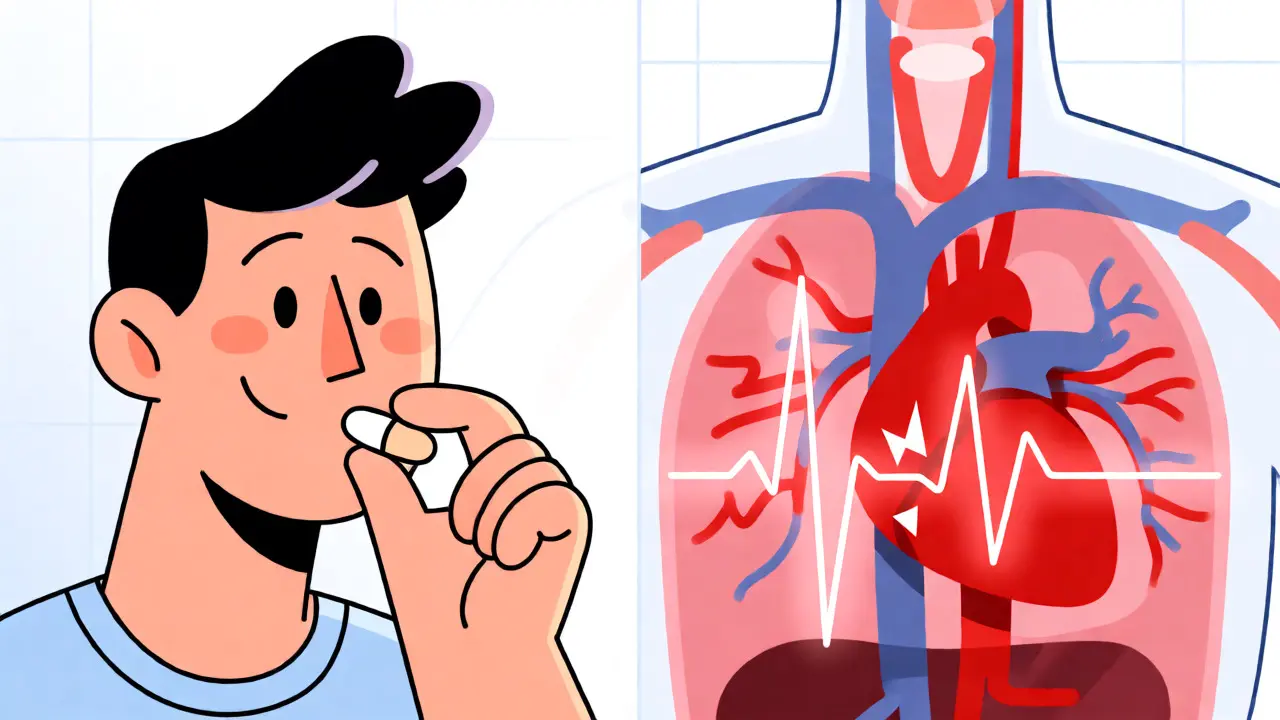
Imagine you're taking a common antibiotic or an antipsychotic medication. You feel fine, but inside your chest, your heart's electrical rhythm is shifting dangerously. This shift, known as QT prolongation, can lead to a chaotic heart rhythm called torsades de pointes, which might cause sudden cardiac arrest. For years, catching this required you to sit in a clinic with sticky electrodes attached to your chest for hours, or worse, wait until it was too late. But the landscape of cardiac safety has shifted dramatically. We now have wearable devices that promise to watch your heart's electrical activity around the clock, right from your wrist or pocket.
This isn't just sci-fi speculation. Since the pandemic accelerated remote monitoring needs, devices like the Apple Watch and KardiaMobile have moved from novelty gadgets to serious medical tools. But how reliable are they for measuring the QT interval specifically? Can they really replace the gold-standard 12-lead ECG for detecting drug-induced risks? Let's break down what the science says, where these devices excel, and where they still fall short.
The Hidden Danger of QT Prolongation
To understand why we need wearables, you first need to grasp the problem. The QT interval represents the time it takes for your heart's ventricles to depolarize and repolarize-essentially, the time it takes to recharge after a beat. It starts at the beginning of the Q wave and ends at the end of the T wave on an electrocardiogram (ECG). When this interval gets too long, usually defined as a corrected QT (QTc) greater than 500 milliseconds, the risk of fatal arrhythmias spikes.
Many common medications prolong this interval. Think about certain antibiotics like azithromycin, antiarrhythmics, or even some antidepressants. Traditionally, doctors monitor this using a standard 12-lead ECG in a hospital setting. But here’s the catch: QT intervals fluctuate. They change with heart rate, stress, sleep, and daily activity. A single snapshot in a clinic might miss a dangerous spike that happens when you’re sleeping or exercising. This is where continuous or frequent intermittent monitoring via wearables becomes crucial. It transforms cardiac safety from a static check-up into dynamic, real-time surveillance.
Leading Devices: Apple Watch vs. KardiaMobile
Two names dominate the conversation when it comes to consumer-grade ECGs capable of contributing to QT assessment: the Apple Watch and AliveCor’s KardiaMobile. While both are popular, their designs and validation histories differ significantly.
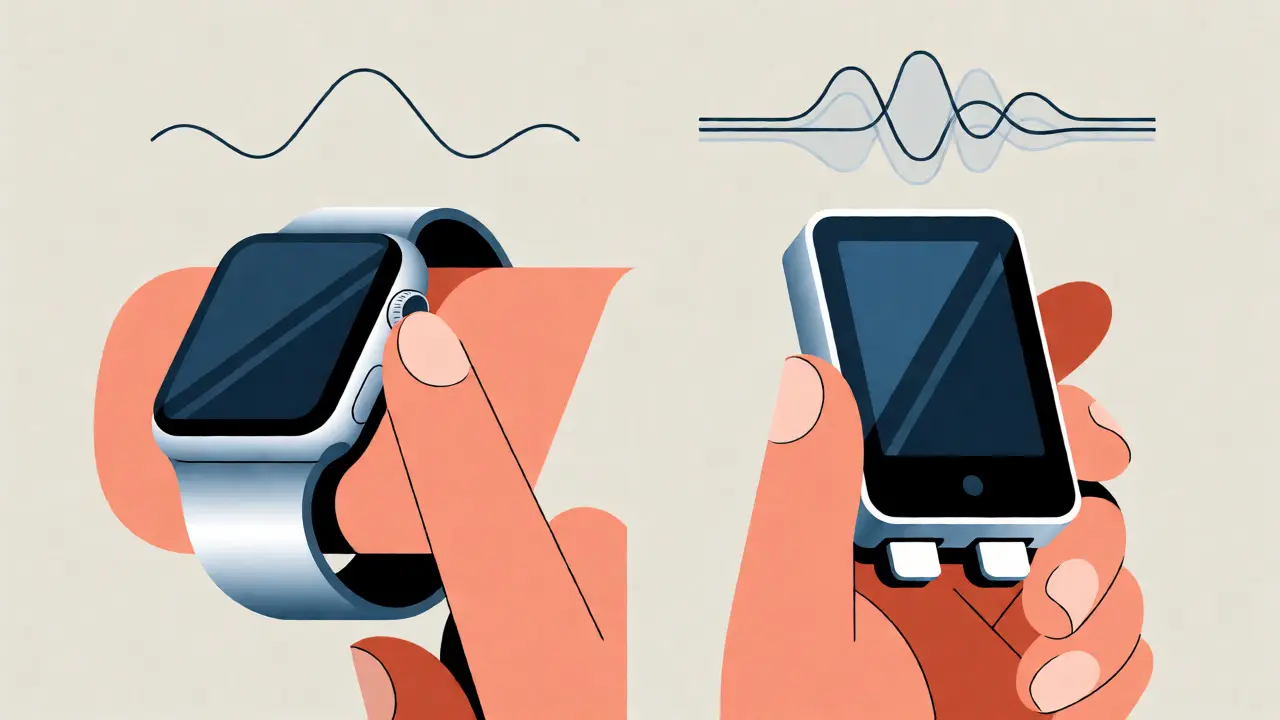
The Apple Watch (Series 4 and later) integrates a single-lead ECG directly into the digital crown. To record, you place your finger on the crown for 30 seconds while wearing the watch on your other wrist. This completes a circuit, recording Lead I. In September 2018, Apple received FDA clearance for its ECG app, marking a major milestone. However, its primary validated use case was detecting atrial fibrillation, not necessarily precise QT measurement out of the box.
In contrast, the KardiaMobile 6L by AliveCor is a dedicated handheld device. It measures 9.0 cm × 3.0 cm × 0.72 cm and records six leads (I, II, III, aVL, aVF, and aVR) simultaneously. You hold the top electrodes with your thumbs and rest the bottom electrodes on your left knee or ankle. This multi-lead capability provides a more comprehensive view of the heart's electrical vector, which is critical for accurate QT analysis. As of October 2023, AliveCor had secured FDA clearance for 16 separate indications, including specific protocols for QT interval measurement.
| Feature | Apple Watch (Series 4+) | KardiaMobile 6L | Standard 12-Lead ECG |
|---|---|---|---|
| Leads Recorded | Single Lead (Lead I) | Six Leads (I, II, III, aVL, aVF, aVR) | Twelve Leads |
| Form Factor | Integrated Smartwatch | Handheld Pocket Device | Clinical Stationary Unit |
| FDA Clearance for QT | Used in research; limited specific indication | Yes (Specific indications since 2020) | Gold Standard |
| Primary Validation | Atrial Fibrillation Detection | AFib & QT Interval Research | Comprehensive Cardiac Diagnosis |
| User Effort | Low (Wrist + Finger touch) | Moderate (Thumbs + Leg contact) | High (Clinic visit) |
What the Science Says About Accuracy
So, do these gadgets actually measure QT accurately? The data suggests a cautious yes, with significant caveats. A pivotal study by Spaccarotella et al. (2021), published in *Scientific Reports*, tested the Apple Watch against standard 12-lead ECGs. The results were promising: Spearman’s correlation coefficients for QT measurement reached 0.886 for Lead I and 0.914 for mean QT. These numbers indicate a strong statistical relationship between the wearable readings and clinical standards.
However, correlation isn't the same as absolute precision. Bland-Altman analyses in the same study showed that while trends matched, individual measurements could deviate. Another pilot study cited in the *Cleveland Clinic Journal of Medicine* (2024) found that single-lead handheld devices were noninferior to 12-lead ECGs within ±20 ms for corrected QT intervals. For many clinical decisions, a 20-millisecond margin is acceptable. But for patients with borderline Long QT Syndrome, that margin matters.
The KardiaMobile 6L performs even better due to its multi-lead nature. Hoek et al. (2023) reviewed sixteen studies involving this device, noting that its 6-lead recordings offer interval measurements comparable to standard ECGs. This is because QT morphology varies across different leads. Relying on a single lead (like the Apple Watch) means you might miss abnormalities visible only in other vectors. The 6L captures a broader picture, reducing the chance of false negatives.
Regulatory Milestones and Clinical Adoption
The path to acceptance wasn't smooth. It took a global crisis to force regulatory bodies to look closely at consumer tech. In April 2020, during the height of the COVID-19 pandemic, the U.S. Food and Drug Administration (FDA) issued emergency guidance permitting the use of the KardiaMobile 6L for QT measurement in patients receiving hydroxychloroquine and azithromycin. Hospitals were overwhelmed, and traditional monitoring was logistically impossible for every patient. This directive legitimized the technology for high-stakes cardiac safety monitoring.
Dr. Jason Chinitz, who published a key case report in 2020, noted that smart device waveforms correlate reasonably well with standard ECG intervals. He emphasized that while these devices aren't perfect for diagnosing complex arrhythmias, they are effective for detecting drug-induced QT prolongation. Today, pharmaceutical companies are increasingly adopting these wearables for Phase I-III clinical trials. Why? Because they reduce patient burden. Instead of visiting a clinic multiple times, participants record ECGs at home, improving compliance and providing richer data sets.
The Role of AI in Automated Analysis
Here is the biggest hurdle: Who reads the ECG? Manual review by cardiologists is the gold standard, but there aren't enough specialists to analyze thousands of 30-second clips generated daily by millions of users. This is where Artificial Intelligence (AI) steps in.
Recent research, such as the 2024 study by Alam et al. in *PLOS Digital Health*, developed deep learning models capable of inferring QT intervals from single-lead ECGs. Using a Residual Neural Network architecture, their model processed two beats from Lead I and Lead II streams to predict QTc prolongation (>500ms). Tested on 686 patients with genetic heart disease, the AI showed potential to automate the screening process. This technology aims to flag risky patterns automatically, alerting clinicians only when necessary. Without AI, the volume of data generated by wearables would be unmanageable.
Practical Limitations and Pitfalls
Before you rush to buy a smartwatch for cardiac safety, consider the limitations. First, signal quality is fragile. Skin-to-electrode impedance affects accuracy. If your skin is dry, hairy, or if you move during the recording, the signal degrades. The Cleveland Clinic review highlighted that sensitivity for detecting pathologic Q waves on consumer wearables can be as low as 20.6%. This means you might miss subtle signs of previous heart attacks, even if the QT interval looks okay.
Second, user error is rampant. Correct placement is vital. With the KardiaMobile, if you don't press your thumbs firmly on the top electrodes or fail to make good contact with your leg, the reading is useless. With the Apple Watch, ensuring the finger touches the digital crown securely is essential. Third, these devices are not designed for emergency response. If you feel faint or experience palpitations, call emergency services. Do not rely on your watch to diagnose a heart attack in real-time.
Finally, there is currently no universally commercially available algorithm for automated QT measurement on all consumer devices. Many apps provide raw data or basic AFib detection, leaving the complex QT calculation to third-party software or clinician interpretation. Always consult your doctor before changing medication based on wearable data.
Key Takeaways
- Accuracy: Wearable ECGs show strong correlation with standard ECGs for QT intervals, particularly multi-lead devices like KardiaMobile 6L.
- Validation: Single-lead devices (Apple Watch) are primarily validated for AFib; multi-lead devices offer better QT fidelity.
- Regulation: FDA guidance since 2020 supports the use of specific wearables for QT monitoring in drug-safety contexts.
- AI Integration: Deep learning models are emerging to automate QT analysis, addressing the shortage of human reviewers.
- Limitations: Signal noise, user error, and lack of standardized algorithms remain significant barriers to full clinical replacement.
Can an Apple Watch detect Long QT Syndrome?
While the Apple Watch can record an ECG, it is not specifically cleared for diagnosing Long QT Syndrome. Studies show it correlates well with standard ECGs, but it lacks the multi-lead perspective needed for definitive diagnosis. It serves best as a screening tool to prompt further clinical evaluation rather than a diagnostic device.
Which is better for QT monitoring: Apple Watch or KardiaMobile?
The KardiaMobile 6L is generally considered superior for QT monitoring because it records six leads simultaneously, offering a more complete view of the heart's electrical activity. The Apple Watch records only a single lead (Lead I), which may miss abnormalities present in other vectors. However, the Apple Watch offers greater convenience for continuous wear.
How accurate are wearable ECGs compared to hospital ECGs?
Research indicates high correlation, with differences often within ±20 milliseconds for corrected QT intervals. Multi-lead devices perform closer to the gold standard. However, they are susceptible to motion artifacts and poor electrode contact, which can degrade accuracy significantly compared to controlled clinical environments.
Do I need a prescription for a wearable ECG?
Most consumer devices like the Apple Watch and KardiaMobile are available over-the-counter. However, interpreting the results for medical decisions, especially regarding medication changes, requires a healthcare provider. Some advanced telehealth services may require a referral to access professional ECG analysis.
Can wearables replace Holter monitors?
Not entirely. Holter monitors provide continuous 24-48 hour recording, capturing events throughout the day and night. Most consumer wearables require manual activation for 30-second snapshots. While patch-based wearables exist, standard smartwatches cannot yet fully replicate the continuous data stream of a Holter monitor for complex arrhythmia detection.
Amy B
September 5, 2026 AT 01:08Okay, this is actually super cool and a little terrifying all at once. I’ve been wearing my Apple Watch for years just to count steps and track sleep, but the idea that it’s secretly watching my heart’s electrical rhythm like a hawk? Wild.
The part about QT prolongation being hidden really hit home because I take an antidepressant, and I always assumed if I felt fine, my heart was fine. But learning that stress or even just sleeping can shift those intervals dangerously makes me want to go check my device right now. It feels like we’re living in a sci-fi movie where your wrist knows more about your health than you do until something goes sideways.
I’m curious though, does anyone else feel like the AI analysis mentioned here is getting too good? Like, what happens when the watch decides I need to stop taking my meds before my doctor even sees the data? The potential for false alarms seems high given how sensitive skin impedance is. Still, I love that we have options beyond sitting in a clinic with sticky pads. It empowers us to be proactive rather than reactive, which is exactly what modern healthcare needs.
Rob Alderman
September 5, 2026 AT 10:54While the enthusiasm is palpable among the layperson demographic, one must maintain a degree of clinical skepticism regarding consumer-grade telemetry. The correlation coefficients cited are statistically significant, yet they fail to address the inherent noise floor of single-lead acquisition in uncontrolled environments. We are effectively asking a smartwatch to perform the function of a calibrated medical instrument while the user is engaged in activities that introduce motion artifacts of varying magnitudes. Until these devices achieve diagnostic parity with 12-lead systems across diverse physiological states, they remain adjunctive tools rather than replacements for professional oversight.
Somnath Thombre
September 6, 2026 AT 19:28honestly this is pretty neat stuff! i use kardia mobile sometimes and yeah its way better than apple watch for detailed stuff since u get more leads. its kinda scary how many meds mess with qt interval tho. glad we have tech to help catch it early. keep up the good work on these devices!
Kimberley Odish
September 7, 2026 AT 09:14This entire premise is fundamentally flawed and dangerously misleading to the general public. You are conflating correlation with causation and convenience with clinical validity. The fact that a consumer gadget shows a Spearman correlation of 0.886 does not mean it is medically actionable without physician interpretation, which most users lack. By promoting these devices as 'real-time risk detection,' you are fostering a culture of self-diagnosis that leads to unnecessary anxiety and potentially missed diagnoses due to algorithmic limitations. The regulatory clearance mentioned is for specific indications under controlled conditions, not for the chaotic reality of daily life where sweat, movement, and poor contact render the data garbage. Stop hyping gadgets as saviors when they are merely toys with FDA stamps.
Adam Viruet
September 8, 2026 AT 10:01Wait... hold on a second???
Are we seriously comparing a $400 watch to a hospital grade ECG??
Like... come on!!!
My uncle has a pacemaker and his cardiologist laughed when he showed him the Apple Watch reading!!
It's cute... but don't trust your life to it!!!
Jenn Bell
September 9, 2026 AT 14:14This is such a hopeful development for people managing chronic conditions! It’s great to see technology stepping in to bridge the gap between clinic visits. For someone like me who gets anxious about waiting weeks for an appointment, having a tool that offers reassurance (or a nudge to call the doctor) is invaluable. I appreciate the balanced view on limitations too; it keeps expectations realistic while still highlighting the progress made.
Eric Schultze
September 9, 2026 AT 23:51The integration of corporate interests into personal health data is troubling. When a private entity controls the algorithm that determines your cardiac risk, who owns that data? Who profits from the alerts? We are moving toward a model where insurance companies may deny coverage based on wearable data anomalies that are clinically insignificant. This is not just a medical issue; it is a civil liberties issue. We must be vigilant against the erosion of privacy in exchange for the illusion of safety provided by Silicon Valley gadgets.
Jeremy Westcott
September 10, 2026 AT 03:06Dude, think about the big picture here. Big Pharma loves this because it keeps patients hooked on their ecosystem. They push meds that affect QT, then sell you the watch to monitor the side effects. It’s a closed loop of profit. Also, the AI training data? Probably biased towards certain demographics. If you’re not the average white male test subject, your readings might be off. Don’t let them fool you with fancy graphs. Your body isn’t a dataset for their quarterly earnings report.
Amanda SF
September 11, 2026 AT 03:09It is imperative to note that the validation studies cited often exclude populations with complex comorbidities. Furthermore, the distinction between Lead I and multi-lead recording is critical. A single lead cannot capture the spatial vector of repolarization abnormalities accurately. Therefore, any claim of equivalence is hyperbolic. Users must understand that a negative result on a wearable does not rule out pathology, particularly in cases of subtle T-wave morphology changes. The stakes are simply too high for casual reliance.
Neil Martin
September 12, 2026 AT 18:22The signal-to-noise ratio in ambulatory settings remains the primary bottleneck. Without robust artifact rejection algorithms integrated directly into the hardware firmware, the downstream analytical burden falls disproportionately on the clinician. Moreover, the lack of standardized interoperability protocols between different vendor ecosystems creates fragmented patient records. We need open-source validation frameworks, not proprietary black boxes, to truly assess the efficacy of these interventions in real-world pharmacovigilance.
Kim Pender
September 13, 2026 AT 16:51seems okay i guess. just dont replace your doc with it. simple as that.
Neil Sahli
September 15, 2026 AT 09:26Oh, fantastic! Nothing says 'trust your life' like a device that also tracks how many stairs you climbed today. But hey, if it saves a few lives by catching a bad drug interaction before it becomes a funeral, I’m all for it. Just make sure you charge it, or your heart might literally miss a beat out of panic.
Pramay Dattani
September 16, 2026 AT 23:03this is why india is lagging behind!! we need govt to subsidize these watches for everyone!! its not fair only rich people get to know if their heart is gonna explode!! buy local tech!!! stop buying apple!!!