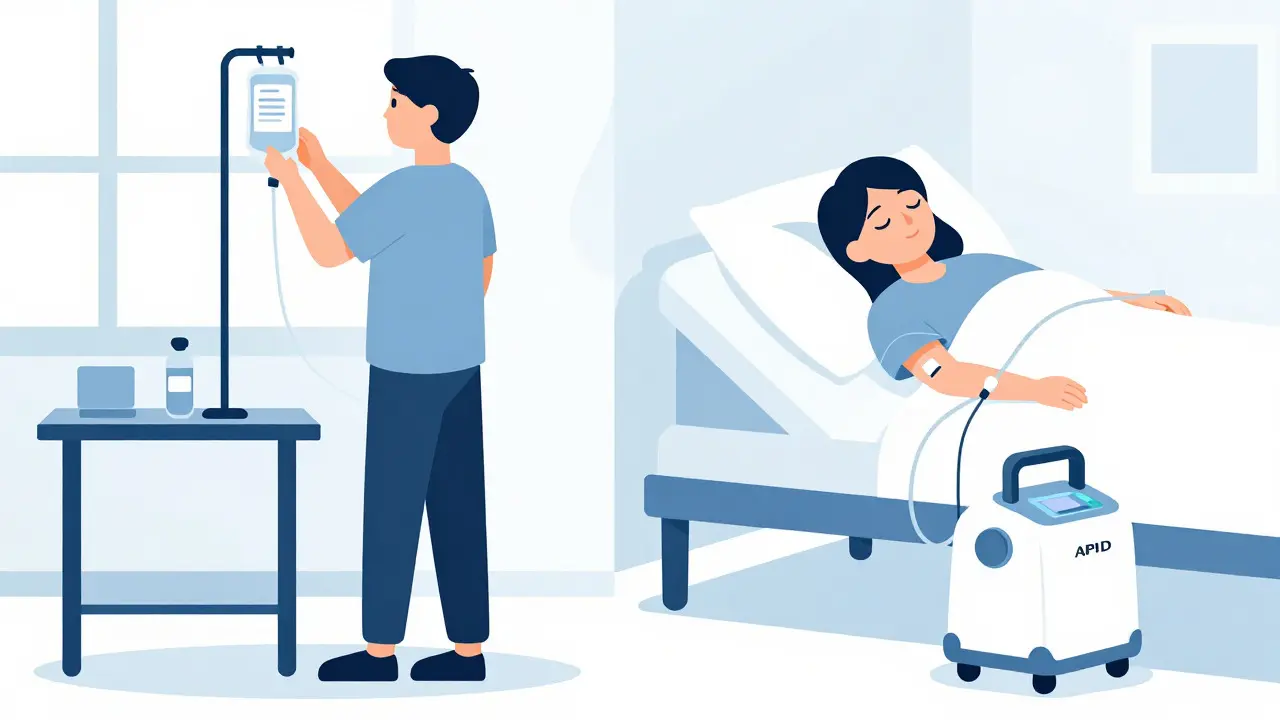
Living with kidney failure used to mean three trips a week to a clinic for hours of uncomfortable treatment. Today, you can treat your kidneys from the comfort of your own living room or bedroom. This shift to home peritoneal dialysis is a life-changing therapy that uses your body's natural lining to filter waste and excess fluid without needles or machines in some cases offers freedom, but it comes with a major choice: Continuous Ambulatory Peritoneal Dialysis (CAPD) or Automated Peritoneal Dialysis (APD). Both methods use the same basic principle-your peritoneum acts as a filter-but they fit into very different lifestyles. Choosing the wrong one can lead to stress, sleep loss, or even infection. Choosing the right one means keeping your health stable while still living your life.
How Peritoneal Dialysis Works at Home
To understand the difference between CAPD and APD, you first need to know what is happening inside your body. In both methods, a soft tube called a catheter is surgically placed in your abdomen. Through this catheter, a special liquid called dialysate flows into your belly. The peritoneal membrane is the thin tissue lining your abdominal cavity that acts as a natural semi-permeable barrier for filtering blood does the heavy lifting. It pulls toxins like urea and creatinine, along with extra fluid, out of your bloodstream and into the dialysate. After a set time, you drain the dirty fluid out and replace it with fresh solution. This cycle repeats throughout the day or night.
The key difference isn't the medicine or the tube; it's who-or what-does the work. In CAPD, you are the machine. In APD, a computerized cycler is the machine. Understanding this dynamic helps clarify why one might suit you better than the other based on your daily routine, physical ability, and home environment.
CAPD: Manual Control and Daytime Freedom
Continuous Ambulatory Peritoneal Dialysis (CAPD) is a manual dialysis method requiring patients to perform 3-5 exchanges of dialysis fluid daily using gravity drainage without machinery has been around since the 1970s. It is simple in concept but demanding in execution. You perform exchanges manually, usually every four to six hours while you are awake. Each exchange takes about 30 to 40 minutes. You hang a bag of fluid, let it fill your abdomen by gravity, wait for the filtration to happen, and then drain it into another bag.
The biggest advantage of CAPD is portability. There is no machine to plug in, no cords to manage, and no noise. If you have a job that requires travel or a busy daytime schedule where you can find quiet moments, CAPD keeps you moving. According to data from Kidney.org, 65% of CAPD users maintain full-time employment because the treatment fits into their existing routine rather than dictating it. You don't need electricity, which makes traveling easier if you plan ahead.
However, the trade-off is constant vigilance. You must carry dialysate bags, which weigh between 4 and 6 pounds each. You need a clean space for every single exchange. A dusty shelf or a drafty window can introduce bacteria, leading to peritonitis-an infection of the abdominal lining. USRDS data shows CAPD users face a slightly higher risk of peritonitis (0.68 episodes per patient-year) compared to APD users (0.52 episodes), largely because there are more opportunities for human error during manual connections. If you have poor eyesight, arthritis, or tremors, the precise hand movements required for sterile technique can be exhausting and risky.

APD: Nighttime Automation and Sleep Recovery
Automated Peritoneal Dialysis (APD) is a machine-assisted dialysis method using a cycler to automatically perform fluid exchanges overnight while the patient sleeps changes the equation completely. Instead of doing exchanges during the day, you connect to a cycler machine before bed. The machine-such as the Baxter Amia or Fresenius Sleep-Safe-weighs between 15 and 25 pounds and sits on the floor next to your bed. For 8 to 10 hours, it fills, dwells, and drains the fluid automatically. When you wake up, you disconnect, and you are free for the day. Often, you leave a final bag of fluid in your abdomen during the day to continue filtering, so you aren't technically "off" treatment, but you aren't actively working either.
The primary benefit here is lifestyle consistency and sleep. Because the treatment happens while you rest, you don't have to interrupt your morning coffee, your commute, or your work meetings. Mayo Clinic research indicates APD users get an average of 3.2 more hours of quality sleep per night compared to those managing daytime exchanges. Modern cyclers also have safety features like air bubble detectors and pressure monitors that reduce manual errors by about 25%. If you work long shifts or have a chaotic household during the day, APD provides a predictable anchor to your evening routine.
The downsides are technical and spatial. You need a dedicated electrical outlet and a 2x2 foot space for the machine. Cyclers generate 35-45 decibels of noise, similar to a quiet library, which some people find disruptive. More importantly, you are dependent on technology. Fresenius data shows a 12% annual incidence of cycler malfunctions. While support teams are available 24/7, a broken machine in the middle of the night can cause significant anxiety. Additionally, the initial training for APD is longer-14 to 21 days versus 10-14 for CAPD-because you need to learn troubleshooting, not just sterile technique.
Side-by-Side Comparison: Making the Choice
To help you visualize the differences, here is a breakdown of how these two modalities stack up against each other in real-world scenarios.
| Feature | CAPD (Manual) | APD (Automated) |
|---|---|---|
| Treatment Time | Daytime, 3-5 exchanges/day | Nighttime, 8-10 hours continuous |
| Equipment Needed | Dialysate bags, tubing, clamp | Cycler machine, power cord, supplies |
| Physical Demand | High (lifting bags, precise hands) | Low (setup only, machine does work) |
| Infection Risk | Slightly higher (manual handling) | Lower (automated connections) |
| Travel Flexibility | High (no power needed) | Medium (need power/carry machine) |
| Cost (Out-of-Pocket) | $50-$75/month | $75-$100/month (cycler rental) |
| Best For | Active travelers, elderly, limited space | Working adults, dexterity issues, sleep priority |

Who Should Choose Which Method?
There is no universally "best" option, but there are clear patterns in who thrives with each approach. Dr. Michael J. Germain, a nephrology professor, notes that CAPD remains the gold standard for patients over 75 due to its cognitive simplicity-you don't have to remember software updates or troubleshoot error codes. If you value independence and have steady hands, CAPD gives you total control.
On the other hand, Dr. Beth Piraino argues that APD should be first-line for eligible patients under 65. Why? Because modern cyclers with remote monitoring have lowered the technical barrier. If you have a job that demands your full attention during the day, or if you struggle with fine motor skills due to diabetes-related neuropathy, APD removes the physical burden. It also tends to offer better fluid control, reducing hypertension emergencies by 22% according to recent meta-analyses. This is crucial for protecting your heart, which is often strained by kidney disease.
Consider your home environment too. Do you live in a small apartment with limited storage? CAPD supplies can be hidden in a closet. An APD cycler needs floor space and a nearby outlet. Do you share a bedroom with a light sleeper? The hum of the cycler might be an issue. These practical details often matter more than clinical statistics when deciding what will actually work in your daily life.
Training and Support: What to Expect
Starting home dialysis is not something you do alone. You will undergo intensive training. For CAPD, expect 10-14 days of learning sterile technique. Nurses will watch you connect and disconnect tubes until you can do it flawlessly. For APD, training extends to 14-21 days because you must also learn how to operate the machine, interpret alarms, and perform basic maintenance. Both require a home assessment to ensure you have a safe, clean area for treatment.
Support structures differ significantly. APD programs increasingly offer 24/7 technical support for machine issues, and 78% now include remote monitoring. This means your care team can see your treatment data in real-time, allowing them to adjust prescriptions proactively. CAPD relies more on clinical follow-up, with monthly nurse visits being critical to check your technique and catch early signs of infection. Regardless of the modality, having a strong support network-whether family, friends, or a robust healthcare team-is the strongest predictor of long-term success.
Is peritoneal dialysis painful?
The procedure itself is generally painless. You may feel bloated or heavy when the fluid is in your abdomen, especially during the first few weeks as your body adjusts. Some patients experience mild discomfort at the catheter site initially, but severe pain is rare and should be reported immediately as it could indicate a complication like hernia or infection.
Can I travel while on peritoneal dialysis?
Yes, absolutely. CAPD is often preferred for frequent travelers because it doesn't require electricity. You can order supplies to be shipped to your hotel or vacation home. APD travelers need to ensure their destination has adequate electrical outlets and space for the cycler, and they may need to arrange for temporary equipment rental through their dialysis provider.
What is the most common complication of PD?
Peritonitis, an infection of the peritoneal membrane, is the most serious and common complication. It occurs when bacteria enter the abdomen through the catheter. Symptoms include cloudy dialysate fluid, abdominal pain, and fever. Strict adherence to sterile technique during exchanges is the best prevention method.
Does Medicare cover home peritoneal dialysis?
Yes, Medicare covers 80% of the costs for home dialysis supplies and equipment, including the cycler for APD. Out-of-pocket expenses vary but typically range from $50 to $100 monthly depending on the modality. Additional coverage for training and home modifications may also be available.
How long can I stay on peritoneal dialysis?
Many patients remain on PD for several years, sometimes a decade or more. Long-term viability depends on factors like residual kidney function, membrane health, and absence of complications. Regular monitoring by your nephrologist helps maximize the lifespan of your PD treatment.
Marc H
August 7, 2026 AT 18:08Oh, the sheer audacity of thinking a machine can replace the sacred ritual of manual labor in one's own abdomen. Truly, we are moving towards a post-human existence where our biological functions are outsourced to plastic boxes that hum like angry bees in the night. The irony is palpable.
Samuel Hershberger
August 9, 2026 AT 12:06Hey Marc, don't be so hard on it! 😊 I actually switched to APD last year and it has been a game changer for my sleep schedule. Being able to wake up without having to rush through exchanges before work is huge. The noise level is really not that bad once you get used to it, kind of like a white noise machine.
Chris McQuaid
August 11, 2026 AT 02:23The fundamental dichotomy here is not about comfort but about agency. CAPD demands you engage with your mortality every four hours, forcing a confrontation with the fragility of the flesh. APD allows you to dissociate, to sleep through the process of being kept alive by a algorithm. One might argue that the constant vigilance of CAPD fosters a deeper appreciation for the present moment, whereas APD encourages a passive acceptance of technological mediation. It is a philosophical choice as much as a medical one.
sam howard
August 12, 2026 AT 09:22apd is just lazy people wanting their hands fed. if you cant handle lifting a few pounds of fluid you probably shouldnt be doing dialysis at all. simple as that. machines break. humans adapt. stop coddling patients with tech solutions for problems that require discipline
Mathew Stuckey
August 13, 2026 AT 07:47Sam, maybe some people have arthritis or neuropathy? 🤔 It's not about laziness, it's about accessibility. Not everyone has the dexterity for manual exchanges. Be nice! 💙
Alli Crumley
August 14, 2026 AT 13:53Let us examine the epistemological implications of the 'sterile technique' fallacy. You assume that human error is the primary vector for peritonitis, yet you ignore the systemic failure of the healthcare apparatus to adequately train patients in the first place. The jargon-heavy discourse surrounding 'cycler malfunctions' serves to obscure the reality that these devices are merely profit centers for pharmaceutical conglomerates. We are trading physical autonomy for financial dependency. The emoticon smiley face : ) cannot hide the grim reality of this transaction. Your peritoneum is no longer yours; it is leased to Baxter or Fresenius. This is the ultimate commodification of the self.
Dennis Leeftink
August 15, 2026 AT 20:25the article says apd lowers infection risk because of automated connections. this is basic logic. less human touch means less bacteria. dumb people keep ignoring this fact. they prefer to feel important doing manual labor when they should be saving their energy. facts dont care about your feelings
John Divers
August 17, 2026 AT 13:18Indeed, the data supports Dennis's assertion regarding infection rates. However, we must also consider the psychological burden of reliance on external machinery. The formal structure of APD provides stability, yet it may erode the patient's sense of self-efficacy over time. A balanced approach would involve regular assessment of both clinical outcomes and patient satisfaction metrics.
Traci Bobbitt
August 19, 2026 AT 07:31Ive been on CAPD for three years and honestly the travel freedom is unmatched. I went to Hawaii last month and didnt have to worry about finding an outlet or carrying a heavy machine. Just pack the bags and go. People who complain about the weight of the bags clearly havent lifted groceries before. Its manageable if you plan ahead.
Sansaray Jones
August 19, 2026 AT 20:46just watch out for cloudy fluid