
Imagine taking a medication where the difference between a helpful dose and a dangerous one is razor-thin. For most medicines, this isn't a daily worry. But for Narrow Therapeutic Index (NTI) drugs, which are medications with a very small window of safety, even a slight change in blood concentration can lead to serious health issues. If you are a patient, a pharmacist, or someone working in pharmaceuticals, understanding how the Food and Drug Administration (FDA) regulates these specific drugs is crucial. The rules here are not just strict; they are fundamentally different from standard generic drug approvals.
The core problem with NTI drugs is that standard bioequivalence limits simply don't cut it. A generic version of a regular painkiller might be allowed to vary by up to 20% compared to the brand name, and still be considered safe. For an NTI drug like warfarin or tacrolimus, that same 20% variance could mean the difference between preventing a stroke and causing a bleed, or keeping an organ transplant alive versus rejecting it. That is why the FDA has established special requirements that go far beyond the usual checklist.
What Exactly Defines an NTI Drug?
To understand the regulations, we first need to pin down what qualifies a drug as "Narrow Therapeutic Index." The FDA doesn't just guess; they use data. In 2022, the agency published a pharmacometric approach that set a clear benchmark: a therapeutic index of ≤ 3 is the reasonable cutoff. This means the ratio between the toxic dose and the effective dose is three or less.
When evaluating whether a drug falls into this category, the FDA looks at five specific criteria:
- Dose Range: There is a maximum two-fold difference between the minimum effective dose and the minimum toxic dose.
- Concentration Window: The lowest and highest concentrations in the therapeutic range differ by no more than two-fold.
- Monitoring Needs: The drug requires routine therapeutic drug monitoring (TDM) to ensure safety.
- Variability: The drug exhibits low-to-moderate within-subject variability (typically ≤ 30%).
- Dosing Increments: Doses are often adjusted in small increments, usually less than 20%.
If a medication checks these boxes, it gets flagged for stricter scrutiny. Common examples include warfarin (a blood thinner), tacrolimus (an immunosuppressant), phenytoin (an anticonvulsant), and digoxin (used for heart conditions). These aren't casual over-the-counter remedies; they are powerful tools that demand precision.
The Shift in Bioequivalence Limits
Here is where the rubber meets the road. For decades, the standard rule for generic drugs was that the 90% confidence interval for bioavailability had to fall between 80% and 125%. This meant a generic could deliver significantly less or more drug into your system than the brand name, yet still be approved. For NTI drugs, experts argued this was too loose. Back in 2010, an advisory committee voted overwhelmingly that these standard limits were insufficient.
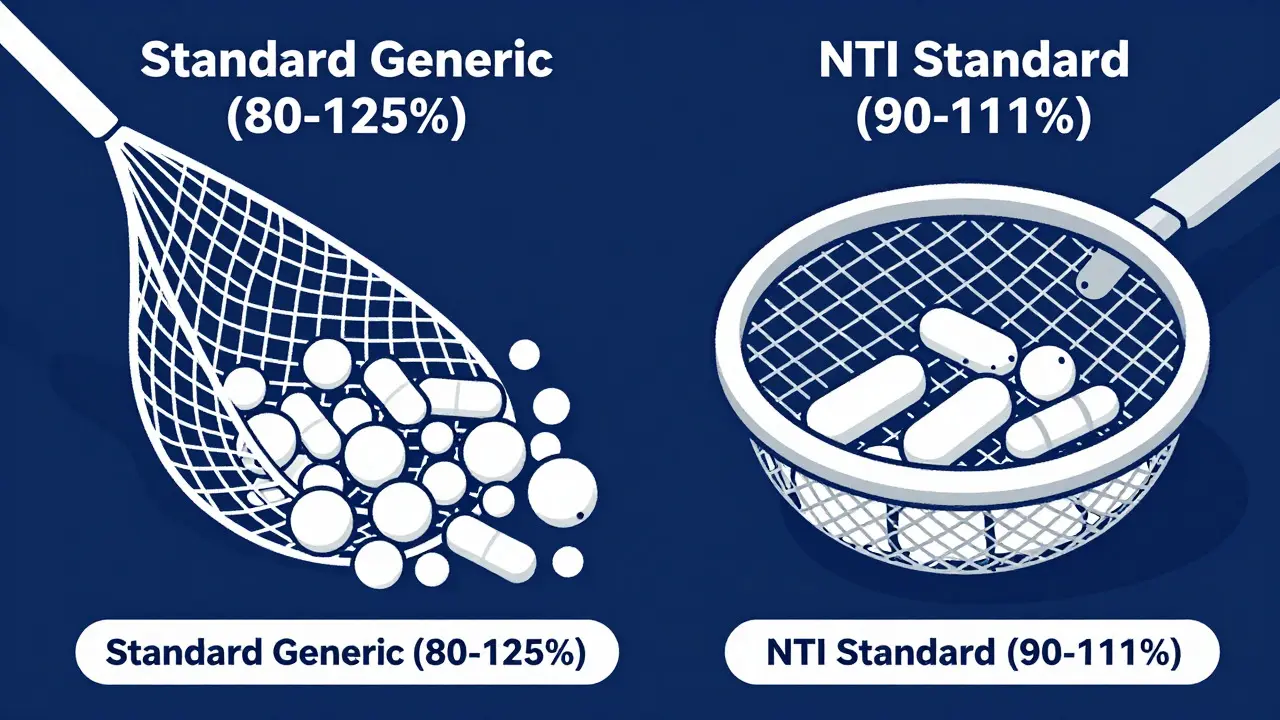
Today, the FDA applies a much tighter net. For NTI drugs, the acceptance interval for bioequivalence is tightened to 90.00-111.11%. Let’s break that down. Instead of allowing a swing from 80 to 125, the FDA now demands that the generic perform almost identically to the reference product, staying within a roughly 21% total range centered on 100%. This ensures that when a pharmacist substitutes a generic for a brand-name NTI drug, the patient’s blood levels remain stable.
But it doesn't stop there. The FDA uses a dual-criteria approach. The generic must pass both the new, tighter scaled limits AND the old, conventional 80-125% limits. It sounds redundant, but it acts as a safety net. If a drug is highly variable, the scaled limits adjust, but the requirement to also meet the conventional standards ensures consistency across the board.
Quality Assay and Manufacturing Precision
Bioequivalence isn't just about how the body absorbs the drug; it's about the quality of the pill itself. The FDA has also tightened the rules for quality assays. For non-NTI drugs, the amount of active ingredient in a tablet can range from 90% to 110% of the labeled amount. For NTI drugs, this range shrinks to 95-105%.
This might sound like a minor technicality, but in manufacturing, it represents a significant increase in control. It forces manufacturers to have more precise processes. When you consider that a patient might take hundreds of these pills, even a small drift in potency can accumulate. By demanding that every single pill contains nearly the exact stated dose, the FDA reduces the risk of batch-to-batch variation affecting patient outcomes.
The Role of Reference Scaled Average Bioequivalence (RSABE)
You will hear the term RSABE thrown around in regulatory circles. It stands for Reference Scaled Average Bioequivalence. This is the statistical engine behind the FDA's NTI standards. Why do we need scaling? Because some drugs are naturally more variable in how people absorb them than others.
If the reference listed drug (the brand name) has high within-subject variability (let's say the standard deviation is greater than 0.21), the FDA allows slightly wider bioequivalence limits for the generic, but only up to a point. However, there is a hard cap. The upper limit of the 90% confidence interval of the ratio of within-subject standard deviations must be ≤ 2.5. This prevents a manufacturer from arguing that their generic is equivalent just because the brand name is unpredictable. The generic must be consistent, and ideally, more consistent than the reference.
This approach differs from other global regulators. Health Canada and the European Medicines Agency (EMA) often recommend direct tightening of average bioequivalence limits without the complex scaling mechanism. The FDA’s method is more nuanced, acknowledging biological reality while maintaining strict safety boundaries.
Study Designs: Replicate Trials Are Mandatory
To prove that a generic NTI drug meets these tough standards, companies can't just run a simple study. The FDA mandates replicate crossover designs. In a standard bioequivalence study, you might give each participant one dose of the brand and one dose of the generic. In a replicate study, participants receive multiple doses of both.
Why? Because you need to measure within-subject variability accurately. You need to know how much *that specific person* varies from day to day when taking the drug. This requires larger sample sizes and more complex statistical analysis. It costs more and takes longer, but it provides the robust data needed to justify approving a generic for a high-stakes medication. Without this design, the FDA cannot reliably apply the RSABE methodology.

Real-World Concerns and Substitution Policies
Even with these rigorous standards, skepticism remains. Some clinicians and patients worry about switching between different generic manufacturers. Studies have shown that while Generic A and Generic B might both be bioequivalent to the Brand Name, they might not be perfectly bioequivalent to each other. This is known as the transitivity issue.
The FDA maintains that real-world evidence supports the therapeutic equivalence of generic NTI drugs. Dr. Honghui Zhou, Director of the Office of Generic Drugs, has emphasized that generic NTI drugs are clinically substitutable. However, the agency acknowledges the debate. This tension has led to a patchwork of state laws in the US. Some states allow automatic substitution of generic NTI drugs, while others require explicit patient consent or prohibit substitution altogether. Pharmacists play a key role here, often needing to educate patients and navigate these local regulations.
Looking Ahead: Harmonization and Transparency
The landscape is evolving. The FDA does not publish a single, comprehensive public list of all NTI drugs. Instead, they identify them through product-specific guidance documents. This can make it tricky for developers to know if their drug falls under the NTI umbrella until they engage with the agency. Recent efforts aim to increase transparency and harmonize these standards with global partners like the EMA and Health Canada.
As research continues, particularly on model drugs like tacrolimus and warfarin, the goal is to refine the pharmacometric models further. The industry is seeing a rise in NTI generic applications, accounting for about 15% of new generic approvals in recent years. This trend highlights the growing importance of mastering these specialized bioequivalence standards. For anyone involved in drug development or healthcare delivery, staying updated on these shifting guidelines is not optional-it’s essential for patient safety.
What is the therapeutic index cutoff for NTI drugs according to the FDA?
The FDA established in 2022 that a therapeutic index of ≤ 3 is a reasonable cutoff to define Narrow Therapeutic Index drugs. This means the ratio between the toxic dose and the effective dose is three or less.
How do bioequivalence limits for NTI drugs differ from standard generics?
Standard generic drugs must show bioequivalence within an 80-125% confidence interval. NTI drugs face much stricter limits, typically requiring a 90-111% range. Additionally, NTI generics must pass both the scaled limits and the conventional 80-125% limits.
Which common medications are classified as NTI drugs?
Common NTI drugs include warfarin, tacrolimus, phenytoin, digoxin, carbamazepine, everolimus, and valproic acid. These cover categories like anticoagulants, immunosuppressants, anticonvulsants, and cardiac glycosides.
Why does the FDA require replicate studies for NTI drugs?
Replicate studies allow researchers to accurately measure within-subject variability. This data is essential for applying the Reference Scaled Average Bioequivalence (RSABE) methodology, ensuring that the generic drug performs consistently relative to the reference product.
Is there a public list of all NTI drugs maintained by the FDA?
No, the FDA does not maintain a single comprehensive public list. Instead, NTI status is identified through product-specific guidance documents. Developers must consult these specific guidances to determine if a drug requires NTI-specific bioequivalence standards.
What is the quality assay range for NTI drugs?
For NTI drugs, the FDA requires the amount of active ingredient in a dosage unit to be within 95-105% of the labeled amount. This is tighter than the 90-110% range allowed for non-NTI drugs.
Do all states allow automatic substitution of generic NTI drugs?
No, state laws vary. While the FDA approves generic NTI drugs as therapeutically equivalent, some states require patient consent or prohibit automatic substitution due to ongoing clinical concerns and historical debates about therapeutic equivalence.