
Imagine a pill that works perfectly in the lab but fails on the patient's tongue. That gap between potential and reality is exactly what Good Manufacturing Practice (GMP) is designed to close. GMP is not just a checklist; it is a systematic framework of regulations ensuring that pharmaceutical, food, and medical device products are consistently produced and controlled according to quality standards appropriate for their intended use. Established initially by the U.S. Food and Drug Administration (FDA) through the 1938 Federal Food, Drug, and Cosmetic Act, GMP evolved into Current Good Manufacturing Practice (CGMP) to emphasize the requirement for manufacturers to use up-to-date systems and technologies. The 'C' in CGMP specifically denotes 'current,' requiring companies to implement modern approaches as mandated by FDA regulations (21 C.F.R. Parts 210 and 211), which were formally codified in 1978 but have undergone continuous updates.
As of August 2026, the landscape has shifted significantly. Regulatory agencies have discontinued pandemic-related flexibilities, with the GMP/GDP Inspectors Working Group ending the extension of GMP certificate validity that had been prolonged until December 31, 2024. This means compliance is no longer a temporary adjustment but a permanent, rigorous standard. Whether you are a quality assurance manager struggling with legacy equipment or a startup founder trying to navigate initial certification, understanding these detailed requirements is critical for survival in the market.
The Core Pillars of Modern GMP Compliance
GMP rests on nine fundamental principles that form the backbone of any compliant facility. These are not optional suggestions; they are the minimum requirements for drug manufacturing processes, ensuring product safety, ingredient accuracy, and potency consistency.
- Quality Management: Requires comprehensive quality assurance systems covering all production aspects. It’s the central nervous system of your operation.
- Sanitation and Hygiene: Mandates clean manufacturing environments with documented cleaning procedures validated to prevent cross-contamination.
- Building and Facilities: Specifications include proper zoning, air handling systems meeting ISO 14644-1 Class 5 standards for sterile manufacturing, and environmental monitoring.
- Equipment Qualification: Includes installation qualification (IQ), operational qualification (OQ), and performance qualification (PQ) as mandated by FDA 21 C.F.R. § 211.67.
- Raw Materials Control: Requires identity testing, quality verification, and proper storage conditions documented through temperature/humidity monitoring.
- Personnel Qualifications: Mandates documented training programs with competency assessments conducted quarterly.
- Validation and Qualification: Protocols require thorough process validation to ensure consistent results.
- Complaints and Recalls: Procedures require investigation within 72 hours of receipt and documented root cause analysis.
- Documentation and Record Keeping: Requires complete, contemporaneous records maintained for minimum periods specified by jurisdiction (typically 1-5 years post-product expiration).
A key nuance in current standards is the flexibility around process monitoring. The FDA clarifies that process monitoring decisions resulting in minor equipment adjustments don't require additional quality unit approval if adjustments remain within preestablished scientifically justified limits, these limits were approved by the quality unit in the master production record, and production data undergoes quality unit review before batch approval. However, be careful: the FDA explicitly advises against using process models alone, requiring them to be paired with in-process testing due to identified limitations in detecting invalid assumptions during manufacturing.
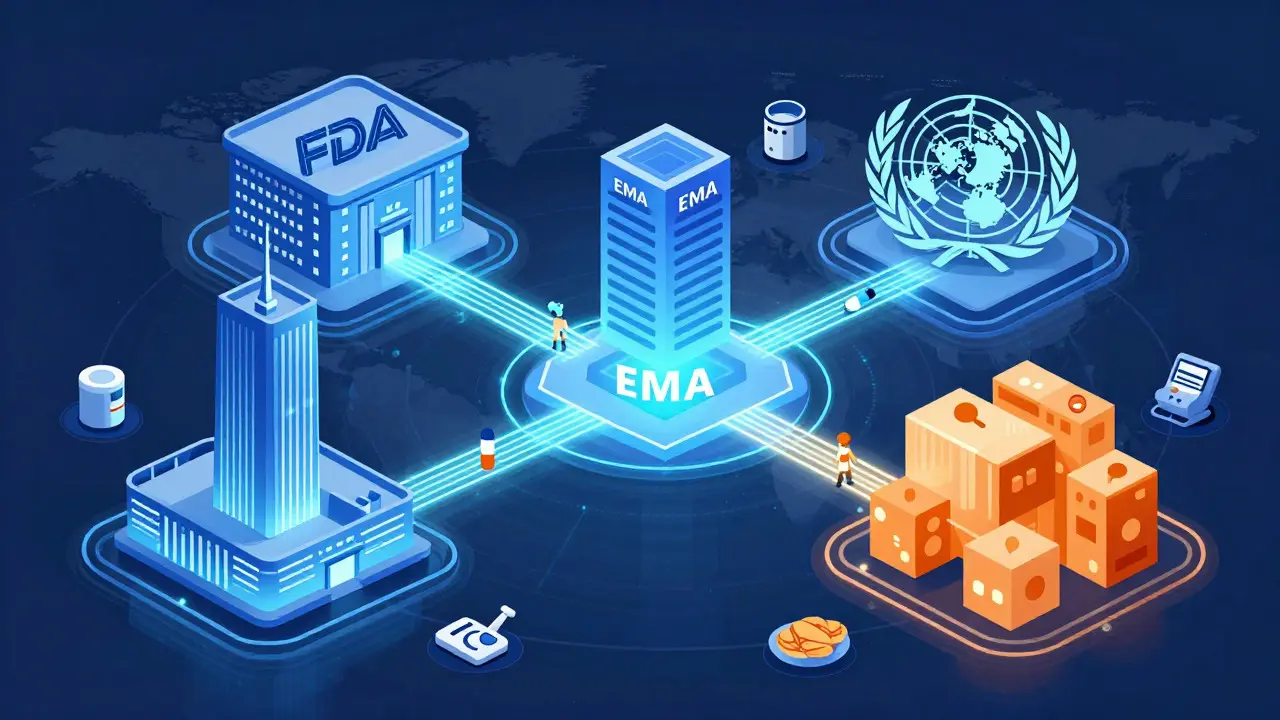
Global Regulatory Frameworks: FDA vs. EU vs. WHO
You might think GMP is one-size-fits-all, but regional differences can make or break your supply chain. Here is how the major regulatory bodies compare in 2026:
| Feature | FDA (USA) | EMA (EU) | WHO (Global) |
|---|---|---|---|
| Primary Regulation | 21 C.F.R. Parts 210-211 | EudraLex Volume 4 | WHO TRS 996 Annex 5 |
| Approach Style | Flexible, risk-based | Prescriptive, strict | Baseline, adaptable |
| Sterile Manufacturing | Allows PAT integration | Mandates closed isolators (Annex 1) | General guidelines |
| Data Integrity Focus | ALCOA+ Principles | Annex 11 Audit Trails | Basic Documentation |
| Market Share (Pharma) | ~34% | ~28% | ~22% (Emerging Markets) |
The FDA's CGMP emphasizes flexibility, allowing manufacturers to determine optimal implementation methods using scientifically sound approaches. In contrast, EU GMP provides more prescriptive requirements, particularly regarding sterile manufacturing where Annex 1 mandates closed isolator systems for aseptic processing. The WHO GMP framework serves as the basis for many developing nations but lacks the enforcement mechanisms of FDA or EMA regulations. A significant differentiator is data integrity: the FDA's focus intensifying electronic record-keeping standards per ALCOA+ principles (Attributable, Legible, Contemporaneous, Original, Accurate, + Complete, Consistent, Enduring, Available), while EU GMP Annex 11 requires audit trails for critical data changes.
The Data Integrity Revolution
If there is one area where inspectors are looking hardest in 2026, it is data integrity. The FDA issued 2,147 Warning Letters in FY2024 citing data integrity violations. Why? Because digital transformation has outpaced documentation practices in many facilities. The ALCOA+ principles are no longer just buzzwords; they are the legal standard.
For example, if a sensor fails during a batch run, how do you prove the data was captured correctly? Under current standards, you need an unbroken audit trail. The European Medicines Agency's November 2024 position paper also emphasizes stricter personnel gowning requirements in Annex 1, mandating full-body coverage with sterility-assured garments for Grade A/B environments. This physical rigor mirrors the digital rigor required for records. If your data isn't attributable to a specific person at a specific time, it doesn't exist in the eyes of the regulator.
Implementation Challenges and Costs
Let’s talk numbers, because compliance isn’t free. A PharmaTech Solutions survey of 347 facilities conducted in December 2024 found that 68% of respondents cited data integrity compliance as their top challenge, with average remediation costs of $185,000 per facility. For mid-sized pharmaceutical manufacturers, full compliance typically requires 18-24 months, with average implementation costs of $1.2 million.
Common pitfalls include:
- Legacy System Integration: Reported by 73% of facilities. Trying to force old hardware to speak with new software often leads to data gaps.
- Cultural Resistance: Cited in 61% of FDA 483 observations in 2024. Employees who view documentation as busywork rather than a safety net create compliance blind spots.
- Supplier Quality Management: Contributing to 27% of 2024 product recalls. Your GMP status is only as strong as your weakest supplier.
One Pfizer manufacturing supervisor noted that differing environmental monitoring requirements between FDA and EMA create duplicate testing protocols costing approximately $75,000 annually per facility. This highlights the cost of non-harmonization. To mitigate this, many companies are adopting ICH Q9 guidelines for quality risk management, which helps streamline decision-making across borders.

Future Trends: AI and Continuous Manufacturing
The future of GMP is predictive, not reactive. The FDA's January 2025 guidance represents a significant shift toward modern manufacturing approaches, particularly regarding in-process controls and testing flexibility. Industry adoption of continuous manufacturing is up 37% from 2023, and AI-driven quality systems are up 52%. However, this comes with validation complexities. Implementing machine learning algorithms for real-time quality prediction requires extensive documentation per FDA 21 C.F.R. § 211.100(b).
Merck’s Whitehouse Station facility achieved zero FDA 483 observations after implementing continuous manufacturing with integrated Process Analytical Technology (PAT) tools. Their success wasn't about having the best AI; it was about proving that the AI worked consistently. As Dr. Emily Chen, Director of Pharmaceutical Quality at FDA's Center for Drug Evaluation and Research, stated, advanced manufacturing where in-line, at-line, or on-line measurements in lieu of physical sample removal for laboratory testing is feasible represents the agency's preferred modern approach. But remember: you still need to validate that the model isn't hallucinating a pass when the batch actually failed.
Practical Steps for Compliance in 2026
So, how do you get there? Start with a comprehensive facility audit, which typically requires 4-6 weeks. Build a dedicated GMP compliance team-minimum 3 full-time personnel for facilities over 10,000 sq ft. Develop Standard Operating Procedures (SOPs); the average facility needs 120-150 documents covering all operations. Finally, invest in training: minimum 40 hours annually per staff member. Cultural change is harder than technical change, so prioritize mindset shifts alongside software upgrades.
The GMP compliance industry is a $4.7 billion sector growing at 8.3% CAGR through 2027. With pharmaceuticals representing 63% of spending, the stakes are high. By aligning your practices with the latest FDA, EU, and WHO standards, you don't just avoid fines-you build a brand that patients trust. The era of "good enough" is over; now, we demand precise, verified, and current excellence.
What is the difference between GMP and CGMP?
GMP stands for Good Manufacturing Practice, a general term for quality standards. CGMP stands for Current Good Manufacturing Practice, which adds the requirement that manufacturers must use up-to-date systems and technologies. The 'C' emphasizes that static compliance is insufficient; practices must evolve with technology and science.
How long does it take to achieve GMP compliance?
For established facilities, full compliance typically requires 18-24 months. This includes conducting audits, updating SOPs, validating equipment, and training staff. New facilities may take longer depending on construction timelines.
What are ALCOA+ principles?
ALCOA+ stands for Attributable, Legible, Contemporaneous, Original, Accurate, plus Complete, Consistent, Enduring, and Available. These are the core data integrity standards required by the FDA and EMA to ensure that quality data is trustworthy and verifiable.
Does GMP apply to food and medical devices?
Yes. While most associated with pharmaceuticals, GMP principles apply broadly. Medical devices account for 22% of GMP compliance spending, and food products for 15%. Each sector has specific annexes or parts of the regulation tailored to its risks.
What is the biggest challenge in GMP compliance today?
Data integrity remains the top challenge, cited by 68% of facilities in recent surveys. Integrating legacy systems with new digital tools without breaking the audit trail is technically complex and expensive.