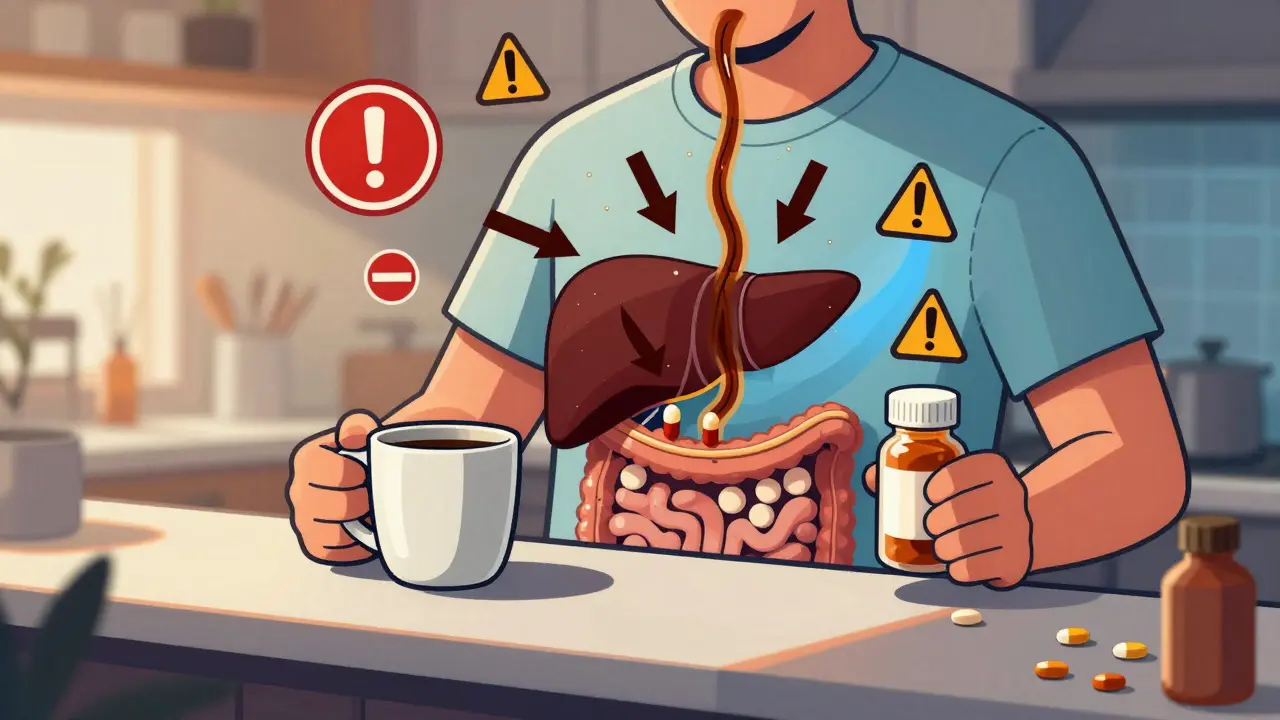
Every morning, millions of people reach for their coffee, tea, or a piece of chocolate without thinking twice. But what if that cup of joe or dark chocolate bar is quietly messing with your medication? It’s not a myth - it’s a real, documented risk that affects one in four people taking prescription drugs. And most of them have no idea.
Why Your Morning Drink Might Be Sabotaging Your Medicine
Coffee, tea, and chocolate aren’t just comfort foods. They’re powerful chemical mixtures that interfere with how your body processes medications. The main culprits? Caffeine, theobromine, and polyphenols. These compounds don’t just float around harmlessly. They lock onto enzymes in your liver, block drug absorption in your gut, or compete with your meds at receptor sites. The result? Your medicine either doesn’t work - or it works too well.Take thyroid medication like levothyroxine. It’s supposed to be taken on an empty stomach with water. But if you drink coffee 30 minutes later, your body absorbs 27% less of the drug. Wait an hour? That number jumps to 55% less. A 2023 study in the Journal of Clinical Endocrinology showed patients who took their thyroid pill with coffee had TSH levels nearly double what they should be. That means your body thinks it’s hypothyroid - even if you’re taking your dose perfectly.
Coffee: The Most Dangerous Culprit
Coffee is the biggest offender. An 8-ounce cup contains 95-200 mg of caffeine. That’s enough to shut down the CYP1A2 enzyme for up to 48 hours. This enzyme handles about 10% of all prescription drugs. When it’s blocked, drugs build up in your bloodstream - sometimes to toxic levels.Here’s what happens with common meds:
- Theophylline (for asthma): Coffee increases its concentration by 2.8 times. That can trigger rapid heartbeat, shaking, or even seizures.
- Fluvoxamine (an antidepressant): A 2024 JAMA Psychiatry study found regular coffee drinkers on this drug had 31% lower blood levels - enough to cause depression relapse in 22% of cases.
- Verapamil (for high blood pressure): Coffee cuts its effectiveness by 28%. Patients in a University Hospitals trial saw their systolic pressure spike by 15-20 mmHg within hours.
- Tiagabine (for epilepsy): Caffeine can increase seizure frequency by 37%. The FDA issued a direct warning in 2024 after reviewing over 1,200 patient reports.
And it’s not just about quantity. A single cup can do damage. Harvard Medical School found peak enzyme inhibition happens just 30 minutes after drinking coffee - long before most people think it’s safe to take meds.
Tea: Not Just a Calm Brew
Green tea gets a bad rap as a health drink, but it’s one of the sneakiest drug interferers. Its catechins - especially EGCG - block P-glycoprotein, a transporter that helps absorb drugs like chemotherapy agents, antibiotics, and blood thinners.In a 2024 study published in Clinical Pharmacology & Therapeutics, patients taking the multiple myeloma drug bortezomib saw its effectiveness drop by 68% when they drank green tea daily. That’s not a small drop - it’s the difference between remission and progression.
Even black tea isn’t safe. It contains tannins that bind to iron and some antibiotics, making them useless. And if you’re on warfarin (a blood thinner), the vitamin K in tea can slash your INR levels by 0.8-1.2 points in 24 hours. That means your blood thickens - and your risk of clotting goes up.
Here’s a trick: steeping green tea for 2 minutes instead of 5 reduces catechin levels by 63%. If you must drink it, make it weak.
Chocolate: The Sweet Trap
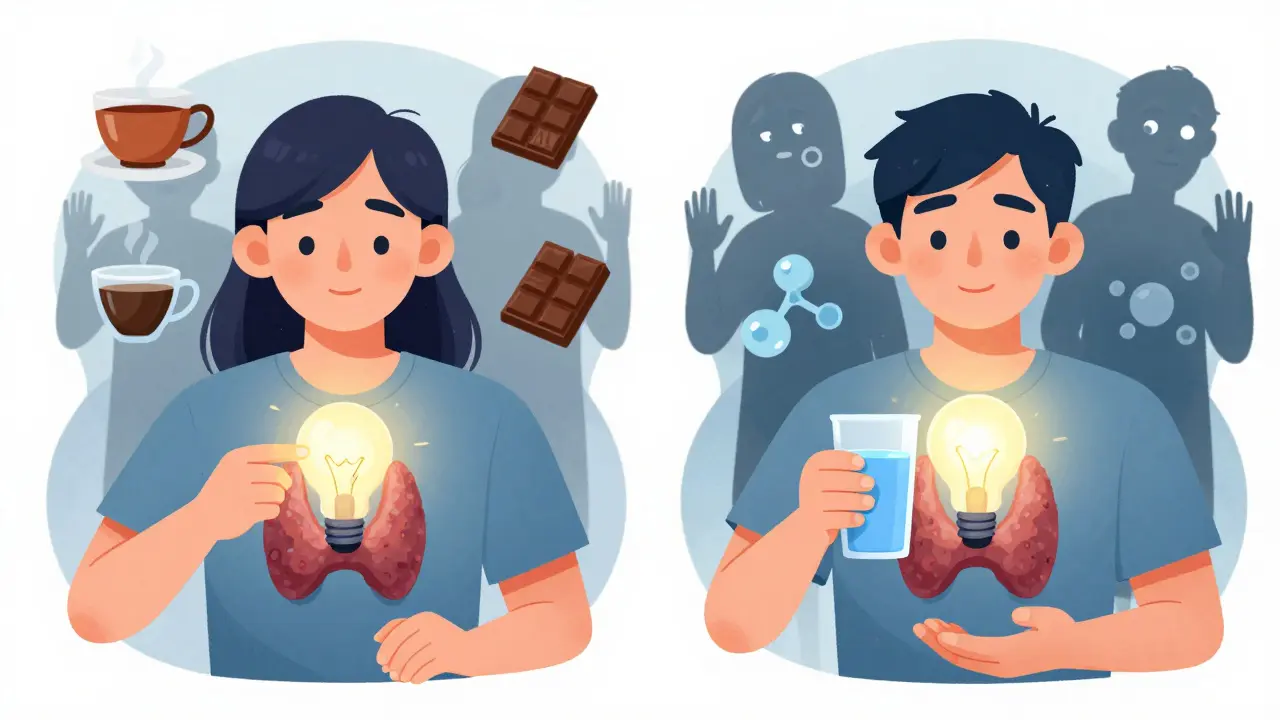
Dark chocolate has 200-450 mg of theobromine per 100 grams. That’s nearly half the caffeine in a cup of coffee. And like caffeine, it’s metabolized by the same liver enzymes. The problem? It doesn’t just add up - it multiplies.If you’re on MAOIs (like phenelzine for depression), chocolate can cause a hypertensive crisis. Between 2020 and 2024, WebMD recorded 17 cases of patients ending up in the ER after eating just 50g of dark chocolate. Their blood pressure shot over 200 mmHg. One woman described it as "a sledgehammer to the chest."
For people with diabetes, chocolate is a double-edged sword. Added sugar and milk fat slow stomach emptying, which delays how fast your diabetes meds (like glimepiride) get absorbed. One user on TuDiabetes wrote: "I took my Amaryl with a chocolate bar - and spent 6 hours with my blood sugar at 450."
Milk chocolate has less theobromine (50-200 mg per 100g), so it’s safer - but still not risk-free. And the sugar? That’s another problem entirely.
The Exceptions: When These Drinks Actually Help
Not all interactions are bad. Sometimes, they’re helpful.Caffeine boosts painkillers. A 2023 meta-analysis in the Journal of Pain Research confirmed that adding caffeine to acetaminophen or aspirin improves pain relief by 40%. That’s why many headache meds (like Excedrin) include caffeine. It helps the drug work faster and stronger - without extra side effects.
And in a surprising twist, a June 2025 JAMA Internal Medicine study found that people on escitalopram (Lexapro) who drank 1-2 cups of coffee daily had better mood outcomes than those who avoided it. Their depression scores improved by 22%. Researchers think low-dose caffeine may help the drug cross the blood-brain barrier more effectively.
So blanket warnings don’t always fit. It’s not about cutting out coffee - it’s about timing, dosage, and knowing your own body.
How to Stay Safe: Practical Rules
Here’s what actually works - based on 2025 guidelines from the American Pharmacists Association:- Thyroid meds (levothyroxine): Take with water. Wait at least 60 minutes before coffee, tea, or even breakfast. A 30-minute wait only blocks 32% of the interference.
- Antidepressants (fluvoxamine, sertraline): Avoid coffee entirely. Switch to decaf or drink it 4 hours after your dose.
- Blood pressure meds (verapamil, diltiazem): Separate coffee by 2 hours. Use a timer if you need to.
- Asthma meds (theophylline): No more than 100 mg caffeine per day - that’s less than one cup. Talk to your doctor about switching to a different drug.
- Chemotherapy (bortezomib, etoposide): Avoid green tea completely. If you must drink tea, choose white tea - it has 80% fewer catechins.
- MAOIs (phenelzine, tranylcypromine): No dark chocolate. Stick to plain sugar-free treats. Check labels: even "sugar-free" chocolate can have cocoa butter and theobromine.
- Antibiotics (ciprofloxacin, tetracycline): Don’t drink tea with them. Wait 2 hours before or after.
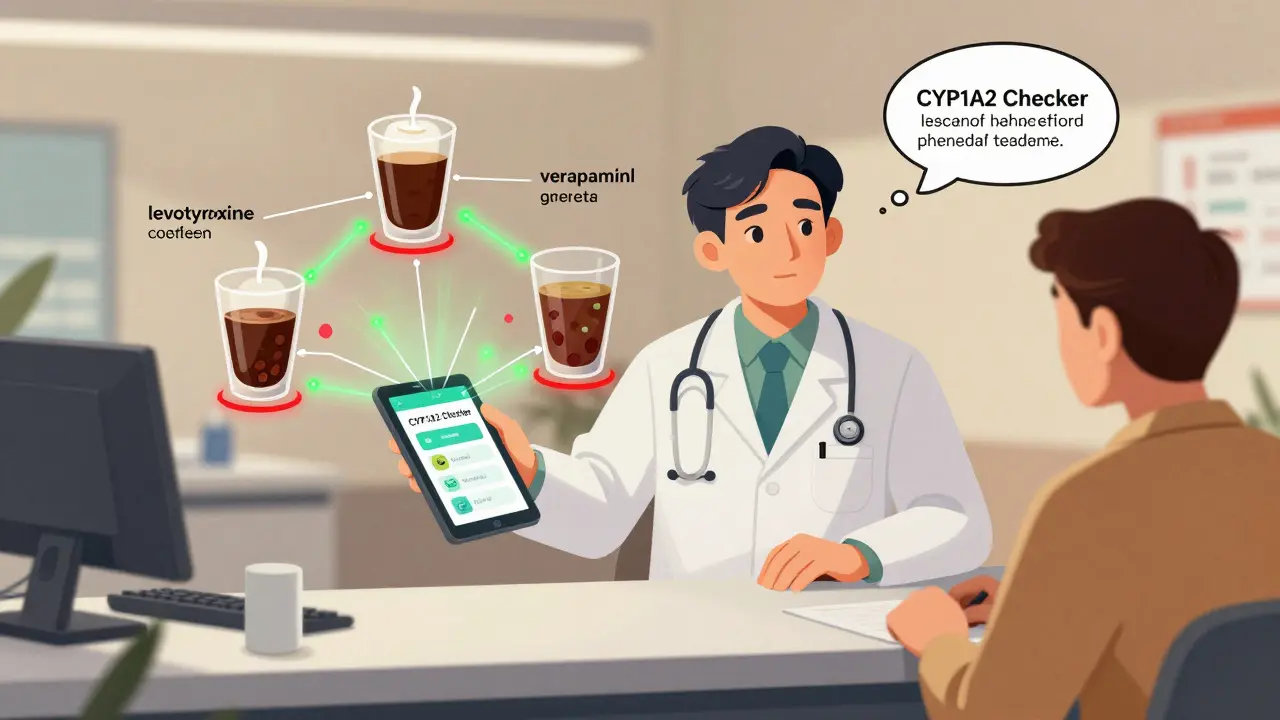
Pharmacists at CVS Health started using a digital screening tool in early 2025. It checks your meds against 47 drugs and 12 beverage compounds. In a 12,000-patient trial, it cut adverse events by 37%. You can download the free CYP1A2 Interaction Checker app - it even lets you input your genetic test results if you’ve had one.
What’s Changing in 2026
The FDA now requires all levothyroxine packaging to include a bold warning about coffee. The European Medicines Agency has approved genetic testing for CYP1A2 metabolism as standard for patients on clozapine. And AstraZeneca just launched an enteric-coated version of levothyroxine that delays release until after the stomach - meaning it won’t be blocked by coffee.But here’s the real shift: doctors are moving away from "never drink coffee" advice. A 2025 consensus from the American College of Clinical Pharmacy says: "Individualized assessment over blanket restrictions." Their analysis of 247,000 patient records showed 31% of "high-risk" interactions had no real-world impact. The key? Know your dose. Know your timing. Know your body.
What You Should Do Today
1. Look at your prescription bottle. Is there a warning about food or drinks? If not, ask your pharmacist.One woman in Bristol, who’d been taking levothyroxine for 8 years, finally tested her TSH after switching from coffee to water. Her level dropped from 8.2 to 1.9 in six weeks. She said: "I thought I was doing everything right. I didn’t know my coffee was making me hypothyroid."
You don’t have to give up your morning ritual. But you do need to understand it.
Can I drink tea with my blood pressure medication?
It depends on the drug. Green tea can reduce the effectiveness of verapamil and diltiazem by up to 28%. Black tea can interfere with calcium channel blockers and beta-blockers. The safest approach is to wait 2 hours after taking your pill before drinking tea. If you’re on amlodipine or lisinopril, tea is usually fine - but always check with your pharmacist.
Does decaf coffee still interact with medications?
Yes - but less. Decaf coffee still contains 2-5 mg of caffeine per cup, which can affect sensitive drugs like theophylline or fluvoxamine. More importantly, decaf still has the same polyphenols and acids that can block absorption of thyroid meds and antibiotics. If you’re on levothyroxine or antibiotics, even decaf should be avoided for at least an hour after your dose.
Can I have chocolate with my antidepressant?
Only if it’s not an MAOI. If you’re on phenelzine, selegiline, or tranylcypromine, avoid all dark chocolate. Even 20g can trigger a dangerous spike in blood pressure. For other antidepressants like sertraline or escitalopram, moderate chocolate (20-30g) is usually fine - but watch for jitteriness or headaches. If you feel off, cut it out for 3 days and see if it changes.
Why does coffee make my asthma worse?
If you’re taking theophylline, coffee can cause dangerous caffeine buildup. Theobromine in chocolate does the same thing. Together, they can push your heart rate over 120 bpm and trigger tremors or palpitations. In one 2025 study, patients on theophylline who drank two cups of coffee daily had a 43% higher chance of being hospitalized. If you have asthma, ask your doctor if you can switch to a different bronchodilator like albuterol - it doesn’t interact with caffeine.
Is there a safe time to drink coffee with my meds?
For most drugs, the answer is: don’t drink it close to your dose. But if you must, wait at least 2 hours after taking your pill - and avoid coffee for 1 hour before. For thyroid meds, wait 60 minutes after taking the pill before coffee. For painkillers, coffee right after can help. Timing matters more than you think.
What should I do if I accidentally took my med with coffee?
Don’t panic. Skip your next dose if it’s within 2 hours. Call your pharmacist or doctor. For thyroid meds, your next TSH test will show if absorption was affected. For blood pressure or heart meds, watch for dizziness, racing heart, or headaches. If symptoms appear, go to urgent care. Most interactions are reversible - if caught early.
Adebayo Muhammad
March 7, 2026 AT 11:47Let’s be real: this isn’t about coffee-it’s about the illusion of control. We think we’re in charge of our bodies, but the liver? It’s a silent dictator. CYP1A2 doesn’t care about your morning ritual. It doesn’t care if you’re "biohacking" or "mindful." It just metabolizes. And when it’s blocked? Your meds become theater. You’re not taking levothyroxine-you’re taking a placebo with a side of espresso.
And don’t get me started on "natural" being safe. Nature doesn’t care if you live or die. It’s not a moral agent. It’s chemistry. Tea? Chocolate? They’re not snacks. They’re pharmacological agents with branding.
We treat food like it’s innocent. It’s not. It’s a battlefield. Your thyroid? Your liver? Your serotonin receptors? They’re not debating. They’re fighting. And you? You’re the idiot holding the match.
Stop romanticizing your routine. Stop calling it "self-care." It’s self-sabotage dressed in a ceramic mug.
And if you think you’re "too healthy" to be affected? You’re the patient in the study who didn’t believe the data until their TSH hit 12. Then you cried. Then you Googled "why am I so tired."
Wake up. The system doesn’t care about your vibe. It cares about kinetics. And kinetics don’t care about your Instagram aesthetic.
You think you’re being smart? You’re just the average person who reads the headline and thinks they’ve won the game.
There’s no heroism in drinking coffee with your meds. There’s only ignorance with a caffeine buzz.
Next time you reach for that cup, ask yourself: am I optimizing-or just delaying the inevitable crash?
And don’t say "I’ve been doing this for years." So have the people in the ER with BP over 200. And they didn’t get a second chance.
This isn’t a lifestyle tweak. It’s a survival protocol. Treat it like one.
Or keep sipping. See how that works out.
Pranay Roy
March 8, 2026 AT 09:59Everyone’s missing the real issue here. Big Pharma doesn’t want you to know this. They profit from people getting sicker because their meds "don’t work." That’s why coffee isn’t banned-it’s because they’d lose billions if people realized their meds were being sabotaged by a $3 latte.
And don’t you dare think the FDA is on your side. They’re paid off. The same people who approved the drug also own stock in coffee chains. That’s why the warning is buried in fine print. It’s not negligence-it’s a conspiracy.
They want you dependent. They want you confused. They want you believing you need more pills, more tests, more visits. Meanwhile, your liver is dying from the caffeine overload they never warned you about.
And green tea? That’s a plant-based weapon. The Chinese government has known this for centuries. They’ve been quietly controlling global pharmaceutical supply chains through tea exports. You think that’s coincidence?
Check your meds. Check your tea. Check your blood pressure. And if you’re still drinking anything after 9 AM? You’re part of the problem.
Wake up. The matrix is real. And your coffee cup? It’s a tracking device.
Joe Prism
March 9, 2026 AT 16:56Interesting. But let’s not turn this into a moral panic.
Medications are tools. So are coffee and tea.
The real issue isn’t the drink-it’s the lack of education. Why are we not taught this in high school? Why do pharmacists wait for you to ask?
Knowledge is the real intervention. Not fear.
Timing matters. Dose matters. Genetics matter.
One size doesn’t fit all. But awareness? That’s universal.
Bridget Verwey
March 9, 2026 AT 23:05Oh honey. You’re telling me my 3pm matcha is secretly plotting my demise? I’m sorry, but I’ve been drinking this since 2017 and my thyroid is better than my ex’s new partner’s.
Also, I took my levothyroxine with coffee for five years. My doctor said I was "fine." Now you’re telling me I was just lucky? That’s not science-that’s a horror story with footnotes.
And since when did caffeine become the villain? I need it to function. I don’t need a lecture wrapped in a 2025 guideline.
Maybe the real problem is that we’re told to follow rules but never taught how to listen to our own bodies.
Just sayin’.
Andrew Poulin
March 10, 2026 AT 10:29Stop overcomplicating this. If your med says "take on empty stomach" then don’t eat or drink anything for an hour. Done.
Stop making excuses. Stop blaming coffee. Stop pretending you’re special.
You don’t get a pass because you "like the taste." Your body doesn’t care.
Weston Potgieter
March 11, 2026 AT 00:02So let me get this straight-coffee is bad for thyroid meds but good for painkillers? That’s not a rule. That’s a glitch in the system.
And why is green tea the enemy but white tea is chill? What’s the difference? A few leaves? A few minutes?
Who decided this? Who got paid?
And why is the FDA only now slapping warnings on levothyroxine? Did they just notice?
Also, I ate dark chocolate with my antidepressant for 3 years. I didn’t die. I got a promotion. So maybe your study is just… noise.
People are not lab rats. We’re not variables.
And if you’re telling me to avoid tea because of "catechins"-I’m going to need a flowchart.
Vikas Verma
March 12, 2026 AT 23:19From a clinical pharmacology standpoint, the CYP1A2 enzyme polymorphism is highly variable across populations. South Asian populations exhibit lower CYP1A2 activity compared to Caucasians, which may reduce the risk of interaction in certain subgroups.
Therefore, blanket recommendations without genetic profiling are suboptimal.
Additionally, the bioavailability of levothyroxine is influenced by gastric pH, motility, and food matrix-not merely caffeine.
Recommendation: Perform therapeutic drug monitoring before altering dietary habits.
And yes, decaf still contains polyphenols. But at 2–5 mg caffeine, the risk is negligible for most non-MAOI users.
Context is king.
Sean Callahan
March 13, 2026 AT 14:02so i took my lexapro with coffee for 2 years and i was fine?? like i felt better?? like my anxiety went down??
and now you’re telling me it’s because the caffeine helped??
so… was i lucky?? or was the study wrong??
i dont get it
my brain is confused
also i had chocolate with my blood pressure med once and i got a headache
but then i had it again and i was fine??
why is everything so confusing
i just want to sleep
phyllis bourassa
March 15, 2026 AT 08:59Oh sweetie, you’re so cute thinking you’re the first person to notice this.
I’ve been a nurse for 22 years. I’ve seen patients come in with TSH levels so high their hair was falling out in clumps. They swore they took their meds. Then I asked: "What’s the first thing you drink in the morning?"
9 out of 10 said coffee.
And then they cried.
And then they switched to water.
And then they got their lives back.
Don’t be the 10th.
Ferdinand Aton
March 17, 2026 AT 07:03What if coffee actually helps the body absorb meds better? What if the study was funded by tea companies?
I’ve never heard of a single person dying from coffee with levothyroxine.
Maybe we’re just being manipulated into fear.
Also, I drink tea with my blood pressure meds and I’m 87. Still walking. Still laughing. Still caffeinated.
Maybe your data is garbage.
William Minks
March 18, 2026 AT 22:01So… if I take my thyroid med with water, wait an hour, then have my coffee… I’m golden? 😊
And if I eat a tiny square of dark chocolate after lunch? 👉👈
Also, can I still hug my dog? Just asking for a friend.
Jeff Mirisola
March 19, 2026 AT 09:56My grandma took her levothyroxine with orange juice for 15 years. She lived to 94. Walked 3 miles a day. Never had a hospital stay.
Maybe science is still figuring this out.
Maybe some people just metabolize differently.
Maybe we’re over-medicalizing a simple habit.
Don’t panic. Don’t demonize. Just observe.
Your body will tell you.